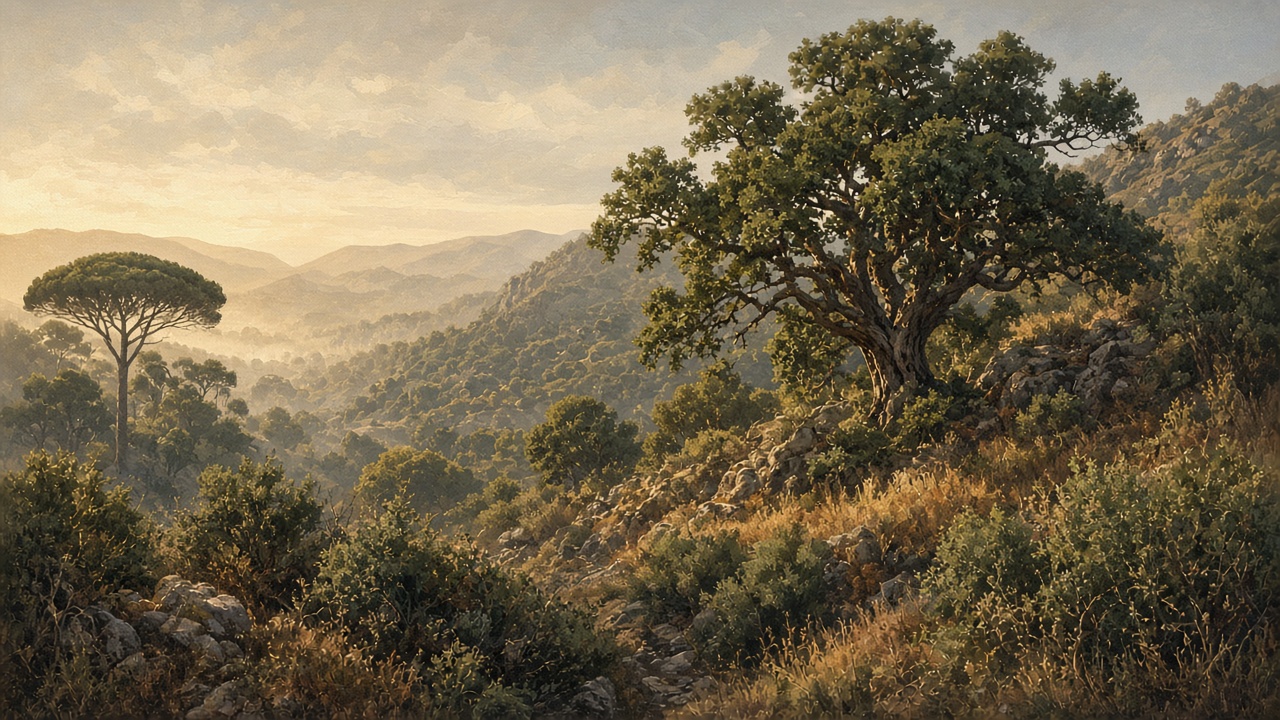
- Open forests of sclerophyll trees (hard, evergreen leaves) with a well-developed shrub layer.
- Hot dry summers and mild wet winters; fire returns at intervals of a few decades.
- Distinct from maquis and garrigue, shrub formations covered in a separate sheet.
- Wild boar, common genet and red deer are characteristic in Europe.
Definition and boundaries
This sheet covers sclerophyll forests and woodlands of Mediterranean climates (group T2.6 of the IUCN Global Ecosystem Typology): an open canopy 10 to 30 m tall of hard-leaved trees above a dense shrub layer. Maquis and garrigue, shrub formations often derived from the degradation of these forests, belong to the Garrigue and maquis sheet.
Distribution
Mediterranean climates exist in five world regions: the Mediterranean Basin, California, central Chile, the Cape region of South Africa and south-western Australia. In Europe these forests cover the Iberian Peninsula, southern France, Italy, the coastal Balkans and the large islands; in the Maghreb they rise into the Atlas.
Climate
Summers are hot and dry, with a marked water deficit; winters are mild and bring most of the rain. Frosts are light and snow is rare in the lowlands. The IUCN notes that these hot summers define a fire season, with surface or crown fires at decadal to multi-decadal intervals.
Soils, relief and water
Soils are often poor in nitrogen and phosphorus. They are not uniformly calcareous: cork oak and maritime pine grow on acid soils (granite, schist, sandstone), while holm oak and Aleppo pine tolerate limestone well. Relief and aspect create strong contrasts between cool north-facing and dry south-facing slopes.
Structuring vegetation
Around the Mediterranean the dominant trees are holm oak, cork oak, downy oak in cooler areas, and Aleppo, maritime and stone pines. Cedars form mountain forests in the Atlas. The shrub layer combines strawberry tree, phillyrea, mastic and tree heath, with small, leathery leaves.
Characteristic fauna
In Europe, wild boar and common genet are typical, and the stone marten uses forest edges; red deer and fallow deer occupy the largest forest blocks. The Egyptian mongoose lives in southern and western Iberia, the crested porcupine in Italy and North Africa. In California, mule deer use the oak woodlands. Rabbits and hares belong mainly to more open habitats (Garrigue and maquis sheet).
Functioning and dynamics
Fire is a natural factor in these forests: the thick bark of cork oak, resprouting stumps and pine cones that open with heat. According to the IUCN, almost all plants are shade-intolerant and fire regulates diversity by interrupting competition. Without disturbance, maquis can grow back into forest within a few decades.
Threats
Fires that are too frequent prevent stands from recovering and favour pines or scrub. Coastal urbanisation fragments forest blocks, while the decline of grazing closes open habitats. Longer droughts weaken oaks and increase fire risk.
Field reading
In summer, animals gather around water points and in cool valley bottoms; south-facing slopes empty during the hot hours. Autumn acorn crops draw wild boar and deer under the oaks. Thermal breezes, rising by day and falling in the evening, govern how far scent travels.
This sheet describes a habitat. It publishes no season, quota or hunting authorisation: those rules must be checked with the competent authorities of the territory concerned.
Documented gaps
- Mediterranean forests outside Europe (California, Chile, the Cape, Australia) are only described for their climate setting.
- The thermo-, meso- and supra-Mediterranean vegetation belts are not detailed.
- No figures on burnt areas.
Sources
- IUCN Global Ecosystem Typology — T2.6 Temperate pyric sclerophyll forests and woodlands (consulted 2026-11-04)
- IUCN Global Ecosystem Typology — T3.2 Seasonally dry temperate heath and shrublands (consulted 2026-11-04)
Related species
Related techniques
Practice information — not a legal authorisation.
Frequently asked questions
Mediterranean forest, maquis and garrigue: what is the difference?
Forest has a tree canopy 10 to 30 m tall. Maquis is a tall, dense shrub formation, mostly on acid soils; garrigue is a low, open formation, mostly on limestone. Both are often derived from degraded forest.
Is fire always a disaster for these forests?
No: these forests are adapted to fires several decades apart. It is fires that come too close together that prevent trees from recovering.
Are Mediterranean soils calcareous?
Not everywhere. Limestone soils tend to carry holm oak and Aleppo pine; acid soils (granite, schist) carry cork oak, maritime pine and maquis.
Does this sheet authorise hunting in this habitat?
This sheet describes a habitat. It publishes no season, quota or hunting authorisation: those rules must be checked with the competent authorities of the territory concerned.
Gallery
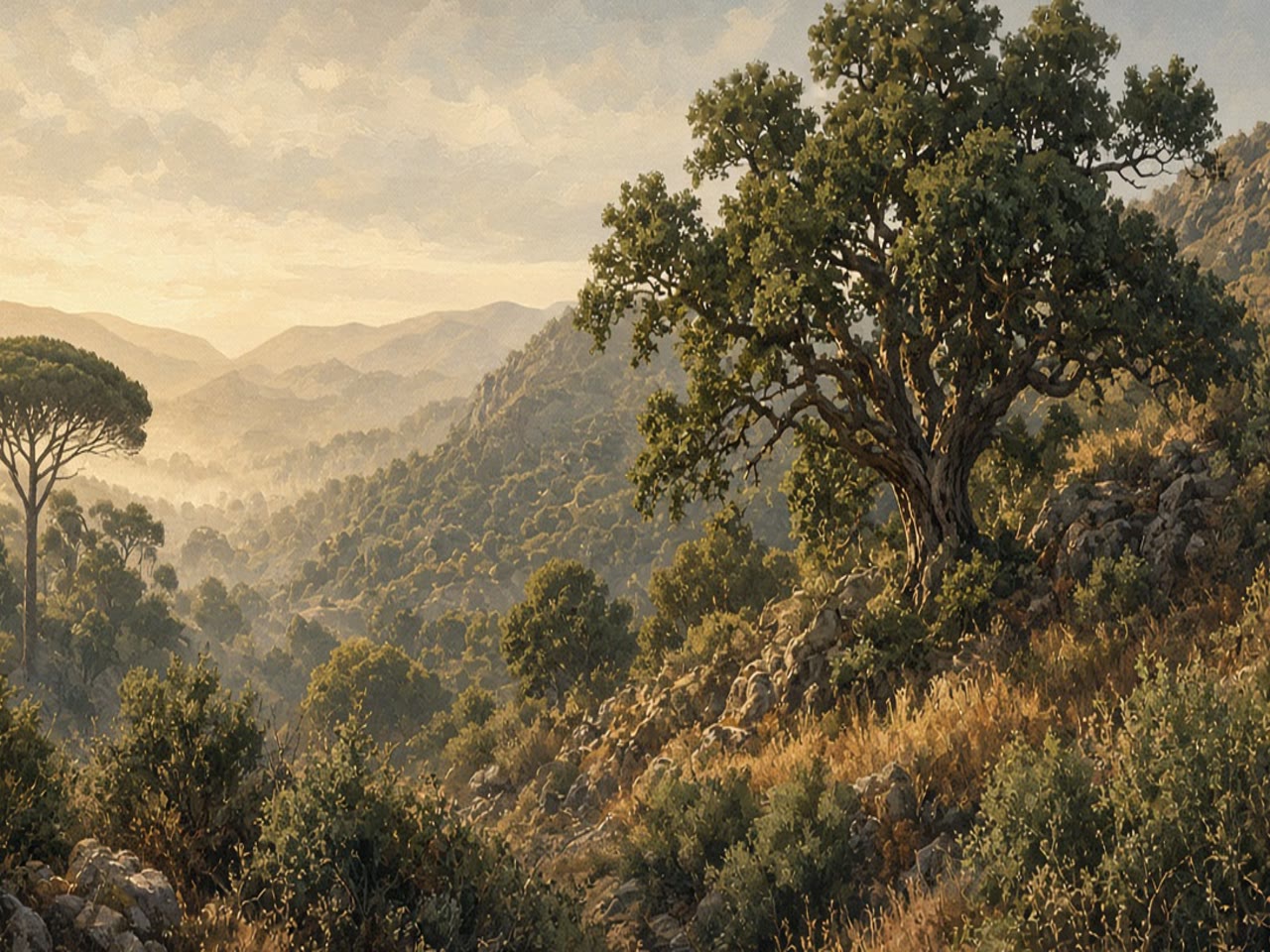
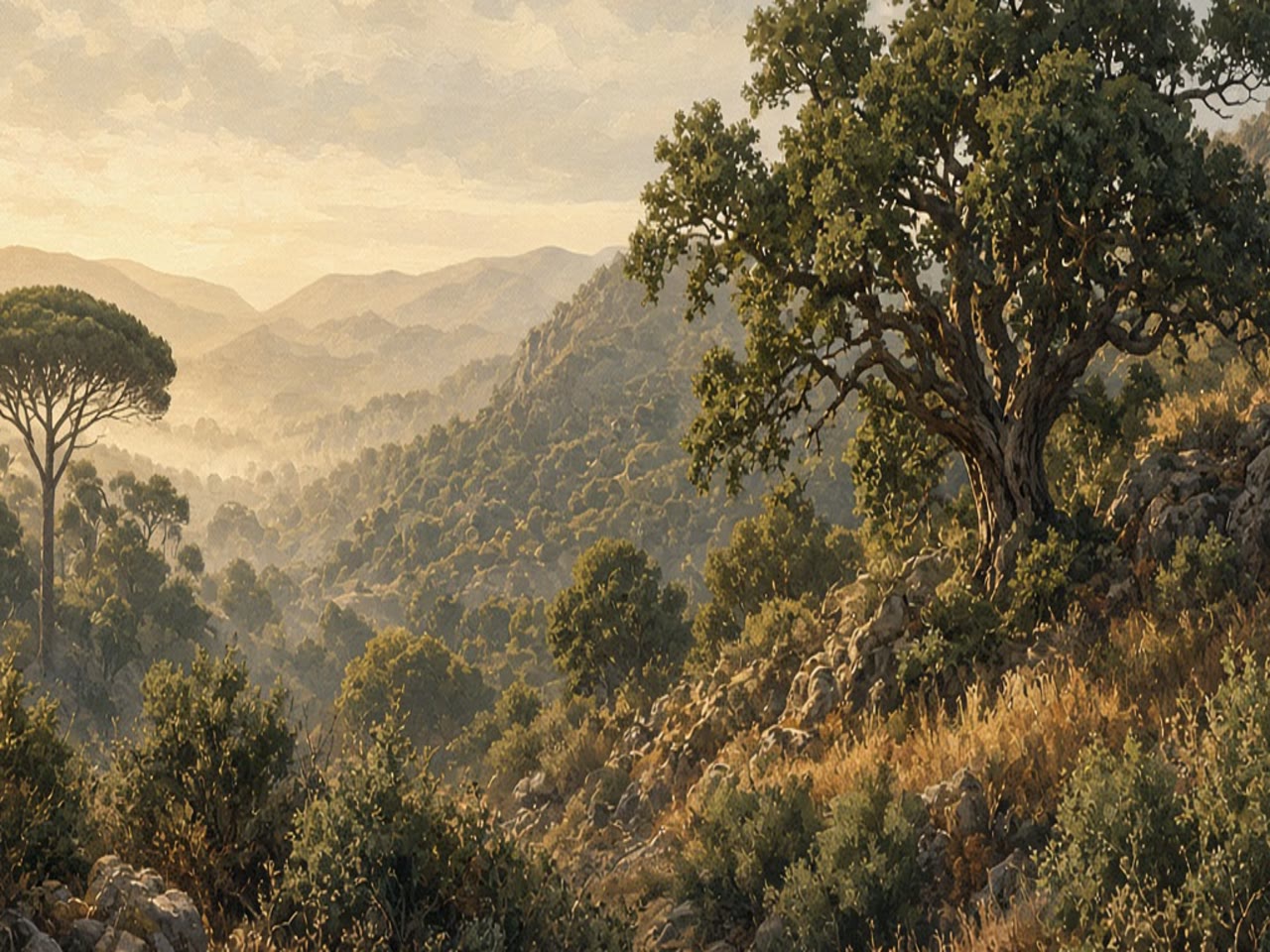
Keep exploring
Connect this environment to documented species, techniques and other habitats — without confusing ecological description with hunting authorisation.