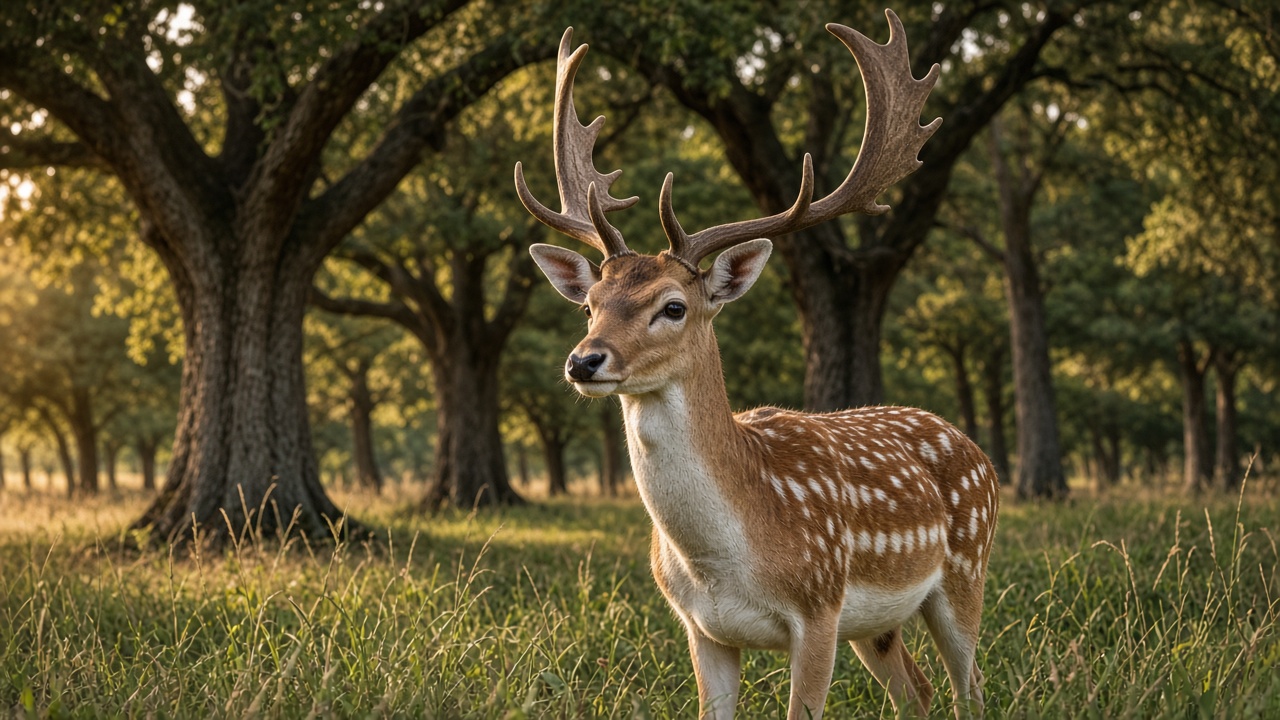
Common Fallow Deer
Dama damaCommon Fallow Deer (Dama dama): biology, habitats and field signs across its documented range, hunting-context reading.
Seen in: Argentina · Australia · Austria · Belgium · Bulgaria
Overview
Common Fallow Deer (Dama dama) is presented here in a hunting-context reading across its documented range: biology, habitats and field signs useful to observers — without publishing season, quota or authorisation.
Classification: order Artiodactyla, family Cervidae, genus Dama. Common names: Common Fallow Deer in English, Daim européen in French, Gamo in Spanish.
Identification
In the wild, adult male fallow deer weigh 46 to 80 kg, 67 kg on average, and females 30 to 50 kg, 44 kg on average; head and body length is 1.3 to 1.75 m, the tail 15 to 23 cm, and males stand 0.9 to 1 m at the shoulder. The forelegs are shorter than the hind legs, so the back rises towards the rump, and males have a prominent Adam’s apple. Their palmate antlers, 50 to 70 cm long, set them apart from all other deer; they are shed in April. No deer has a more variable coat: white, menil, common or black. The pale brown summer coat has white spots on the back and flanks, and a black stripe runs from the nape to the tail tip.
It feeds mainly on grasses, mast and browse, along with herbs, dwarf shrubs, leaves, buds, shoots and bark, depending on season. The breeding season runs from September to January, with most conceptions in late October. Males then set up a rutting stand by pawing scrapes, urinating in them, thrashing vegetation with their antlers and giving low groans. A single fawn of 2 to 4 kg is born after 33 to 35 weeks, mostly in early June; its mother hides it in dense bushes and returns only to nurse. Young become independent at about one year.
Habitats and range
According to MDD, naturally wild populations survive only in southern Turkey; elsewhere it has been introduced into nearly every European country, France included, as well as South Africa, Australia, New Zealand, the United States and South America. ADW places its natural post-glacial range in southern Europe, Asia Minor and around the Mediterranean. It prefers old broadleaf forest of varying density interspersed with grassy areas, but also uses mixed forest, grassland, scrub and low mountains.
The countries where the species’ presence is established are shown in the tags on this sheet.
Field signs
Mainly nocturnal, it is most active at dusk and dawn. When trotting it lifts its legs higher than any other species, and when fleeing it jumps with all four feet in the air, tail held erect. Six calls are known: the female’s explosive alarm bark, bleating, submissive mewing, fawns’ peeping and wailing, and the groaning of rutting males. Adult males are often solitary, or in bachelor groups of fewer than six in late summer, while females, fawns and yearlings form groups of 7 to 14.
Conservation
For conservation status of Dama dama, consult the current IUCN assessment, then cross with French monitoring programmes when they exist (OFB portal and related publications). Never turn a global IUCN category into a departmental hunting rule. GBIF occurrences help situate documented distribution but remain effort-biased.
The IUCN lists it as Least Concern. MDD notes that the species formerly included the Persian fallow deer, now separated as Dama mesopotamica; ADW, which still treats it as a subspecies, describes it as very rare, with the last wild population apparently gone by 1988 and a reintroduction under way in northern Israel. ADW also reports that collisions with fallow deer occasionally cause road accidents.
Limits
This sheet on the Common Fallow Deer publishes no season, quota, hunting method or fee: those rules differ between countries and territories and must be checked in official texts. Being described here does not mean a species may be hunted.
Local densities and management plans are not covered here: they are a matter for the managers of each area.
Sources
Sources consulted for this sheet:
- IUCN Red List — species search (consulted 2026-11-01)
- ASM Mammal Diversity Database — Dama dama (consulted 2026-11-01)
- GBIF — species search (consulted 2026-11-01)
- Animal Diversity Web — Dama dama (fallow deer) (consulted 2026-11-05)
Conclusion
In short: use the scientific name Dama dama to cross-check sources, confirm taxonomy and conservation status on the institutional portals listed above, and relate every field sign to the habitat where it was actually found.
Identification
Dama dama
Common Fallow Deer · preferred
Daim européen · preferred
Gamo · preferred
European Fallow Deer
Classification
Class : Mammalia
Order : Artiodactyla
Family : Cervidae
Genus : Dama
Conservation
IUCN : LC
CITES : —
iucn · LC (global)
Habitat
Practices
Frequently asked questions
How do I recognise Common Fallow Deer?
Use Dama dama as the scientific anchor. In the wild, adult male fallow deer weigh 46 to 80 kg, 67 kg on average, and females 30 to 50 kg, 44 kg on average; head and body length is 1.3 to 1.75 m, the tail 15 to 23 cm, and males stand 0.9 to 1 m at the shoulder. The forelegs are shorter than the hind legs, so the back ri...
Where does Common Fallow Deer typically live?
According to MDD, naturally wild populations survive only in southern Turkey; elsewhere it has been introduced into nearly every European country, France included, as well as South Africa, Australia, New Zealand, the United States and South America. ADW places its natural post-glacial range in southern Europe, Asia Minor and around the Mediterranean. It pref...
What field signs help confirm Common Fallow Deer?
Mainly nocturnal, it is most active at dusk and dawn. When trotting it lifts its legs higher than any other species, and when fleeing it jumps with all four feet in the air, tail held erect. Six calls are known: the female’s explosive alarm bark, bleating, submissive mewing, fawns’ peeping and wailing, and the groaning of rutting males. Adult males are often...