- Family
- Collective big-game hunting
- Difficulty
- Moderate for a standing hunter, high for the organiser: shooting discipline, quick identification, knowing the rules of the day
- Organisation
- An organised group: a hunt leader, standing hunters, beaters and often dog handlers
- Key gear
- A rifle or a shotgun firing slugs, bright clothing, a horn or whistle for signals, radios where the organisers use them
- Season
- Varies by species, region and country: check with the departmental federation in France or the autonomous community in Spain
- Who it suits
- Hunters confident shooting single projectiles at moving game who are happy to follow collective rules
What is the idea behind drive hunting?
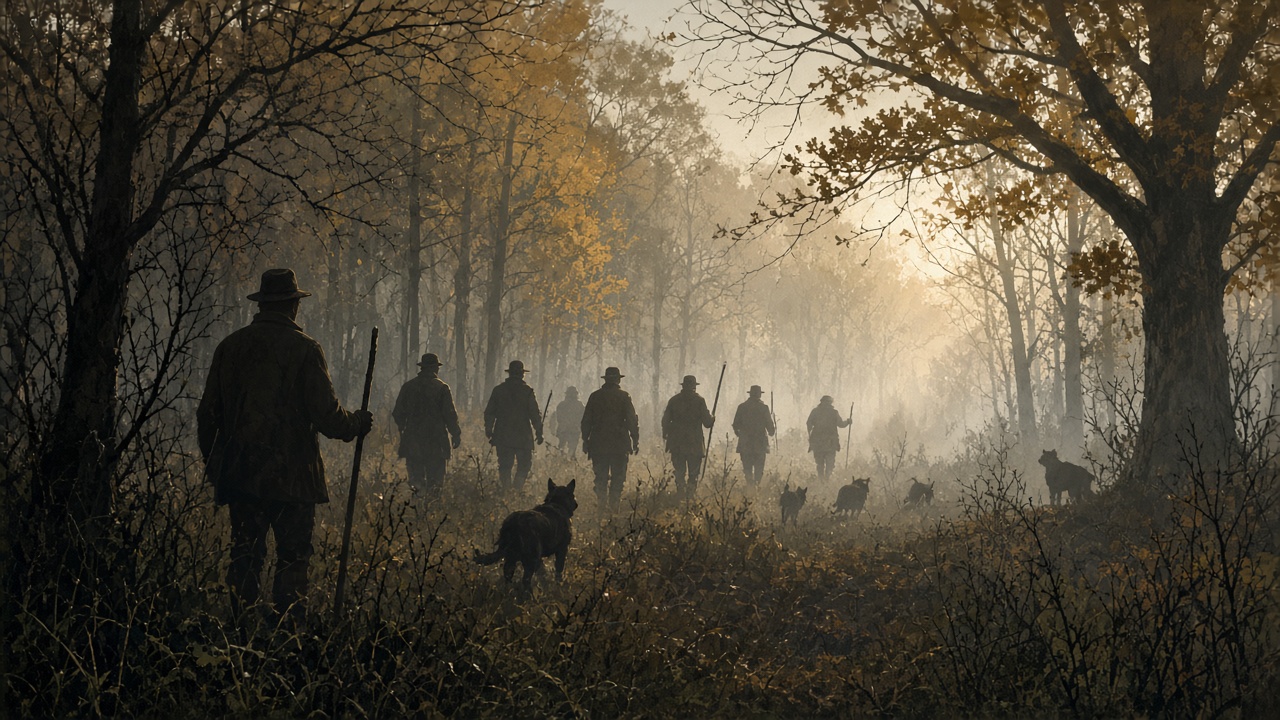
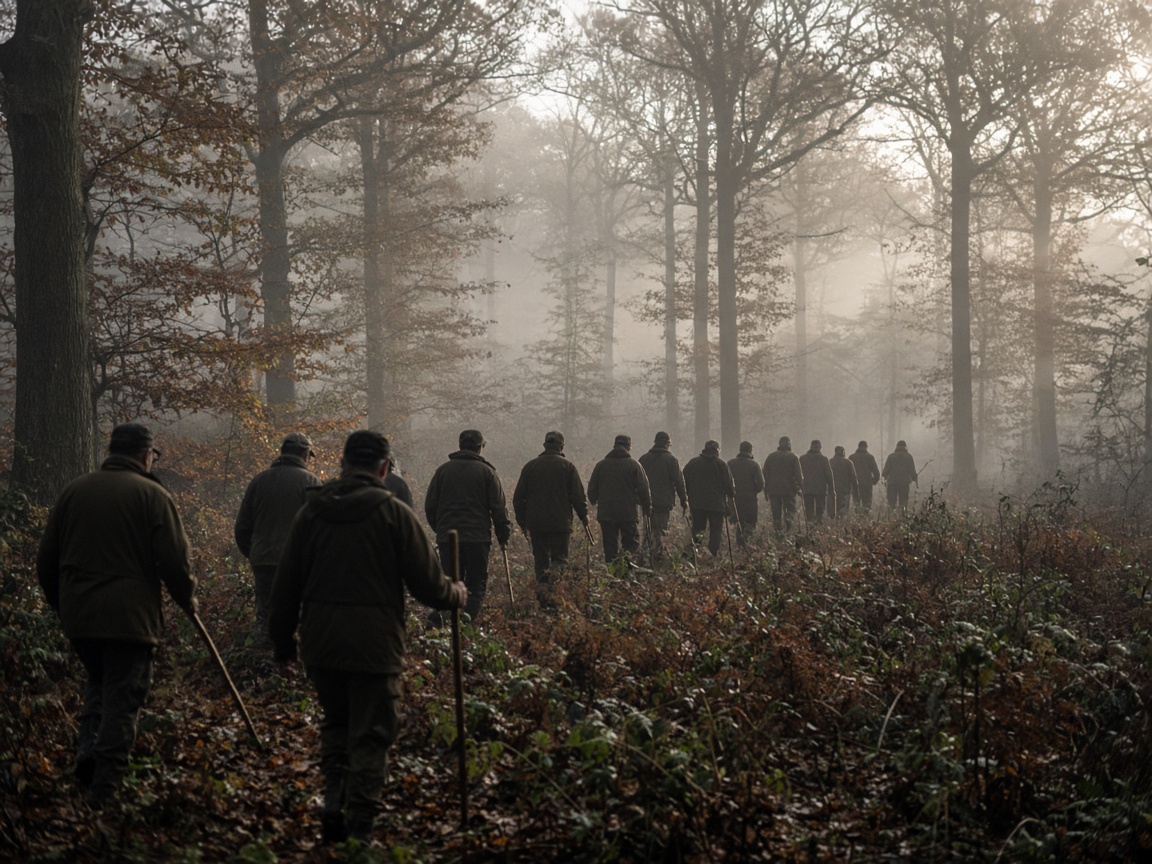
A drive depends on clearly divided roles. The hunt leader, the chef de battue in France, organises the day and answers for the rules being followed. Standing hunters wait at an allocated stand, often along a track or a woodland edge. Beaters move through the cover in a line, with or without scent hounds, to get game moving. Foxes are often shot during these drives if the day’s instructions allow it.
The day starts with the briefing, the rond in France, where the leader goes over which game may be shot that day, the horn or whistle signals that open and close each drive, the permitted shooting sectors and what to do about a wounded animal. Once on your stand, you locate your neighbours, tracks, houses and the directions you will not shoot towards.
Shots are taken at moving animals, often at close quarters and in cover. You must identify the species, and the sex or age where a cull plan requires it, never fire towards the beaters or a neighbour, and favour a downward shot so that the ground stops the bullet. Letting a doubtful animal pass is a normal part of the day.
How does drive hunting work in the field?
What equipment do you need for drive hunting?
- A rifle or slug gun and big-game ammunition that meet local rules
- A horn or whistle for the beaters, and radios if the organisers use them
- Protection for the hounds, such as a vest against boar tusks and a collar that makes them easy to locate
- Bright clothing that every participant can see
Safety rules for drive hunting
- Never shoot towards the beaters, a neighbour, a road or a house, and keep to the safe arc you were taught
- Favour a downward shot with the ground as backstop, and never fire over a ridge or into a hedge you cannot see through
- Keep the firearm unloaded with the action open outside the drives, especially in vehicles and at the briefing
- Follow the briefing given before the start, including the signals that open and close each drive
Common mistakes in drive hunting
- Shooting at a noise or a movement in thick cover without having seen the whole animal
- Getting distracted on the stand by a phone or a conversation when game can appear at any moment
- Loading before the signal or unloading too late, when the beaters are already in sight
- Leaving or moving your stand without the organiser’s agreement or telling your neighbours
Which species are hunted by drive hunting?
Where is drive hunting practised?
Croatia
The regulation names three collective methods: prigon, pogon and circle hunting (kružni lov). A collective-hunt permit is valid for one day and is issued to the hunt leader with the list of participants.
Czechia
At a collective hunt, hoofed game may only be shot within set classes: red and sika hinds and calves, mouflon ewes and lambs, and wild boar piglets and yearlings; the rule does not cover fenced game parks (obory).
France
In France, the battue is the main collective hunt for wild boar, roe deer and red deer. Since an order of 5 October 2020, everyone taking part in a collective big-game hunt with firearms wears a fluorescent vest and the organiser puts up temporary signs around the area; each department’s game management scheme adds its own rules, such as a drive register in some departments. Deer are shot under a cull plan. The departmental federation and the OFB explain these rules; the Ministry of Agriculture publishes African swine fever prevention measures for boar hunters.
Germany
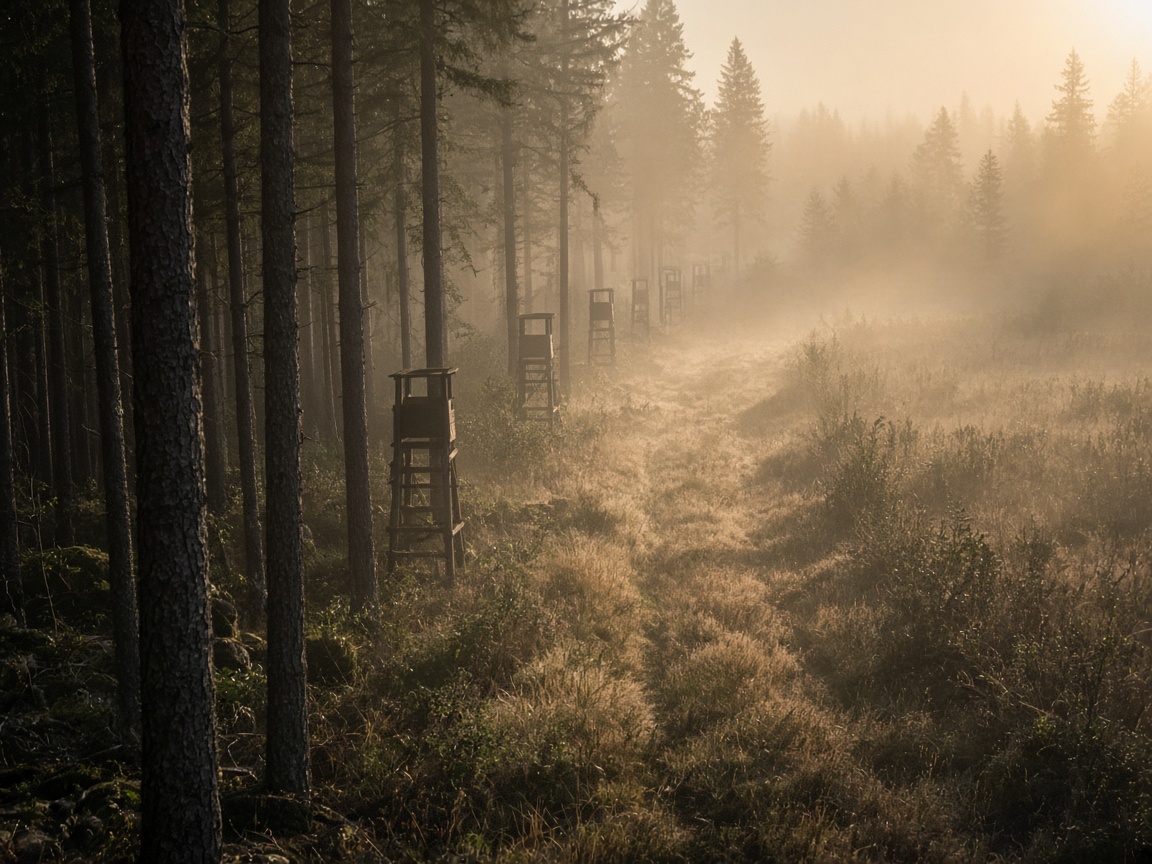
In Germany, driven big-game hunting falls under Bewegungsjagden (hunts in which game is put on the move); in woodland the usual form is the Drückjagd, in which beaters and dogs push animals slowly towards standing guns, often on raised stands. The German Hunting Association (DJV) notes that almost every state hunting act requires dogs certified as fit for hunting, and federal law bans drives by moonlight.
North Rhine-Westphalia (Germany)
In North Rhine-Westphalia, the law calls Bewegungsjagden all hunts in which game is deliberately disturbed and driven towards the guns. To take part in one for hoofed game, a hunter needs proof of shooting practice less than a year old, and dogs certified as fit for hunting must be used.
Hungary
The decree limits collective big-game hunts to certain species and classes, including wild boar, and caps the number of hunters, with a higher cap under conditions on area, forest cover and supervision. A hunt leader is mandatory, the schedule goes to the authority by 30 September and a drive map is required; on flat ground, raised stands are compulsory where cross-fire is possible.
Latvia
Driven hunts, with beaters or disturbance, run from sunrise to sunset between 1 October and 31 March (until 31 January for wild boar and red deer). A certified hunt leader (medību vadītājs) is mandatory, bright clothing is required and no shot may be fired into the drive if beaters are within 200 m.
Poland
A collective hunt brings together at least two cooperating hunters, or a hunter and a beater, under a hunt leader (prowadzący polowanie). With dogs or beaters it is allowed only from 1 October to 31 January, except for birds, predators and tracking.
Portugal
In Portugal, a big-game batida is held without dogs; hunting with packs is the montaria. On non-managed hunting grounds, no hunting is allowed in the area during the 15 days before a batida or montaria, nor, on the day itself, in a 500 m strip around it, provided the area is signposted.
Romania
Drives (« la goană ») are banned for red deer, roe deer and chamois, which may not be hunted with hounds either; wild boar is not covered. Flags and fences to steer game are banned, and only single-projectile ammunition is allowed for deer, chamois, mouflon, wild boar and bear.
Spain — Castilla y León
In Spain, a drive is called a batida; small boar drives go by the name of gancho in some regions. Batidas are common in the north, in regions such as Galicia, Asturias and Catalonia, while the montería dominates in the central and southern sierras. Each autonomous community sets its own rules: prior notice, the number of participants, high-visibility clothing. The regional federation and the community’s hunting service explain the requirements.
Rules vary by country and region: check with the local authority. See the sources
Drive hunting compared with neighbouring techniques
A drive is smaller than a Spanish montería: fewer stands, set along tracks, and beaters on foot, where a montería deploys large armadas and several packs. Hunting with scent hounds relies on the hounds’ pursuit rather than on a line of beaters. Driven game-bird shooting borrows the idea of the drive, with shotguns and birds in flight. Blood tracking takes over when a shot animal is not found.
Regional forms of drive hunting
- Montería in Spain The montería is a large Spanish collective big-game hunt: rehalas, packs of dogs handled by perreros, work through a wide area of scrub, the mancha, to push wild boar, red deer and fallow deer towards lines of stands called armadas.
Key terms in drive hunting
- drive
- A collective hunt in which beaters, often with dogs, push game towards a line of standing guns.
- drive (area)
- The block of ground covered in one go during a drive, and the beaters’ sweep through it.
- stand (peg)
- The position allocated to a hunter on a drive; called a peg on British driven shoots.
- beater
- A person who walks through the drive to flush game towards the guns.
- hunt leader
- The person in charge of a drive, who organises it, places the standing hunters and sees that the safety rules are followed.
- briefing
- The gathering before a drive at which the hunt leader sets out the rules, the quarry and the signals; called the rond in France.
- safety angle
- The angle either side of the direction of each neighbour within which a standing gun must not shoot; federations often set it at 30 degrees.
- safe backstop
- Ground behind the animal that will stop the bullet; shooting downwards from a high seat provides one.
- scent hound
- A dog that follows an animal’s scent line while giving tongue, alone or in a pack.
- blood-tracking dog
- A dog trained to find wounded big game, worked on a long lead by a handler.
Frequently asked questions about drive hunting
What is drive hunting?
It is a collective hunt in which beaters, with or without dogs, work through an area to move big game towards hunters waiting on fixed stands, under shared safety rules.
Who runs a drive?
The hunt leader. They organise the drives, place the standing hunters or have them placed, give the briefing and decide when hunting stops. Everyone taking part agrees to follow their instructions.
What is a safe arc on a drive?
In France it is defined by a safety angle either side of the line towards each neighbour, into which you must not shoot; you fire only into the remaining sector, the safe arc. The angle is taught during hunting licence training and repeated by the federations; you work it out from the stand before the drive starts.
Can you leave your stand during a drive?
No, unless the hunt leader says otherwise. A hunter who moves is no longer where the neighbours expect, which throws out their shooting sectors. You wait for the closing signal and for someone from the organisation to collect you.
What should you do if you wound an animal on a drive?
Tell the hunt leader at the end of the drive, show the spot and the direction it ran, keep people off the area and call a blood-tracking dog handler, who will decide when to start the search.
Do you need dogs for a drive?
Not always: some drives use beaters only. Scent hounds help push wild boar out of dense cover. How many are used, and how, depends on the ground and on local rules.
Drive hunting in pictures
Sources and references on drive hunting
- Office français de la biodiversité (OFB) — Chasse, permis de chasser et police de l’environnement (consulted on )
- Office français de la biodiversité (OFB) — La sécurité à la chasse : consignes des chasses collectives, miradors de battue, angles de sécurité (consulted on )
- Fédération nationale des chasseurs (FNC) — Chasseur de France : pratiques, sécurité et fédérations départementales (consulted on )
- Légifrance — Code de l’environnement, livre IV, titre II : chasse
- Légifrance — Arrêté du 5 octobre 2020 relatif à la sécurité en matière d'activité cynégétique (gilet, panneaux temporaires, remise à niveau décennale) (consulted on )
- Union nationale pour l’utilisation du chien de rouge (UNUCR) — Recherche au sang du grand gibier blessé (consulted on )
- Ministère de l’Agriculture — Peste porcine africaine : mesures de prévention (consulted on )
- Boletín Oficial del Estado (BOE) — Legislación estatal y autonómica de caza (consulted on )
- Real Federación Española de Caza (RFEC) — Modalidades, licencias y federaciones autonómicas (consulted on )
- e-Sbírka (Ministerstvo vnitra ČR) — Zákon č. 449/2001 Sb., o myslivosti, § 45 odst. 1 (znění platné k 4. 11. 2026) (consulted on )
- Deutscher Jagdverband (DJV) — Bewegungsjagd (Drückjagd, Treibjagd) (consulted on )
- Boletín Oficial del Estado (BOE) — Ley 4/2021, de 1 de julio, de Caza y de Gestión Sostenible de los Recursos Cinegéticos de Castilla y León (texto consolidado) : arts. 32-40, 50-51 y anexo III (modalidades) (consulted on )
- Narodne novine — Pravilnik o uvjetima i načinu lova (NN 48/2022) : članci 4.–6., 14., 16. (consulted on )
- Nemzeti Jogszabálytár — 79/2004. (V. 4.) FVM rendelet (hatályos 2026.08.30.) : 22. §, 66. §, 68.–71. §, 73. § (consulted on )
- Likumi.lv — Medību noteikumi, points 3.1.1, 10¹, 11, 49, 51.6, 62, 68, 73, 77, 80, 81, 86 à 91, 95 à 99 (consulted on )
- Dziennik Ustaw (Rządowe Centrum Legislacji) — Rozporządzenie Ministra Środowiska z dnia 23 marca 2005 r. w sprawie szczegółowych warunków wykonywania polowania i znakowania tusz (Dz.U. 2005 nr 61 poz. 548), zm. 2010, 2011, 2019 i 2025 : § 2, § 3, § 5, § 17, § 25, § 40 (consulted on )
- Procuradoria-Geral Distrital de Lisboa — Decreto-Lei n.º 202/2004, de 18 de agosto (versão consolidada, DL 71/2024) : art. 84.º, 86.º, 88.º, 90.º (consulted on )
- Portal Legislativ (Ministerul Justiției) — Legea vânătorii și a protecției fondului cinegetic nr. 407/2006, forme actualisée : art. 24, 39, 42 et annexe 1 (consulted on )
- Land Nordrhein-Westfalen (recht.nrw.de) — Landesjagdgesetz Nordrhein-Westfalen (LJG-NRW), version consolidée publiée sur recht.nrw.de (consulted on )
Practice information — not a legal authorisation.