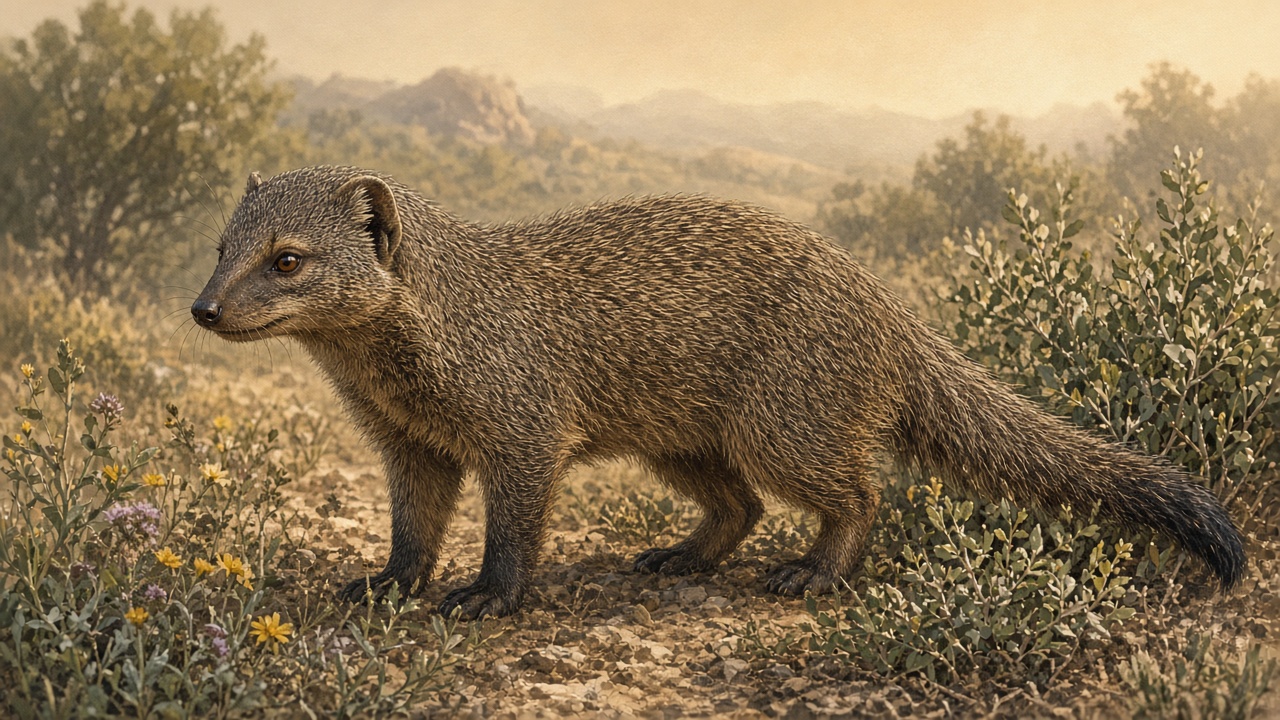
Egyptian Mongoose
Herpestes ichneumonEgyptian Mongoose (Herpestes ichneumon): coexistence sheet across its documented range — presence, biology and prudence, without an invented hunting status.
Seen in: Namibia · Portugal · South Africa · Spain
Overview
Egyptian Mongoose (Herpestes ichneumon) is a coexistence sheet across its documented range: presence, biology and prudence — not a hunting status claim.
Classification: order Carnivora, family Herpestidae, genus Herpestes. Common names: Egyptian Mongoose in English, Mangouste ichneumon in French, Mangosta egipcia in Spanish.
Identification
The Egyptian mongoose measures 48 to 60 cm, plus a 33 to 54 cm tail, and weighs 1.7 to 4 kg; the sexes look alike. Its long coat is grey speckled with brown, more rarely reddish-brown speckled with yellow, and a narrow strip of bare skin surrounds the eye. The slender, low-slung body, almost reptilian from a distance, contrasts with the long bushy tail ending in a black tassel. The face is long, the small rounded ears do not project above the head and the curved front claws are used for digging. When excited it bristles its fur and arches its back to look twice its size.
Diurnal, agile and alert, it likes to bask in the morning sun and swims readily. It eats invertebrates, fish, amphibians, reptiles, birds, mammals and sometimes fruit; it is fond of eggs, which it breaks by throwing them between its hind legs against a rock. It also kills snakes, although it is not immune to their venom. In Doñana, groups number one to seven animals, with adults living alone or in pairs. After about 11 weeks of gestation, 2 to 4 young are born, in July or August in Spain; born blind but furred, they open their eyes at 6 to 8 weeks.
Habitats and range
MDD gives it across most of Africa, in the Iberian Peninsula (Spain, Portugal, Gibraltar) and in the Near East (Israel, Jordan, Lebanon, Syria, Turkey). According to ADW it is absent from central DR Congo, the West African lowland forests and south-eastern South Africa, and has been introduced to Madagascar and Italy. A ground dweller, it prefers wooded areas near water, cultivated fields and vegetated canal banks, sheltering in burrows, hollow logs, holes and rock crevices.
The countries where the species’ presence is established are shown in the tags on this sheet.
Field signs
Its most distinctive habit is moving in single file: each mongoose follows the one ahead with its nose against the leader’s anal region, a behaviour that starts when young follow their mother. It also scent-marks with its anal glands. It forages by walking continuously with its nose to the ground, digging out insects it has smelled. It may be seen stretched out in the sun early in the morning.
Conservation
For conservation status of Herpestes ichneumon, consult the current IUCN assessment and cross with national monitoring programmes in countries of documented presence. Never turn a global IUCN category into a local hunting rule. GBIF occurrences help situate distribution but remain effort-biased.
The IUCN lists it as Least Concern; widespread, it is often the most abundant carnivore where it occurs. ADW notes that it also kills poultry and other species people wish to protect, to the point that importing and keeping it is banned in some countries. Known as the “Pharaoh’s cat”, it was sacred in ancient Egypt, where mummified animals have been found.
Limits
This sheet on the Egyptian Mongoose covers presence and biology. A species being present in a country does not mean it may be hunted, and no season or quota is published here.
Local densities and management plans are not covered here: they are a matter for the managers of each area.
Sources
Sources consulted for this sheet:
- IUCN Red List — species search (consulted 2026-11-02)
- ASM Mammal Diversity Database — Herpestes ichneumon (consulted 2026-11-02)
- GBIF — species search (consulted 2026-11-02)
- Animal Diversity Web — Herpestes ichneumon (Egyptian mongoose) (consulted 2026-11-04)
Conclusion
In short: use the scientific name Herpestes ichneumon to cross-check sources, confirm taxonomy and conservation status on the institutional portals listed above, and relate every field sign to the habitat where it was actually found.
Identification
Herpestes ichneumon
Egyptian Mongoose · preferred
Mangouste ichneumon · preferred
Mangosta egipcia · preferred
Large Gray Mongoose
Ichneumon
Classification
Class : Mammalia
Order : Carnivora
Family : Herpestidae
Genus : Herpestes
Conservation
IUCN : LC
CITES : —
iucn · LC (global)
Habitat
Frequently asked questions
How do I recognise Egyptian Mongoose?
Use Herpestes ichneumon as the scientific anchor. The Egyptian mongoose measures 48 to 60 cm, plus a 33 to 54 cm tail, and weighs 1.7 to 4 kg; the sexes look alike. Its long coat is grey speckled with brown, more rarely reddish-brown speckled with yellow, and a narrow strip of bare skin surrounds the eye. The slender, low-slung...
Where does Egyptian Mongoose typically live?
MDD gives it across most of Africa, in the Iberian Peninsula (Spain, Portugal, Gibraltar) and in the Near East (Israel, Jordan, Lebanon, Syria, Turkey). According to ADW it is absent from central DR Congo, the West African lowland forests and south-eastern South Africa, and has been introduced to Madagascar and Italy. A ground dweller, it prefers wooded area...
What field signs help confirm Egyptian Mongoose?
Its most distinctive habit is moving in single file: each mongoose follows the one ahead with its nose against the leader’s anal region, a behaviour that starts when young follow their mother. It also scent-marks with its anal glands. It forages by walking continuously with its nose to the ground, digging out insects it has smelled. It may be seen stretched...