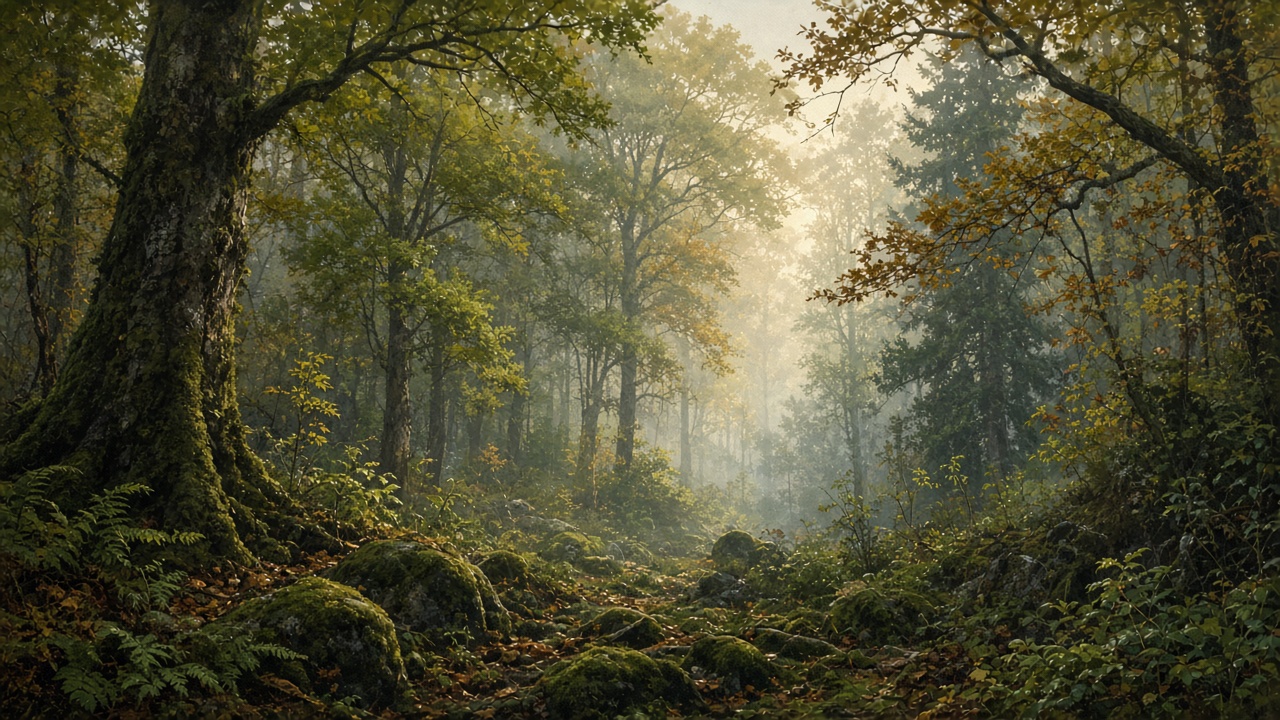
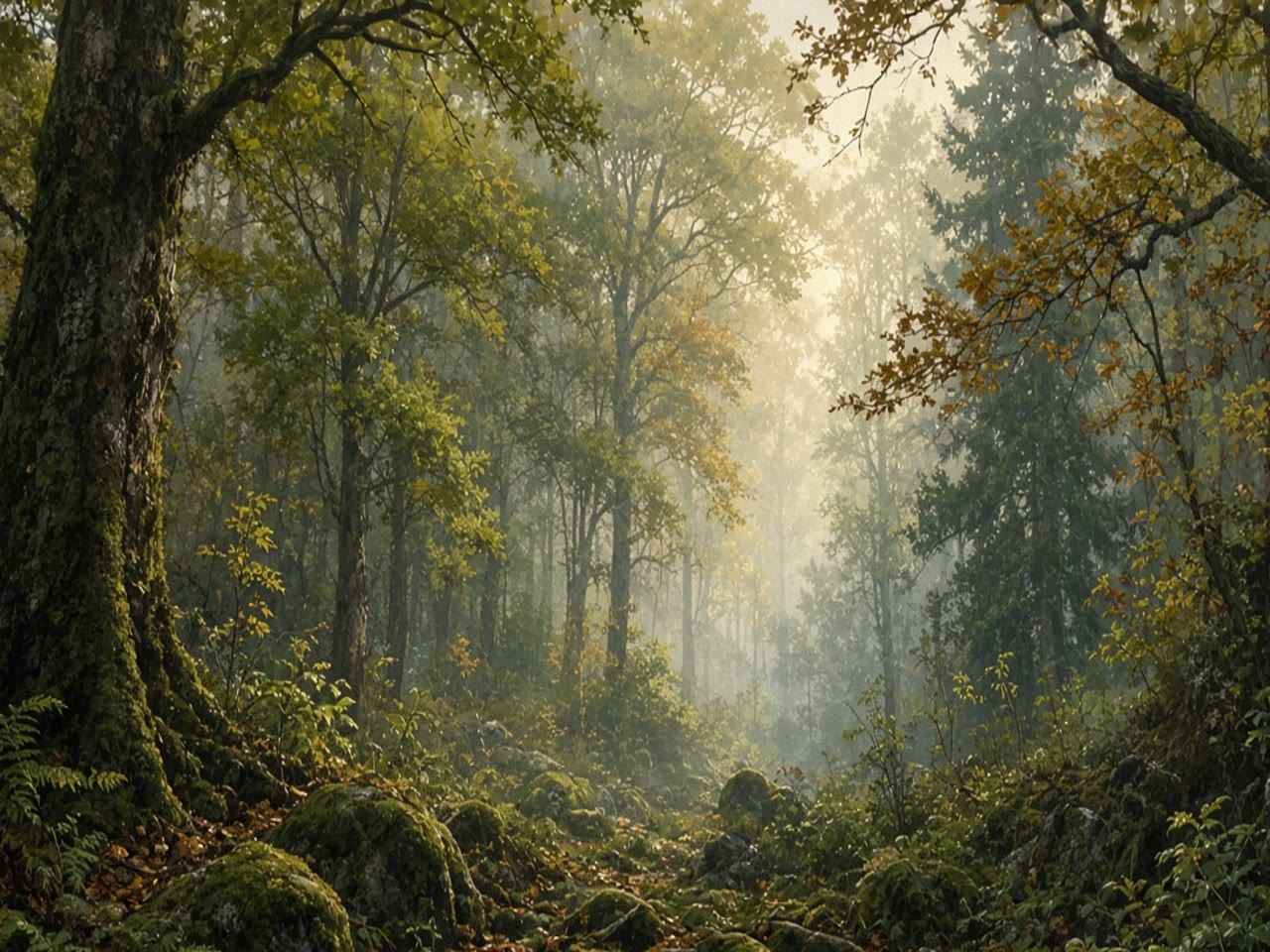
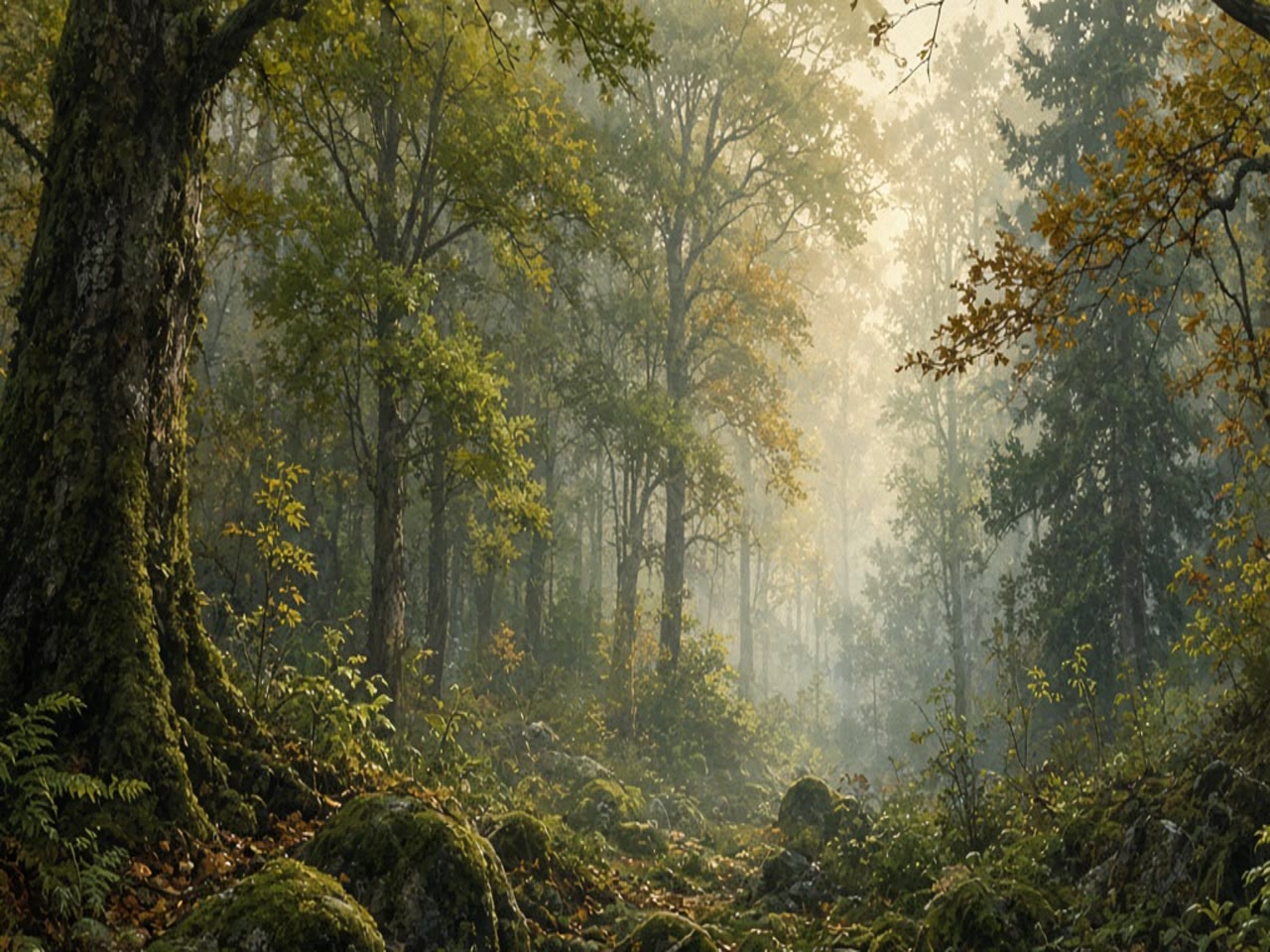
- Forests dominated by deciduous broadleaf trees, sometimes mixed with conifers, under a cold-winter climate with a short growing season.
- Found in temperate Europe, north-east Asia and eastern North America.
- Deer, roe deer, wild boar and predators (felids, canids) make up most of the large fauna.
- Fragmentation, loss of old stands and browsing pressure on regeneration are the main issues.
Definition and boundaries
Temperate forests are used here in the sense of the IUCN Global Ecosystem Typology (group T2.2): stands in which deciduous broadleaf trees make up at least two-thirds of the canopy, with conifers accounting for up to one-third. Cold conifer forests belong to the Boreal forest / taiga sheet, and dry evergreen forests to the Mediterranean forests sheet.
Distribution
The IUCN places these forests in temperate Europe, from south-west Russia to the British Isles, in north-east Asia (north-east China, southern Siberia, Korea, Japan) and in north-eastern North America. WWF adds distinctive areas in the Caucasus, the Himalayas, central China and the Russian Far East. Humid temperate forests also occur in Chile and New Zealand.
Climate
The climate is seasonal: cold, often snowy winters, mild summers and rainfall spread across the year with an overall water surplus. The IUCN profile gives winter means below −1 °C and four to six months above 10 °C. Late spring frosts limit regeneration; fires are uncommon.
Soils, relief and water
Soils are fertile, rich in nitrogen and well supplied with water. Annual leaf fall feeds a litter layer broken down by fungi and bacteria, which recycle carbon and nutrients in the surface horizon. These forests mostly occupy plains, hills and lower slopes; higher up they give way to mountain forests.
Structuring vegetation
Oaks, beeches, birches and maples typify these forests, with hornbeam, limes and ashes depending on soils. WWF describes four layers: canopy, subcanopy trees, shrubs and then herbs. In spring a woodland ground flora blooms before the canopy closes. Firs, spruces or pines appear in mixed stands.
Characteristic fauna
The food web includes large browsers (red deer, roe deer, white-tailed deer in North America), granivores and small herbivores (red squirrel, dormice, hares), canid and felid predators (wolf, Eurasian lynx, wildcat) and mustelids (pine marten, badger). In North America, the grey squirrel and black bear are typical; the grey squirrel, introduced to Britain and Italy, competes there with the red squirrel. European bison (wisent) survive only in reintroduced, very localised populations. Hibernation, food caching and migration help animals through winter.
Functioning and dynamics
Regeneration is almost continuous in gaps opened by windthrow or management. Browsers regulate the density of young trees: heavy ungulate pressure can block the regeneration of some species. Broadleaf trees readily colonise disturbed ground and may later give way to shade-tolerant species.
Threats
WWF stresses how sensitive these forests are to fragmentation: many understorey species cannot cross cleared areas, and breeding birds suffer more nest predation. Many plants, lichens, fungi and invertebrates depend on old-growth stands. Exotic species and the loss of large predators also alter forest structure.
Field reading
In the field, read the structure first: stand age, understorey density, edges and clearings, and the extraction racks that animals use as trails. Browsed shoots, fraying marks on trunks and wild boar rooting show where ungulates are present. An observation made in high forest does not transfer to neighbouring coppice.
This sheet describes a habitat. It publishes no season, quota or hunting authorisation: those rules must be checked with the competent authorities of the territory concerned.
Documented gaps
- Temperate rainforests (Chile, New Zealand, the North American Pacific coast) are only described briefly.
- No figures on forest area or ungulate densities by region.
- The distinction between old-growth and managed forests is not mapped.
Sources
- IUCN Global Ecosystem Typology — T2.2 Deciduous temperate forests (consulted 2026-11-04)
- WWF — Temperate broadleaf and mixed forests (biome) (consulted 2026-11-04)
Related species
Related techniques
Practice information — not a legal authorisation.
Frequently asked questions
What is the difference between temperate and boreal forest?
Temperate forest is dominated by deciduous broadleaf trees on fertile soils, with a growing season of four to six months. Boreal forest is dominated by conifers on acid soils, with a shorter season and longer winters.
Why does the forest floor flower early in spring?
Herbaceous plants use the light available before the trees come into leaf. Once the canopy closes, the forest floor receives much less light.
Do ungulates harm the forest?
They are part of how the forest works and help cycle nutrients. High densities can however block the regeneration of some tree species; the balance has to be assessed locally.
Does this sheet authorise hunting in this habitat?
This sheet describes a habitat. It publishes no season, quota or hunting authorisation: those rules must be checked with the competent authorities of the territory concerned.
Gallery
Keep exploring
Connect this environment to documented species, techniques and other habitats — without confusing ecological description with hunting authorisation.