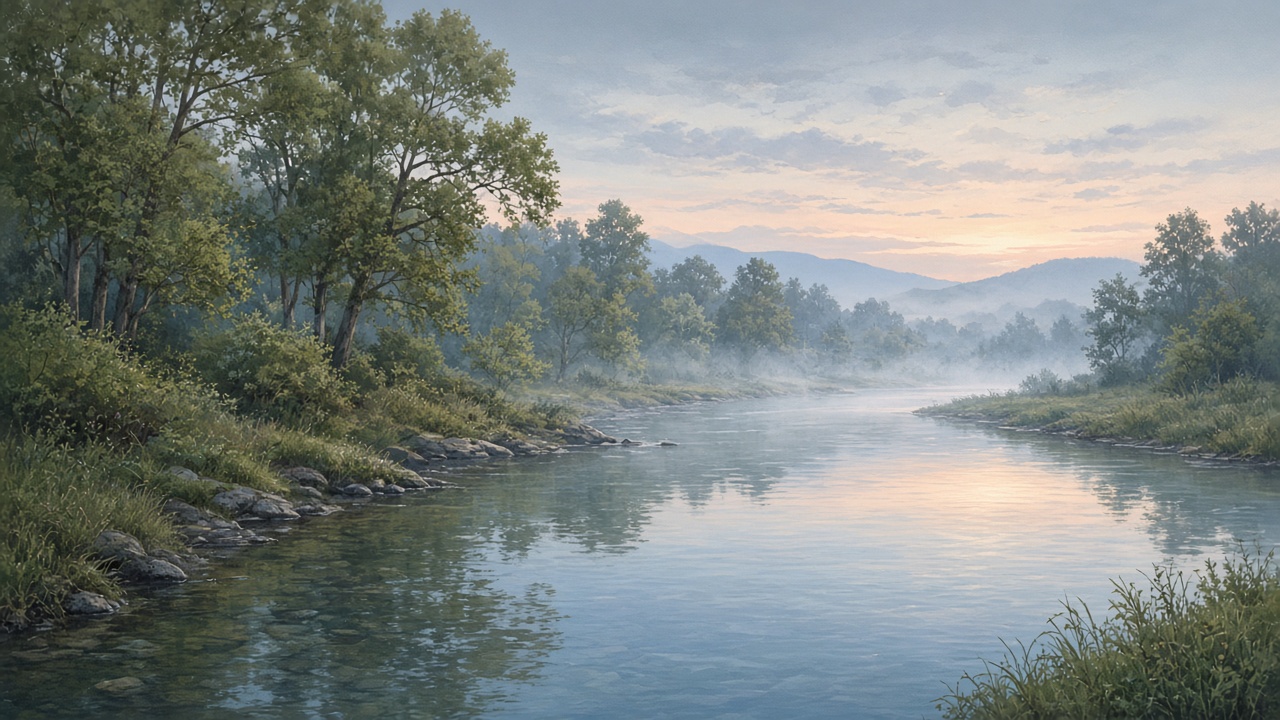
- Running waters (rivers, streams) are distinguished from standing waters (lakes, ponds).
- Flow, temperature and dissolved oxygen determine which organisms are present.
- Beaver, otter and water vole live at the interface between water and bank.
- Bankside woodland is covered in the Riparian woodland and riverbanks sheet.
Definition and boundaries
This sheet covers inland open waters: permanent upland streams (group F1.1 of the IUCN typology), permanent lowland rivers (F1.2), large permanent freshwater lakes (F2.1) and small lakes (F2.2). Marshes, reedbeds and peatlands belong to the Wetlands and Peatlands sheets; bankside forest to the Riparian woodland and riverbanks sheet.
Distribution
Rivers and lakes exist on every continent except where water is permanently frozen or evaporates. Large freshwater lakes are concentrated in regions shaped by glaciation (Canada, Scandinavia, the Alps) and in rift valleys (the African lakes, Baikal). In Europe, the Loire, Danube and Rhine drain vast networks.
Climate
Rainfall and snowmelt regimes control flow: spring floods in the mountains, summer low flows in Mediterranean regions. Water temperature varies less than air temperature. In winter, temperate lakes can freeze at the surface; in summer, they stratify into warm and cold layers.
Soils, relief and water
Mountain rivers have beds of boulders and cobbles, fast currents and cold, well-oxygenated water. In the lowlands the current slows, the bed becomes sandy or muddy and the river meanders. Lakes have shallow, sunlit margins and deep, dark, cold water.
Structuring vegetation
In the current, attached algae and aquatic mosses dominate. In calm waters, beds of pondweed, water milfoil and water lilies shelter invertebrates and fry. Shallow margins carry belts of reed, sedge and rush that form the transition to the bank.
Characteristic fauna
Eurasian and North American beavers build dams and lodges; the Eurasian otter hunts fish and crayfish. The water vole and the water shrew live in the banks. The critically threatened European mink and the introduced American mink hunt along watercourses.
Functioning and dynamics
Floods rework the channel, deposit sediment and open new bars. Fallen trunks form log jams that provide shelter for fish. Beavers change the habitat strongly: their dams slow the water, create ponds and flood woodland.
Threats
Dams, weirs and channel straightening break river continuity and change flows. Agricultural and urban discharges enrich the water with nutrients and encourage algal blooms. Introduced species such as American mink or non-native crayfish compete with native wildlife.
Field reading
Signs are read on the banks: otter spraints on rocks, beaver-gnawed trees and slides, vole burrows. Undercut banks and mud bars are unstable. Never cross a river in flood or walk on lake ice without knowing its thickness.
This sheet describes a habitat. It publishes no season, quota or hunting authorisation: those rules must be checked with the competent authorities of the territory concerned.
Documented gaps
- Fish and aquatic invertebrates are not linked to species sheets.
- Temporary streams and saline lakes are not described.
- No water-quality data by river basin.
Sources
- IUCN Global Ecosystem Typology — F1.1 Permanent upland streams (consulted 2026-11-04)
- IUCN Global Ecosystem Typology — F2.1 Large permanent freshwater lakes (consulted 2026-11-04)
- IUCN Global Ecosystem Typology — F1.2 Permanent lowland rivers (consulted 2026-11-04)
- IUCN Global Ecosystem Typology — F2.2 Small permanent freshwater lakes (consulted 2026-11-04)
Related species
Related techniques
Practice information — not a legal authorisation.
Frequently asked questions
What is the difference between running and standing waters?
Running waters are cooler and better oxygenated; standing waters warm up more, stratify and accumulate fine sediment.
Why is the beaver called an engineer?
Its dams turn a river into a series of ponds, hold water back in summer and create habitat for many other species.
How can I tell whether otters use a river?
Look for spraints, droppings with a distinctive smell left on prominent spots such as rocks, stumps and bridges.
Does this sheet authorise hunting in this habitat?
This sheet describes a habitat. It publishes no season, quota or hunting authorisation: those rules must be checked with the competent authorities of the territory concerned.
Gallery
Keep exploring
Connect this environment to documented species, techniques and other habitats — without confusing ecological description with hunting authorisation.