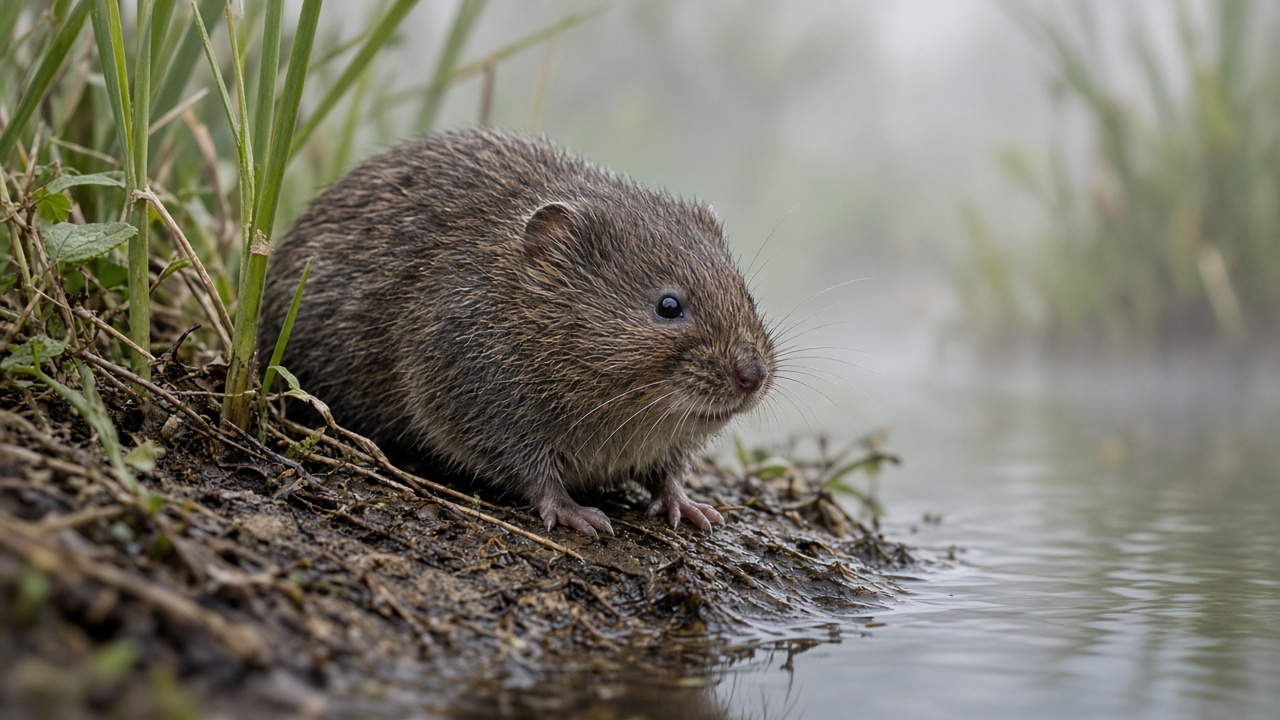
Eurasian Water Vole
Arvicola amphibiusEurasian Water Vole (Arvicola amphibius): ecology sheet across its documented range — natural history and habitats, without hunting framing.
Seen in: Austria · Belgium · Bulgaria · Croatia · Czechia
Overview
Eurasian Water Vole (Arvicola amphibius) is an ecology sheet across its documented range: natural history and habitats, without any hunting framing.
Classification: order Rodentia, family Cricetidae, genus Arvicola. Common names: Eurasian Water Vole in English, Campagnol amphibie in French, Rata de agua in Spanish.
Identification
The Eurasian water vole is a large vole: males average 21 cm head and body and 263 g, females 18.7 cm and 232 g, with a tail of about 12 cm. Its dense fur covers the whole body to the tip of the tail; it has small, rounded ears and a short tail, like other voles of similar size. The upperparts range from light to dark brown, sometimes black, and the underside from white to slate grey, colours that make it hard to see in dense vegetation. Its claws are well developed and the flank glands are usually visible.
It feeds mainly on plants – grasses, sedges, rushes, reeds and herbs, sometimes fruit and seeds – and on roots, which can damage crops; it occasionally adds water snails and freshwater mussels. In winter it stores food in a chamber of its burrow. Breeding runs from April to October, with up to four litters averaging 4 to 6 young after a 21-day gestation; females can breed as early as 5 weeks old. Predators include the European mink, otters, harriers, buzzards, herons and pike.
Habitats and range
MDD lists it from Europe, including northern Spain and northern Portugal but not central and southern Spain, east to the Lena basin in Siberia, and from the Arctic Ocean south to Lake Baikal, the Tien Shan, Iran, the Caucasus and Turkey; it occurs in Great Britain but not in Ireland. It lives mainly in lowlands, on the banks of rivers, streams and ponds with a fairly constant water level and good plant cover, and sometimes in gardens and fields.
The countries where the species’ presence is established are shown in the tags on this sheet.
Field signs
Its burrows, dug into banks, can reach 34 m of tunnels in winter and 74 m in summer. It leaves its droppings in latrines, which also help mark territory in the breeding season. It also scent-marks by rubbing its flank glands with its feet and then stamping the ground. Active mostly by day or at dusk and dawn, it stays within a limited range around its burrow.
Conservation
For conservation status of Arvicola amphibius, consult the current IUCN assessment, then cross with French monitoring programmes when they exist (OFB portal and related publications). Never turn a global IUCN category into a departmental hunting rule. GBIF occurrences help situate documented distribution but remain effort-biased.
The IUCN lists it as Least Concern, but it is declining in some regions: in England, habitat change and the introduced American mink (Mustela vison) play a large part, and conservation work is under way in the British Isles. It can carry tularaemia. According to MDD, the species formerly included A. italicus and A. persicus; the burrowing form monticola (or terrestris), often treated as a species, is better regarded as a subspecies or synonym.
Limits
This sheet on the Eurasian Water Vole covers biology and ecology only; it publishes no hunting season, quota or authorisation.
Local densities and management plans are not covered here: they are a matter for the managers of each area. Hunting-related sources on this small rodent are limited, so the sheet sticks to biology and ecology.
Sources
Sources consulted for this sheet:
- IUCN Red List — species search (consulted 2026-11-01)
- ASM Mammal Diversity Database — Arvicola amphibius (consulted 2026-11-01)
- GBIF — species search (consulted 2026-11-01)
- Animal Diversity Web — Arvicola amphibius (Eurasian water vole) (consulted 2026-11-04)
Conclusion
In short: use the scientific name Arvicola amphibius to cross-check sources, confirm taxonomy and conservation status on the institutional portals listed above, and relate every field sign to the habitat where it was actually found.
Identification
Arvicola amphibius
Eurasian Water Vole · preferred
Campagnol amphibie · preferred
Rata de agua · preferred
European Water Vole
Water Vole
Classification
Class : Mammalia
Order : Rodentia
Family : Cricetidae
Genus : Arvicola
Conservation
IUCN : LC
CITES : —
iucn · LC (global)
Habitat
Frequently asked questions
How do I recognise Eurasian Water Vole?
Use Arvicola amphibius as the scientific anchor. The Eurasian water vole is a large vole: males average 21 cm head and body and 263 g, females 18.7 cm and 232 g, with a tail of about 12 cm. Its dense fur covers the whole body to the tip of the tail; it has small, rounded ears and a short tail, like other voles of similar size....
Where does Eurasian Water Vole typically live?
MDD lists it from Europe, including northern Spain and northern Portugal but not central and southern Spain, east to the Lena basin in Siberia, and from the Arctic Ocean south to Lake Baikal, the Tien Shan, Iran, the Caucasus and Turkey; it occurs in Great Britain but not in Ireland. It lives mainly in lowlands, on the banks of rivers, streams and ponds with...
What field signs help confirm Eurasian Water Vole?
Its burrows, dug into banks, can reach 34 m of tunnels in winter and 74 m in summer. It leaves its droppings in latrines, which also help mark territory in the breeding season. It also scent-marks by rubbing its flank glands with its feet and then stamping the ground. Active mostly by day or at dusk and dawn, it stays within a limited range around its burrow...