- Family
- Hunting with dogs
- Difficulty
- Moderate to high: you need to know your hounds, the ground and how the quarry behaves, and to hold your stand
- Organisation
- One handler and a few posted guns for small game, more people in a big-game drive
- Key gear
- Trained hounds, tracking collars, protective vests, a horn or whistle to call them in
- Season
- Varies by species and region: check with the regional hunting federation and the local authority
- Who it suits
- Hunters who love listening to hounds and accept that the run will not always come their way
What is the idea behind hunting with scent hounds?
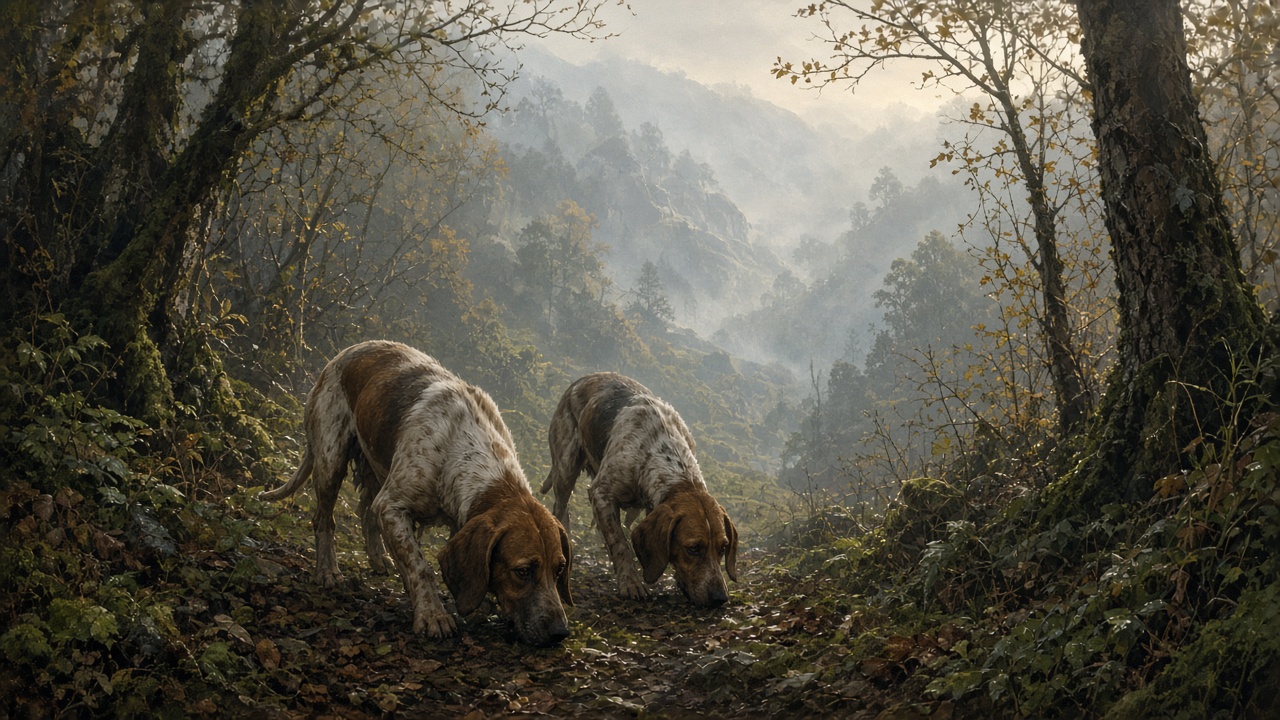
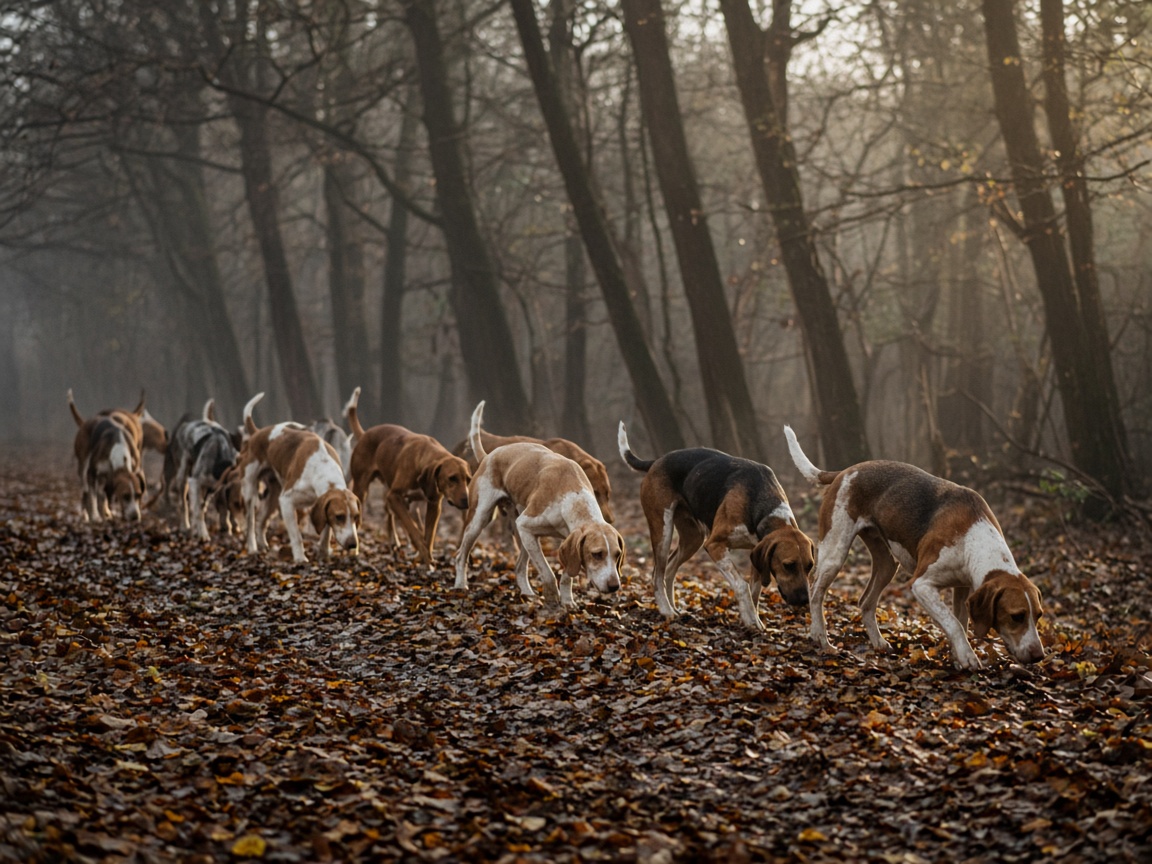
A scent hound hunts by nose. It casts for the line an animal has left, works it out to where the animal is lying, puts it up and then follows it while giving tongue. That cry keeps the person handling the hounds and the posted guns informed all the time: it tells them where the hounds are running, whether they are drawing away or coming back and whether they have lost the line.
Unlike hunting with hounds, where the pack itself pursues the animal until it is taken, this is a shooting method. The aim is not for the hounds to catch the animal but to bring it past a gun waiting at a known crossing point. Hares often run in loops within their home ground, so guns can be placed on their usual runs; roe deer and wild boar are more often hunted in a drive, where the hounds get the animal moving and push it out of cover.
A hound working up an old line usually speaks only now and then, and the cry builds once the animal is on the move. The handler also has to deal with a change, when hounds switch to another animal, and with a check, when they lose the line on a track or ploughed ground.
How does hunting with scent hounds work in the field?
What equipment do you need for hunting with scent hounds?
- A GPS or radio tracking collar; how it may be used and which functions are allowed vary between countries
- A protective vest for hounds that work wild boar
- A horn or whistle to call hounds in, and leads to take them up
- A canine first-aid kit
Safety rules for hunting with scent hounds
- Never shoot into cover the hounds are coming out of: a hound may be right behind the animal
- Decide beforehand who will stop the hounds if they head for a road or houses
- A boar held at bay by hounds is dangerous to them and to people; any approach follows the hunt leader’s instructions
- Shoot only when you know where the dog is and it is clear of the line of fire
Common mistakes in hunting with scent hounds
- Casting on a line that is too old, or in an area cut by a road
- Leaving your stand or moving when you hear the hounds coming
- Going home without having found every hound
- Working a dog that is tired, thirsty or not fit for the season
Which species are hunted by hunting with scent hounds?
Where is hunting with scent hounds practised?
England
In England, the Hunting Act 2004 only allows dogs to be used to flush a wild mammal to guns within its exemptions: no more than two dogs, on one's own land or with permission, for a listed purpose such as preventing damage or obtaining meat, with the animal shot as soon as possible. Hunting rabbits and rats with dogs is exempt separately.
France
In France, hunting with scent hounds is a form of shooting recognised by the Environment Code, which even has a specific rule for moving by vehicle between stands, set by each département's game management plan. Seasons and conditions should be checked with the departmental hunting federation and the prefecture.
Germany
In Germany, Brackenjagd, hunting in which scent hounds (Bracken) drive game towards the guns while giving tongue, is banned by the Federal Hunting Act on any area of less than 1,000 hectares. The federal states cannot relax this rule.
Romania
Hunting red deer, roe deer and chamois with hounds is banned.
Scotland
In Scotland, the Hunting with Dogs (Scotland) Act 2023 only allows dogs to be used to search for or flush a wild mammal under specific exceptions: no more than two dogs, under control, with the landowner's permission, and the animal shot as soon as possible. For damage control or environmental benefit, a licence can allow more dogs.
Spain
In Spain this is called caza con sabueso or caza con perros de rastro. It is used for hare, fox and rabbit, for wild boar and, in some regions, roe deer in a batida or montería, where hounds are grouped into rehalas. The RSCE recognises breeds such as the sabueso español, and hunting rules are set by the autonomous communities. It is distinct from hunting with galgos, which course the hare by sight.
Rules vary by country and region: check with the local authority. See the sources
Hunting with scent hounds compared with neighbouring techniques
Hunting with scent hounds is a shooting method: the hounds find and follow the animal, and the guns wait for it at its crossing points. In hunting with hounds, the pack pursues the animal until it is taken and no firearm is used during the chase. In a drive, hounds may support the beaters, but the day is organised around the blocks of cover being driven. A pointing dog, by contrast, works silently and shows the bird instead of chasing it.
Key terms in hunting with scent hounds
- scent hound
- A dog that follows an animal’s scent line while giving tongue, alone or in a pack.
- line
- The scent trail left by an animal, which hounds follow.
- working up the line
- Following an old scent line, often from the night before, up to where the animal is lying.
- run
- The chase once the animal is up, with hounds following it in full cry.
- change
- When hounds leave the animal they are hunting and switch to another, often fresher one.
- check
- A moment when hounds lose the line and have to cast to find it again.
- pack
- A group of hounds that hunt together.
- stand (peg)
- The position allocated to a hunter on a drive; called a peg on British driven shoots.
- drive
- A collective hunt in which beaters, often with dogs, push game towards a line of standing guns.
- rehala
- A pack of dogs used in a montería, handled by a perrero (dog handler).
Frequently asked questions about hunting with scent hounds
What is hunting with scent hounds?
It is a shooting method in which hounds find an animal’s line, put it up and follow it giving tongue, while the guns wait for it at its usual crossing points.
How does it differ from hunting with hounds?
Both use scent hounds, but the aim differs. With hounds and guns, the animal is shot as the run brings it past a stand. When hunting with hounds, the pack hunts it until it is taken and no gun is used during the chase.
Why do scent hounds give tongue?
It is how they hunt: they bay as they follow the line, which tells the handler and the guns where the hounds are and whether they are still on the animal.
What game is hunted with scent hounds?
Mainly hare, rabbit, fox, roe deer and wild boar; which species may be hunted, and when, depends on the country and region.
Is a GPS collar compulsory for a scent hound?
It helps you follow the run and find a hound that has strayed, but whether it is required and which functions are allowed vary between countries: check with the hunting federation or the local authority.
Can you hunt with scent hounds in the United Kingdom?
Hunting wild mammals with dogs is banned, subject to exemptions, in England and Wales by the Hunting Act 2004 and in Scotland by the Hunting with Dogs (Scotland) Act 2023; their exemptions call for specialist advice.
Hunting with scent hounds in pictures
Sources and references on hunting with scent hounds
- Société centrale canine — Races, groupes et épreuves de travail des chiens de chasse
- Office français de la biodiversité (OFB) — Chasse, permis de chasser et police de l’environnement (consulted on )
- Légifrance — Code de l’environnement, livre IV, titre II : chasse
- Société de Vènerie — Équipages, animaux chassés et déroulement de la chasse (consulted on )
- Real Sociedad Canina de España (RSCE) — Razas y pruebas de trabajo de perros de caza (consulted on )
- Real Federación Española de Caza (RFEC) — Modalidades, licencias y federaciones autonómicas (consulted on )
- Boletín Oficial del Estado (BOE) — Legislación estatal y autonómica de caza (consulted on )
- legislation.gov.uk — Hunting Act 2004 (England and Wales) (consulted on )
- legislation.gov.uk — Hunting with Dogs (Scotland) Act 2023 (consulted on )
- Bundesministerium der Justiz (gesetze-im-internet.de) — Bundesjagdgesetz (BJagdG), § 19 Sachliche Verbote (consulted on )
- Légifrance — Code de l'environnement, article L424-4 (modes de chasse : à tir, à courre, à cor et à cri, au vol ; chasse au chien courant) (consulted on )
- Portal Legislativ (Ministerul Justiției) — Legea vânătorii și a protecției fondului cinegetic nr. 407/2006, forme actualisée : art. 24, 39, 42 et annexe 1 (consulted on )
- legislation.gov.uk — Hunting Act 2004, Schedule 1 : Exempt hunting (paras 1 à 9) (consulted on )
- legislation.gov.uk — Hunting with Dogs (Scotland) Act 2023 (asp 1), sections 1 à 11 et 14 à 16 (consulted on )
Practice information — not a legal authorisation.