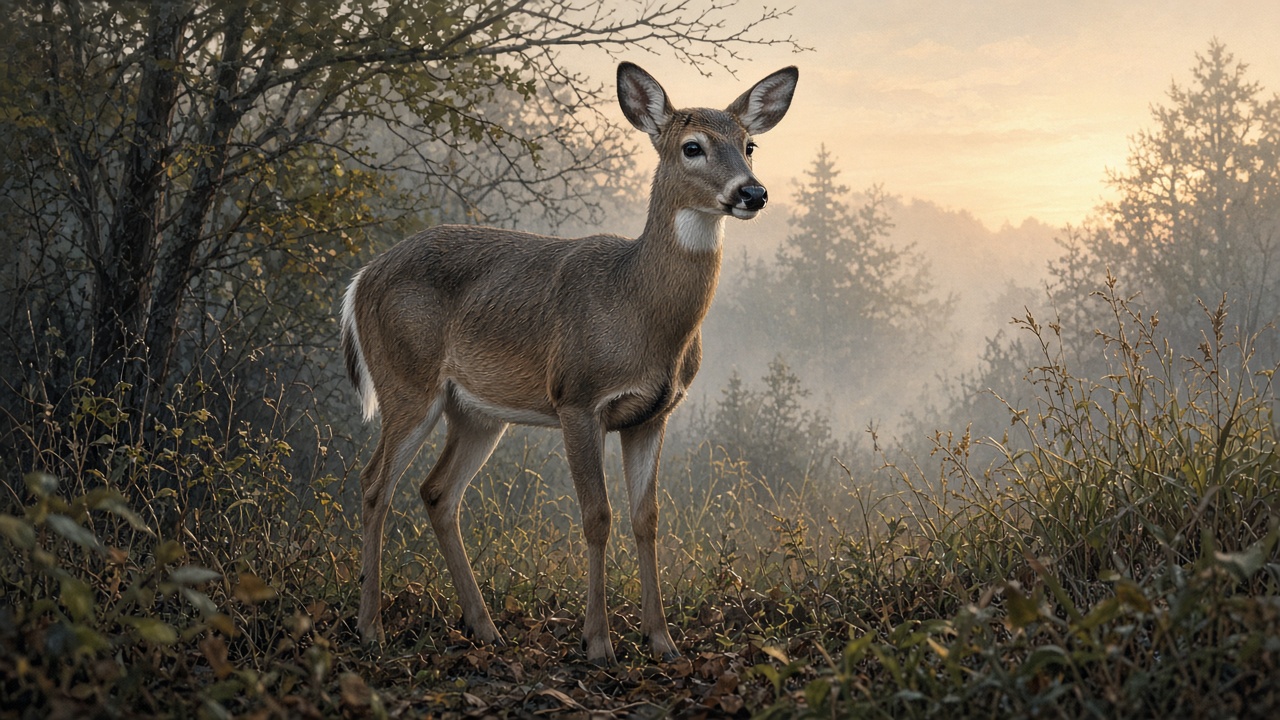
White-tailed Deer
Odocoileus virginianusWhite-tailed Deer (Odocoileus virginianus): biology, habitats and field signs across its documented range, hunting-context reading.
Seen in: Canada · Finland · New Zealand · United States
Overview
White-tailed Deer (Odocoileus virginianus) is presented here in a hunting-context reading across its documented range: biology, habitats and field signs useful to observers — without publishing season, quota or authorisation.
Classification: order Artiodactyla, family Cervidae, genus Odocoileus. Common names: White-tailed Deer in English, Cerf de Virginie in French, Ciervo de cola blanca in Spanish.
Identification
The white-tailed deer measures 150 to 200 cm in head and body, 80 to 100 cm at the shoulder and 57 to 137 kg, with a tail of 10 to 28 cm. The coat is greyer in winter and redder in summer, varying locally and among subspecies. White marks a band behind the nose, rings around the eyes, the inner ears, chin and throat, the upper inside of the legs and the underside of the tail. Males are larger; they shed their antlers from January to March and regrow them from April–May, losing the velvet in August–September. Fawns weigh 1.5 to 2.5 kg and are white-spotted until their first winter.
Crepuscular, it forages mainly from before dawn until a few hours after, and again from late afternoon to dusk: buds and twigs of maple, poplar or birch in eastern forests, yucca and prickly pear in arid areas, conifers in winter. Mating runs from October to December and gestation lasts about six and a half months. A first-time mother has one fawn, later two (occasionally three or four). Fawns stay hidden for up to four hours while the mother forages. Wolves, pumas, bears, jaguars and coyotes prey on it.
Habitats and range
MDD gives a range from southern Canada (north of 60° N in Yukon and the Northwest Territories) through the United States, except from California to western Colorado, all of Central America and northern South America to Peru and Bolivia; it has been introduced to the Czech Republic, Finland, New Zealand and the West Indies. It lives from the big woods of Maine to Florida swamps, in farmland, brush and the thornbrush deserts of Texas and Mexico; ideal habitat combines dense thickets and edges.
The countries where the species’ presence is established are shown in the tags on this sheet.
Field signs
When startled, it flees waving its raised, white-backed tail from side to side. The usual sounds are snorts or whistles from disturbed deer; fawns bleat and injured deer give a loud bawl. It keeps to the same trails but does not reuse its daytime beds. Glands between the hooves and on the hind legs are used for scent marking, especially in the rut; in severe winters it can girdle large numbers of trees.
Conservation
For conservation status of Odocoileus virginianus, consult the current IUCN assessment and cross with national monitoring programmes in countries of documented presence. Never turn a global IUCN category into a local hunting rule. GBIF occurrences help situate distribution but remain effort-biased.
The IUCN lists it as Least Concern. According to ADW it is the most numerous large mammal in North America, probably 8 to 15 million animals; nearly wiped out in many areas around 1900, it later benefited from forest clearing. Where abundant, it damages crops and forests, causes road collisions and hosts the ticks that carry the bacteria of Lyme disease.
Limits
This sheet on the White-tailed Deer publishes no season, quota, hunting method or fee: those rules differ between countries and territories and must be checked in official texts. Being described here does not mean a species may be hunted.
Local densities and management plans are not covered here: they are a matter for the managers of each area.
Sources
Sources consulted for this sheet:
- IUCN Red List — species search (consulted 2026-11-02)
- ASM Mammal Diversity Database — Odocoileus virginianus (consulted 2026-11-02)
- GBIF — species search (consulted 2026-11-02)
- Animal Diversity Web — Odocoileus virginianus (white-tailed deer) (consulted 2026-11-04)
Conclusion
In short: use the scientific name Odocoileus virginianus to cross-check sources, confirm taxonomy and conservation status on the institutional portals listed above, and relate every field sign to the habitat where it was actually found.
Identification
Odocoileus virginianus
Cerf de Virginie · preferred
Ciervo de cola blanca · preferred
White-tailed Deer · preferred
Florida Key Deer
Classification
Class : Mammalia
Order : Artiodactyla
Family : Cervidae
Genus : Odocoileus
Conservation
IUCN : LC
CITES : —
iucn · LC (global)
Habitat
Frequently asked questions
How do I recognise White-tailed Deer?
Use Odocoileus virginianus as the scientific anchor. The white-tailed deer measures 150 to 200 cm in head and body, 80 to 100 cm at the shoulder and 57 to 137 kg, with a tail of 10 to 28 cm. The coat is greyer in winter and redder in summer, varying locally and among subspecies. White marks a band behind the nose, rings around the...
Where does White-tailed Deer typically live?
MDD gives a range from southern Canada (north of 60° N in Yukon and the Northwest Territories) through the United States, except from California to western Colorado, all of Central America and northern South America to Peru and Bolivia; it has been introduced to the Czech Republic, Finland, New Zealand and the West Indies. It lives from the big woods of Main...
What field signs help confirm White-tailed Deer?
When startled, it flees waving its raised, white-backed tail from side to side. The usual sounds are snorts or whistles from disturbed deer; fawns bleat and injured deer give a loud bawl. It keeps to the same trails but does not reuse its daytime beds. Glands between the hooves and on the hind legs are used for scent marking, especially in the rut; in severe...