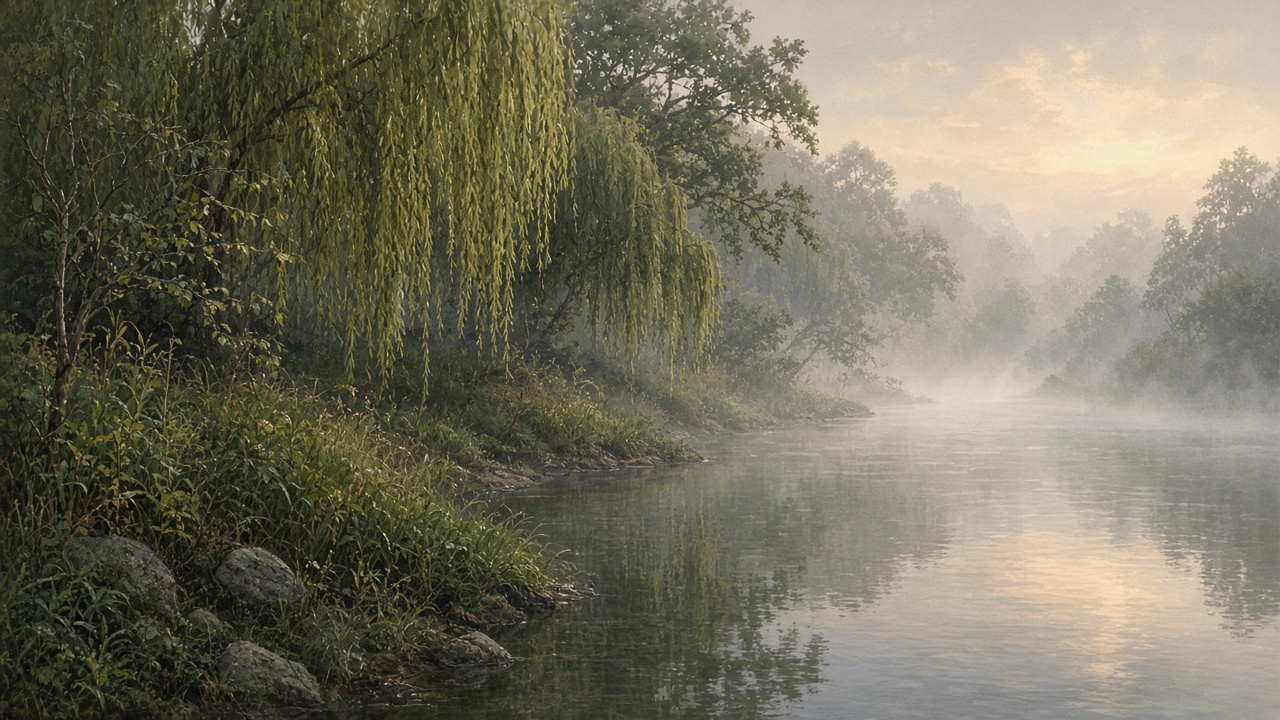
- Riparian woodland is the forest that lines watercourses and is subject to their floods.
- Willows and poplars colonise fresh gravel bars; alders and ashes hold the banks.
- Roots stabilise the banks and shade keeps the water cool.
- It is a continuous corridor that many mammals use to move.
Definition and boundaries
Riparian woodland refers to the wooded vegetation of riverbanks and floodplains. The IUCN places it among subtropical and temperate forested wetlands (group TF1.2), which depend on periodic flooding. The river channel itself belongs to the Aquatic habitats sheet; open marshes to the Wetlands sheet.
Distribution
Riparian woodland occurs along almost every watercourse in temperate and subtropical zones. In Europe, large alluvial forests survive on the Danube, Rhine, Loire and Ebro. In dry regions, they form green ribbons that contrast sharply with arid slopes.
Climate
The river softens the local climate: moister air, frequent fog and late frosts in valley bottoms. The flood regime matters more than local rainfall, since the water comes from the whole catchment. In summer, tree shade limits warming of the water.
Soils, relief and water
Soils are recent alluvium, sands, silts and gravels, regularly reworked and enriched by floods. The water table is close to the surface. Low banks flood often and higher terraces rarely: this difference in flooding arranges the vegetation in bands parallel to the river.
Structuring vegetation
Willows and black poplar colonise fresh gravel bars. Common alder and ash form the bankside woodland; pedunculate oak and elm occupy terraces flooded less often. Hop, clematis and ivy climb the trees. Mediterranean banks also carry oleander and tamarisk.
Characteristic fauna
The Eurasian beaver cuts willows and poplars for food and building; the Eurasian otter dens under bank roots, and the water vole digs its tunnels in soft banks. Roe deer, wild boar and red deer use riparian woodland as cover and as a corridor. Polecat, genet and many bats hunt there. The kingfisher digs its burrow in steep banks.
Functioning and dynamics
Floods destroy and recreate riparian woodland: they uproot trees, lay down new bars and spread willow seed. Fallen trees form log jams and woody debris that diversify flows and shelter fish and invertebrates. Without floods, riparian woodland ages and gives way to terrace forest.
Threats
Embankments, gravel extraction and dams remove the floods that renew riparian woodland. Clear-felling of banks, poplar plantations and farming right up to the water’s edge shrink the wooded strip. Japanese knotweed and other invasive plants overrun disturbed banks.
Field reading
Fords, mud patches and sandbars hold tracks well. Animals follow the river and cross it at the same points. After a flood, debris lines caught in branches show how high the water rose. Undercut banks can give way: do not step right to the edge.
This sheet describes a habitat. It publishes no season, quota or hunting authorisation: those rules must be checked with the competent authorities of the territory concerned.
Documented gaps
- Tropical gallery forests are not described.
- No area figures for alluvial forests by country.
- Riparian birds and bats are not linked to species sheets.
Sources
- IUCN Global Ecosystem Typology — TF1.2 Subtropical/temperate forested wetlands (consulted 2026-11-04)
- IUCN Global Ecosystem Typology — F1.2 Permanent lowland rivers (consulted 2026-11-04)
Related species
Related techniques
Practice information — not a legal authorisation.
Frequently asked questions
Why does riparian woodland matter for the river?
It stabilises the banks, filters some of the nutrients coming from fields, shades the water and supplies deadwood that creates shelter for fish.
Are log jams a problem?
They are useful for aquatic life. They only cause trouble near bridges or settlements, where they can make flooding worse.
How can I recognise beaver activity?
By trunks gnawed to a pencil point, wood chips at the foot of trees, stripped branches and slides running down to the water.
Does this sheet authorise hunting in this habitat?
This sheet describes a habitat. It publishes no season, quota or hunting authorisation: those rules must be checked with the competent authorities of the territory concerned.
Gallery
Keep exploring
Connect this environment to documented species, techniques and other habitats — without confusing ecological description with hunting authorisation.