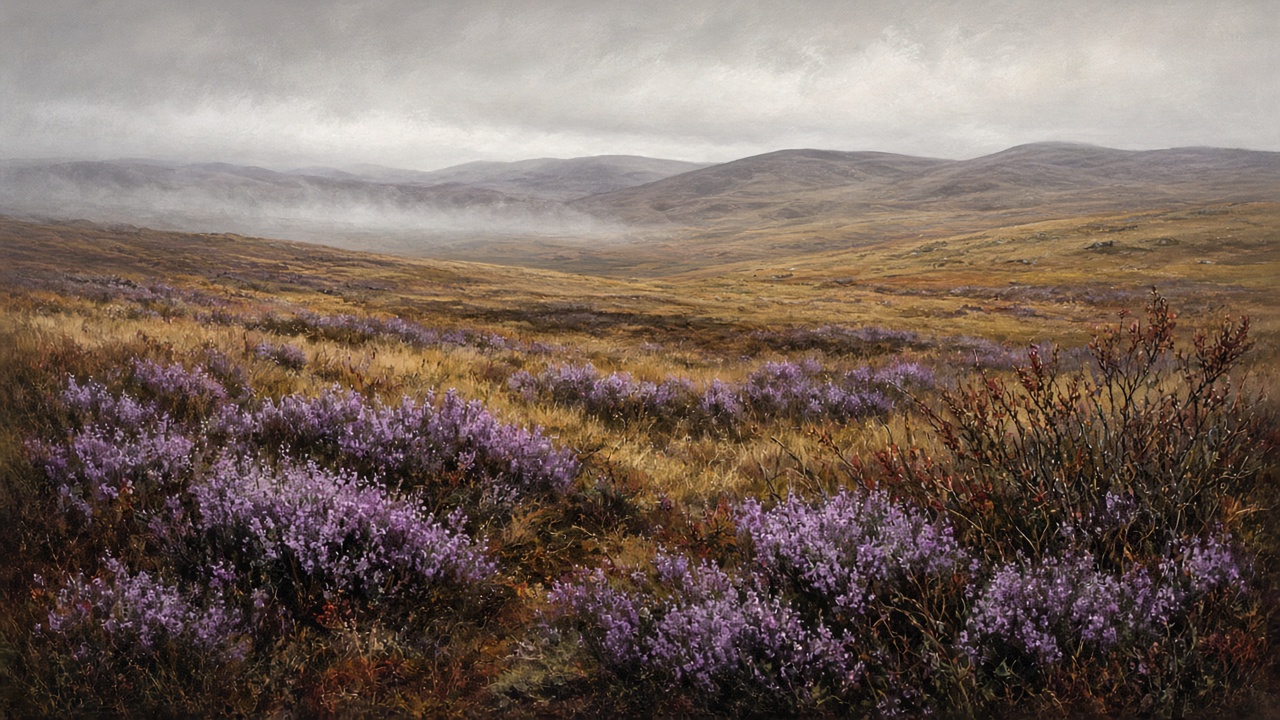
- Atlantic heathlands are dominated by ling heather, other heaths and gorse.
- They grow on acid, nutrient-poor and often leached soils.
- Many are man-made: ancient clearance, grazing, cutting and burning.
- Without management, they close over into scrub and then forest.
Definition and boundaries
A heathland is a low plant formation, usually under two metres, dominated by dwarf shrubs of the heather family and by gorse or broom. The IUCN typology classes it among cool temperate heathlands (group T3.3). Mediterranean garrigue and maquis have their own sheet.
Distribution
Heather heathlands are concentrated on Europe’s Atlantic seaboard, from Portugal and Galicia to Norway, through Brittany, the British Isles, the Netherlands and Denmark. The Landes de Gascogne in south-west France, named after these heaths, were largely planted with maritime pine from the 19th century onwards. Comparable heathlands exist in South Africa, Australia and the Americas, with other plant families.
Climate
Atlantic heathlands enjoy a moist oceanic climate with mild winters. Heavy rainfall leaches the soil and maintains its acidity. Dry heaths occupy free-draining soils; wet heaths, with cross-leaved heath, form on soils waterlogged in winter.
Soils, relief and water
Heathland soils are acid and nutrient-poor, often sandy or derived from granite and schist. Leaching forms podzols, with a bleached grey layer beneath the humus. Organic matter decomposes slowly, which deepens the poverty of the soil.
Structuring vegetation
Ling, bell heather and Dorset heath dominate dry heaths, with common gorse and broom. Wet heaths carry cross-leaved heath, purple moor-grass and sphagnum mosses. Birch and pine are the first trees to colonise abandoned heath.
Characteristic fauna
European rabbit, roe deer, wild boar and red fox use heaths and their edges. On the heather moors of Scotland and northern England, red grouse, mountain hare, stoat and red deer are characteristic. The adder, the viviparous lizard and many insects find warm, open ground there. Dartford warbler, nightjar and hen harrier are among the characteristic birds.
Functioning and dynamics
Most European heathlands are secondary habitats that appeared after forests were cleared. Grazing, cutting (turf stripping, bedding) and fire kept them open. Ling regrows quickly after a moderate burn, but fires that come too close together replace it with grasses. In Scotland and northern England, large moors are managed for red grouse by patchwork burning and shot as driven grouse.
Threats
Abandonment of grazing lets heaths close over. Conifer planting, conversion to farmland and urban growth have removed large areas. Atmospheric nitrogen deposition enriches the soil and favours grasses over heathers. Fires that are too frequent or too intense degrade the habitat.
Field reading
Heathland offers good visibility but little cover: animals keep to the edges of copses and to taller gorse patches. Trails show clearly through low vegetation. Wet heaths hide very boggy patches. In dry weather, the fire risk calls for great caution.
This sheet describes a habitat. It publishes no season, quota or hunting authorisation: those rules must be checked with the competent authorities of the territory concerned.
Documented gaps
- Upland heaths and South African fynbos are not described.
- No area figures by country.
- Heathland reptiles and birds are not linked to species sheets.
Sources
- IUCN Global Ecosystem Typology — T3.3 Cool temperate heathlands (consulted 2026-11-04)
- IUCN Global Ecosystem Typology — T3.2 Seasonally dry temperate heath and shrublands (consulted 2026-11-04)
Related species
Related techniques
Practice information — not a legal authorisation.
Frequently asked questions
Is heathland a natural habitat?
In Atlantic Europe most heaths are semi-natural: they arose from clearance and persist thanks to grazing, cutting or fire.
What is the difference between dry and wet heath?
Dry heath grows on free-draining soils with ling and bell heather; wet heath grows on waterlogged soils with cross-leaved heath and purple moor-grass.
Why do heaths close over?
Without grazing or cutting, shrubs and then birch and pine move in and eventually replace the low vegetation.
Does this sheet authorise hunting in this habitat?
This sheet describes a habitat. It publishes no season, quota or hunting authorisation: those rules must be checked with the competent authorities of the territory concerned.
Gallery
Keep exploring
Connect this environment to documented species, techniques and other habitats — without confusing ecological description with hunting authorisation.