Mountain Hare
Lepus timidusMountain Hare (Lepus timidus): biology, habitats and field signs across its documented range, hunting-context reading.
Seen in: Austria · Estonia · Finland · France · Germany
Overview
Mountain Hare (Lepus timidus) is presented here in a hunting-context reading across its documented range: biology, habitats and field signs useful to observers — without publishing season, quota or authorisation.
Classification: order Lagomorpha, family Leporidae, genus Lepus. Common names: Mountain Hare in English, Lièvre variable in French, Liebre de montaña in Spanish.
Identification
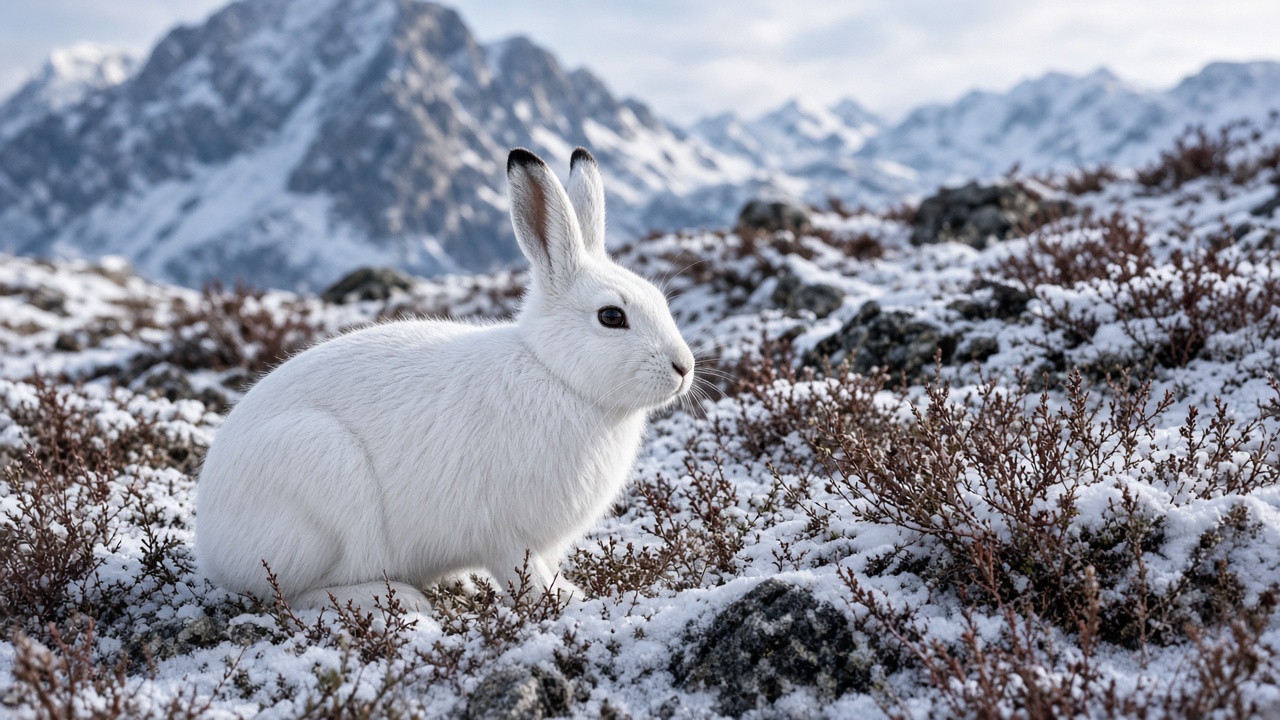
The mountain hare measures 43 to 61 cm head and body, with a tail of 4 to 7 cm, hind feet of 14.5 to 18 cm and ears of 7.6 to 10.6 cm; it weighs 1 to 4 kg, about 3 kg on average. Females are larger than males, and northern hares are heavier than southern ones. Its coat changes with day length: brown in summer, it turns white or grey from October to January and back to brown from February to May, faster in an early, warm spring. The change comes from the colour of the pile hairs, about 25 mm long.
Its diet varies with habitat and season: leaves and twigs in forest in summer, alpine plants in the tundra, as well as grasses, lichen and bark; in winter, when most food lies under snow, heather dominates. It is rarely seen drinking and may eat snow; it feeds with its back to the wind and clears snow from plants with its paws. Breeding runs from January to September: females have one or two litters a year, three after an early spring, of 1 to 4 young born after 47 to 54 days, fully furred with eyes open, which suckle for about 4 weeks.
Habitats and range
MDD lists it across the Palearctic from Scandinavia to eastern Siberia, south to Sakhalin, Hokkaido, northern China and Mongolia, the Altai and Tien Shan, and in the Baltic states, eastern Poland and northern Ukraine; isolated populations live in the Alps, Scotland, Wales and Ireland, and France appears in its country list. It inhabits tundra, forest and the moorlands of Scotland and Ireland, reaching high densities in transition zones with open clearings, and moves to more sheltered areas in winter.
The countries where the species’ presence is established are shown in the tags on this sheet.
Field signs
Nocturnal, it spends the day in a form, a hollow in snow or ground that cuts the wind, sometimes reused but often abandoned; it sleeps only a few minutes at a time there. Before resting it leaps sideways off its own tracks, sometimes repeatedly, a behaviour called hooking that breaks the trail. It is occasionally seen near a burrow, dug or taken over from another animal, which only leverets use while the mother sits at the entrance. Its white winter coat makes it easy to recognise.
Conservation
For conservation status of Lepus timidus, consult the current IUCN assessment, then cross with French monitoring programmes when they exist (OFB portal and related publications). Never turn a global IUCN category into a departmental hunting rule. GBIF occurrences help situate documented distribution but remain effort-biased.
The IUCN lists it as Least Concern, but ADW stresses that numbers fluctuate widely because of predators – red foxes, wildcats, dogs and birds of prey – parasites such as fleas, ticks and lice, and starvation in severe weather. Starving hares may then damage cereal and brassica crops, fruit trees and plantations. MDD gives Irish hare and Alpine mountain hare among its other names, and notes introductions to England, the Faroes and Scottish islands.
Limits
This sheet on the Mountain Hare publishes no season, quota, hunting method or fee: those rules differ between countries and territories and must be checked in official texts. Being described here does not mean a species may be hunted.
Local densities and management plans are not covered here: they are a matter for the managers of each area.
Sources
Sources consulted for this sheet:
- IUCN Red List — species search (consulted 2026-11-01)
- ASM Mammal Diversity Database — Lepus timidus (consulted 2026-11-01)
- GBIF — species search (consulted 2026-11-01)
- Animal Diversity Web — Lepus timidus (mountain hare) (consulted 2026-11-05)
Conclusion
In short: use the scientific name Lepus timidus to cross-check sources, confirm taxonomy and conservation status on the institutional portals listed above, and relate every field sign to the habitat where it was actually found.
Identification
Lepus timidus
Mountain Hare · preferred
Lièvre variable · preferred
Liebre de montaña · preferred
Blue Hare
Snow Hare
Eurasian Arctic Hare
Varying Hare
White Hare
Irish Hare
Alpine Mountain Hare
Classification
Class : Mammalia
Order : Lagomorpha
Family : Leporidae
Genus : Lepus
Conservation
IUCN : LC
CITES : —
iucn · LC (global)
Habitat
Frequently asked questions
How do I recognise Mountain Hare?
Use Lepus timidus as the scientific anchor. The mountain hare measures 43 to 61 cm head and body, with a tail of 4 to 7 cm, hind feet of 14.5 to 18 cm and ears of 7.6 to 10.6 cm; it weighs 1 to 4 kg, about 3 kg on average. Females are larger than males, and northern hares are heavier than southern ones. Its coat changes wi...
Where does Mountain Hare typically live?
MDD lists it across the Palearctic from Scandinavia to eastern Siberia, south to Sakhalin, Hokkaido, northern China and Mongolia, the Altai and Tien Shan, and in the Baltic states, eastern Poland and northern Ukraine; isolated populations live in the Alps, Scotland, Wales and Ireland, and France appears in its country list. It inhabits tundra, forest and the...
What field signs help confirm Mountain Hare?
Nocturnal, it spends the day in a form, a hollow in snow or ground that cuts the wind, sometimes reused but often abandoned; it sleeps only a few minutes at a time there. Before resting it leaps sideways off its own tracks, sometimes repeatedly, a behaviour called hooking that breaks the trail. It is occasionally seen near a burrow, dug or taken over from an...