- Family
- Elevated position
- Difficulty
- Moderate: waiting is comfortable, but climbing, handling the rifle at height and judging the shot angle take discipline
- Organisation
- Alone, sometimes two people in an enclosed seat
- Key gear
- A checked high seat, hauling cord, safety harness, binoculars, a zeroed rifle
- Season
- Depends on the species and the area: check with the relevant authority or a deer organisation
- Who it suits
- Hunters managing deer ground, and accompanied beginners who want a steady, supported shot
What is the idea behind high-seat hunting?
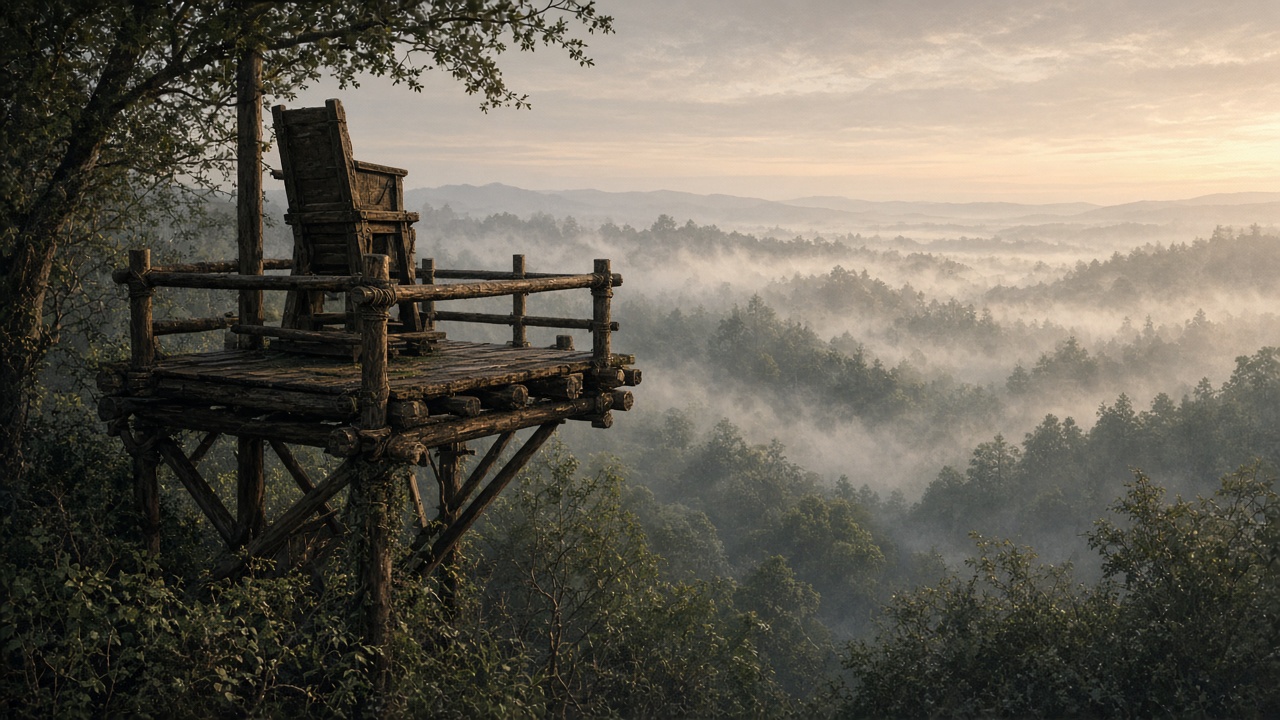
A high seat adds two things to stand hunting. It lifts your view above long grass, crops and scrub, and it points the shot downwards, so the ground behind the animal acts as a safe backstop. That advantage shrinks with range: the further away the animal, the flatter the angle and the less the ground can be relied on.
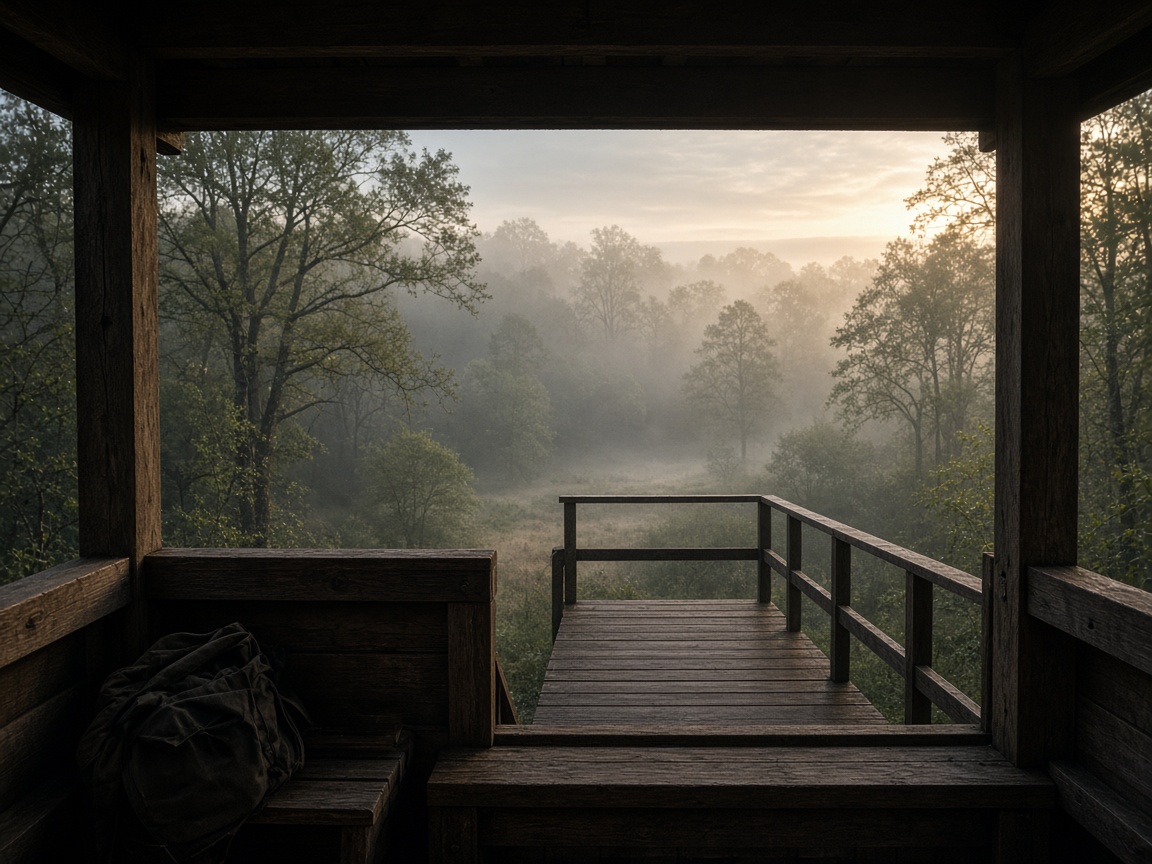
There are several kinds: a simple ladder seat strapped to a tree, a free-standing wooden seat with a rail, an enclosed tower seat that keeps out the cold and hides movement, and portable models moved from season to season. All share one specific risk, which is falling, whether climbing, coming down or through rotten timber. Shooting organisations therefore stress regular inspection and a safety harness on tree-mounted seats.
Height does not let you ignore wind and noise. Scent disperses better, but in still air or a shifting breeze it can reach the deer. Timber creaks, metal ladders ring, a rifle laid against the side knocks: climb quietly, settle once and keep movement on the platform to a minimum.
How does high-seat hunting work in the field?
What equipment do you need for high-seat hunting?
- A safety harness with a tether for tree-mounted seats or seats without a rail
- A cushion and clothing that does not scrape against timber
- A head torch for climbing up and down in poor light, within local rules on lights
- A cord or strap to haul gear up and down instead of carrying it
Safety rules for high-seat hunting
- Unload before climbing, haul the rifle up empty with the bolt open, and load only once seated
- Climb up and down with both hands free, facing the ladder, keeping three points of contact
- Clip on with a safety harness on tree-mounted seats or any seat without a rail, and whenever you might doze off during a long wait
- Do not climb in a thunderstorm or onto a frozen or icy ladder; in rain, take care on slippery rungs
- Shoot only downwards into ground that will stop the bullet; pass up long shots and animals on a ridge
- Check the ladder, platform and fixings before every climb
Common mistakes in high-seat hunting
- Using a seat that has not been checked since last season: rotten timber, split rungs, slack straps
- Shifting on the platform or leaning the rifle against the timber: noise carries a long way on a still evening
- Taking an almost horizontal shot at a distant edge, where the ground no longer stops the bullet
- Climbing up or down with a loaded firearm
Which species are hunted by high-seat hunting?
Where is high-seat hunting practised?
England
In England, the high seat is a common deer management tool, especially in woodland: shooting downwards gives a safer backstop at short range, notes the BASC and British Deer Society code, which also requires the rifle to be unloaded before climbing up or down. The shooting itself is governed by the Deer Act 1991, which applies to England and Wales.
France
In France, high seats (miradors) are widely used for roe deer, wild boar and red deer, both for stand hunting and on driven days. They are put up with the landowner’s consent; departmental hunting federations and the OFB issue safety advice, and deer are shot under the estate’s cull plan.
Germany
The Hochsitz (raised hunting seat) is the emblematic piece of equipment for waiting at a stand in Germany. The German Hunting Association (DJV) points out that it lets the hunter watch a wide area without disturbing the game and makes the shot safer, since the bullet travels down towards the ground.
North Rhine-Westphalia (Germany)
In North Rhine-Westphalia, the state hunting act (LJG-NRW, sections 19 and 28) forbids putting up a stand, or shooting from one, less than 75 metres from the boundary of a neighbouring shoot, unless the neighbours agree in writing; the authority may grant an exemption to prevent excessive game damage. It also bans hunting and hunting stands within 300 metres of the centre of wildlife crossings, although tracking wounded game remains allowed.
Latvia
Night hunting is allowed only from a platform at least 2.5 m high allowing a downward shot, with exceptions (elk and red stag in the rut, waterfowl). Thermal or night-vision sights are limited to wild boar, fox and raccoon dog, from the same height. Guns must be unloaded when climbing a high seat.
Poland
The rules define an ambona as a raised stand for waiting for game. Hunters must shoot standing, except from an ambona.
Scotland
In Scotland, the high seat is used mainly in woodland, alongside stalking on the open hill. The Wild Deer Best Practice guides, published with NatureScot, include a dedicated high seats guide, and shooting is governed by the Deer (Scotland) Act 1996.
Spain — Castilla y León
In Spain, a high seat is called a puesto elevado or torreta. It is mainly used for waiting for wild boar and for deer management on hunting estates (cotos). Rules are set by the autonomous communities: in Castilla y León, for example, the 2021 hunting act (Ley 4/2021) defines the aguardo, or espera, as a single hunter waiting for big game from a fixed post.
Rules vary by country and region: check with the local authority. See the sources
High-seat hunting compared with neighbouring techniques
High-seat hunting is stand hunting raised off the ground: it shares the choice of position by wind and game paths, but adds working-at-height safety that a ground stand does not need. It is often the stand used over a bait site. Unlike stalking, you do not move or choose the angle at which you see the animal; you wait for it to step into the zone where a shot is safe.
Key terms in high-seat hunting
- high seat
- A raised stand, fixed or portable, from which the hunter watches and shoots down towards the ground.
- stand hunting
- Waiting motionless at a chosen spot on a game trail or near an area that game uses.
- safe backstop
- Ground behind the animal that will stop the bullet; shooting downwards from a high seat provides one.
- safety harness
- A harness tethered to the tree or structure that holds the hunter if they fall from a raised stand.
- shot site
- Where the animal stood when it was shot; the starting point of the search.
Frequently asked questions about high-seat hunting
What is high-seat hunting?
It is waiting for game from a raised stand, fixed or portable, overlooking open ground, and shooting downwards so that the ground stops the bullet.
How high should a high seat be?
There is no single height: it depends on the terrain, the vegetation and the model. What matters is that every shot points into the ground within the area covered, and that the structure is sound and maintained.
Do you need a harness in a high seat?
It is strongly recommended on tree-mounted seats and on any seat without a rail. Hunting and shooting organisations single out falls as a major risk of shooting from height.
How do you get a rifle up into a high seat?
Never climb with it in your hands. Unload at the foot of the seat, climb with both hands free, then haul the empty rifle up on a cord.
Can deer smell you in a high seat?
Less often than on the ground, because scent disperses higher up, but it still happens in still air or when the wind shifts. You still need to choose the seat to suit the day’s wind.
Who maintains high seats?
Usually whoever holds the shooting rights or manages the ground. Even so, every user checks the seat before climbing and reports any damage.
High-seat hunting in pictures
Sources and references on high-seat hunting
- Office français de la biodiversité (OFB) — Chasse, permis de chasser et police de l’environnement (consulted on )
- Fédération nationale des chasseurs (FNC) — Chasseur de France : pratiques, sécurité et fédérations départementales (consulted on )
- Légifrance — Code de l’environnement, livre IV, titre II : chasse
- British Association for Shooting and Conservation (BASC) — Shooting advice and codes of practice (consulted on )
- BASC — Deer management (consulted on )
- British Deer Society — Deer, stalking and training (consulted on )
- Wild Deer Best Practice — Best practice guides for deer management (Scotland) (consulted on )
- Real Federación Española de Caza (RFEC) — Modalidades, licencias y federaciones autonómicas (consulted on )
- Boletín Oficial del Estado (BOE) — Legislación estatal y autonómica de caza (consulted on )
- Deutscher Jagdverband (DJV) — Ansitzjagd & Pirsch (consulted on )
- Boletín Oficial del Estado (BOE) — Ley 4/2021, de 1 de julio, de Caza y de Gestión Sostenible de los Recursos Cinegéticos de Castilla y León (texto consolidado) : arts. 32-40, 50-51 y anexo III (modalidades) (consulted on )
- Office français de la biodiversité (OFB) — La sécurité à la chasse : consignes des chasses collectives, miradors de battue, angles de sécurité (consulted on )
- Likumi.lv — Medību noteikumi, points 3.1.1, 10¹, 11, 49, 51.6, 62, 68, 73, 77, 80, 81, 86 à 91, 95 à 99 (consulted on )
- Dziennik Ustaw (Rządowe Centrum Legislacji) — Rozporządzenie Ministra Środowiska z dnia 23 marca 2005 r. w sprawie szczegółowych warunków wykonywania polowania i znakowania tusz (Dz.U. 2005 nr 61 poz. 548), zm. 2010, 2011, 2019 i 2025 : § 2, § 3, § 5, § 17, § 25, § 40 (consulted on )
- Land Nordrhein-Westfalen (recht.nrw.de) — Landesjagdgesetz Nordrhein-Westfalen (LJG-NRW), version consolidée publiée sur recht.nrw.de (consulted on )
- BASC et British Deer Society — Deer stalking code of practice (consulted on )
- Wild Deer Best Practice (NatureScot) — Guide Index : High Seats, Use of Dogs, Reaction & Follow up, Pony Extraction, Use of Night Vision and Thermal (consulted on )
Practice information — not a legal authorisation.