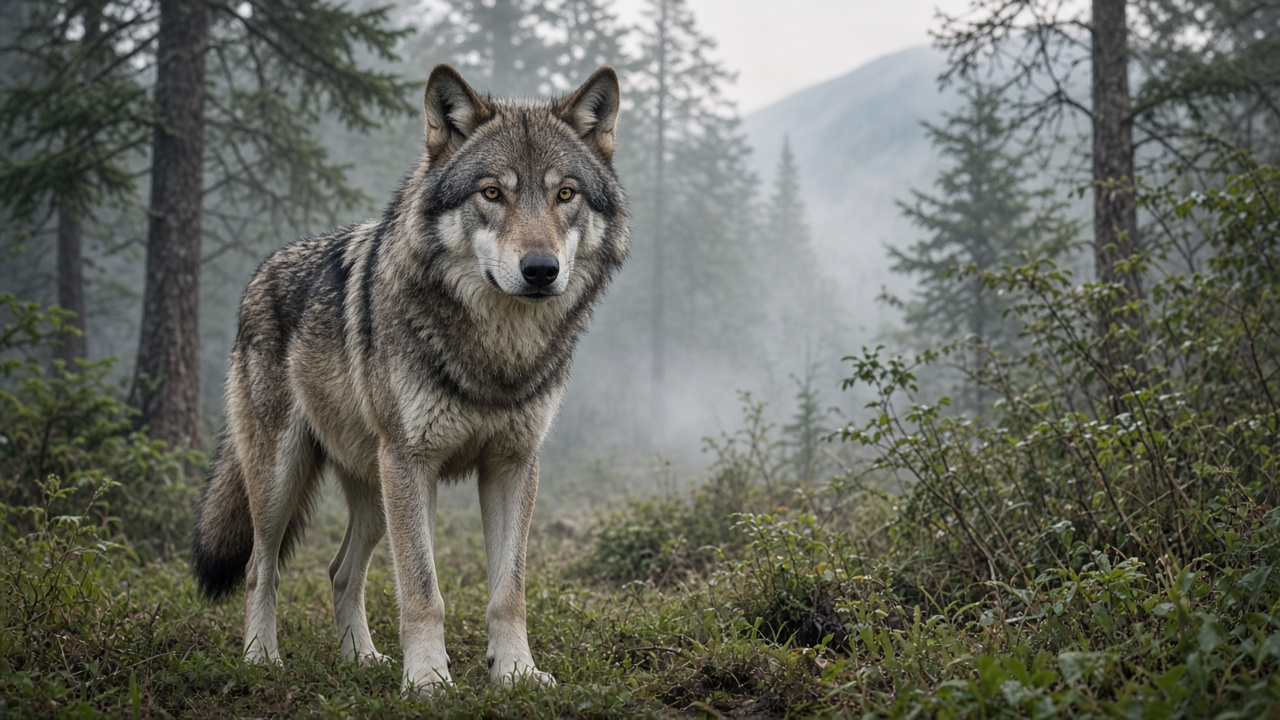
Gray Wolf
Canis lupusGray Wolf (Canis lupus): coexistence sheet across its documented range — presence, biology and prudence, without an invented hunting status.
Seen in: Austria · Belgium · Bulgaria · Canada · Croatia
Overview
Gray Wolf (Canis lupus) is a coexistence sheet across its documented range: presence, biology and prudence — not a hunting status claim.
Classification: order Carnivora, family Canidae, genus Canis. Common names: Gray Wolf in English, Loup gris in French, Lobo gris in Spanish.
Identification
The largest of about 41 wild canid species, the grey wolf varies in size with locality, southern populations generally being smaller than northern ones. Total length, from nose to tail tip, is 100 to 130 cm in males and 87 to 117 cm in females, including a tail of 35 to 52 cm; shoulder height is 60 to 90 cm. Males weigh 30 to 80 kg, 55 kg on average, and females 23 to 55 kg, 45 kg on average. Backed by dense underfur, the coat ranges from pure white in the Arctic through mixtures of white, grey, brown, cinnamon and black to nearly uniform black.
A carnivore, it hunts alone or in packs, steals kills from other predators or scavenges carrion. Packs take large ungulates such as moose, bison and reindeer, while lone wolves catch smaller prey – beavers, rabbits and other small mammals. A wolf can eat up to 9 kg of meat at one meal. Packs hold 2 to 36 animals, most often 5 to 9, and only the dominant pair breeds, between January and April. After 60 to 63 days of gestation, 6 or 7 pups are born on average; the whole pack feeds them regurgitated food until they are 45 days old.
Habitats and range
MDD describes a range spanning the northern hemisphere: North America south to Oaxaca in Mexico, around 20° N, plus Europe and Asia, including the Arabian Peninsula but excluding Indochina and southern India. It has been extirpated from most of the continental United States, Europe, south-eastern China and Indochina; MDD’s country list includes France, Spain, Portugal, Italy and Germany among others. ADW calls it one of the most wide-ranging land animals, living in Arctic tundra, forest, prairie and arid landscapes.
The countries where the species’ presence is established are shown in the tags on this sheet.
Field signs
Howling lets pack members locate one another, assemble for hunts and tell neighbouring packs where territory boundaries lie; territories cover 130 to 13,000 km², and scent marking is mostly done by the dominant male. Wolves travel mainly at night, covering up to 200 km a day at a usual pace of 8 km/h. The den is often dug with an entrance that slopes down and then up again to avoid flooding, or set under cliffs, fallen trees or in caves.
Conservation
For conservation status of Canis lupus, consult the current IUCN assessment, then cross with French monitoring programmes when they exist (OFB portal and related publications). Never turn a global IUCN category into a departmental hunting rule. GBIF occurrences help situate documented distribution but remain effort-biased.
The IUCN lists it as Least Concern. ADW names habitat destruction and human persecution as the main causes of decline: in western Eurasia it was reduced to isolated remnants in countries such as Poland, Scandinavia, Russia, Portugal, Spain and Italy, and it was exterminated from the British Isles in the 1700s. MDD notes that the species formerly included C. lycaon and C. rufus, that the Himalayan form chanco may be a distinct species, and that the wolf is the wild form of the domestic dog.
Limits
This sheet on the Gray Wolf covers presence and biology. A species being present in a country does not mean it may be hunted, and no season or quota is published here.
Local densities and management plans are not covered here: they are a matter for the managers of each area.
Sources
Sources consulted for this sheet:
- IUCN Red List — species search (consulted 2026-11-01)
- ASM Mammal Diversity Database — Canis lupus (consulted 2026-11-01)
- GBIF — species search (consulted 2026-11-01)
- Animal Diversity Web — Canis lupus (gray wolf) (consulted 2026-11-05)
Conclusion
In short: use the scientific name Canis lupus to cross-check sources, confirm taxonomy and conservation status on the institutional portals listed above, and relate every field sign to the habitat where it was actually found.
Identification
Canis lupus
Gray Wolf · preferred
Loup gris · preferred
Lobo gris · preferred
Wolf
Timber Wolf
Tundra Wolf
Arctic Wolf
Classification
Class : Mammalia
Order : Carnivora
Family : Canidae
Genus : Canis
Conservation
IUCN : LC
CITES : —
iucn · LC (global)
Habitat
Frequently asked questions
How do I recognise Gray Wolf?
Use Canis lupus as the scientific anchor. The largest of about 41 wild canid species, the grey wolf varies in size with locality, southern populations generally being smaller than northern ones. Total length, from nose to tail tip, is 100 to 130 cm in males and 87 to 117 cm in females, including a tail of 35 to 52 cm; sh...
Where does Gray Wolf typically live?
MDD describes a range spanning the northern hemisphere: North America south to Oaxaca in Mexico, around 20° N, plus Europe and Asia, including the Arabian Peninsula but excluding Indochina and southern India. It has been extirpated from most of the continental United States, Europe, south-eastern China and Indochina; MDD’s country list includes France, Spain...
What field signs help confirm Gray Wolf?
Howling lets pack members locate one another, assemble for hunts and tell neighbouring packs where territory boundaries lie; territories cover 130 to 13,000 km², and scent marking is mostly done by the dominant male. Wolves travel mainly at night, covering up to 200 km a day at a usual pace of 8 km/h. The den is often dug with an entrance that slopes down an...