Sika Deer
Cervus nipponSika Deer (Cervus nippon): biology, habitats and field signs across its documented range, hunting-context reading.
Seen in: Austria · Czechia · Denmark · France · Germany
Overview
Sika Deer (Cervus nippon) is presented here in a hunting-context reading across its documented range: biology, habitats and field signs useful to observers — without publishing season, quota or authorisation.
Classification: order Artiodactyla, family Cervidae, genus Cervus. Common names: Sika Deer in English, Cerf sika in French, Ciervo sika in Spanish.
Identification
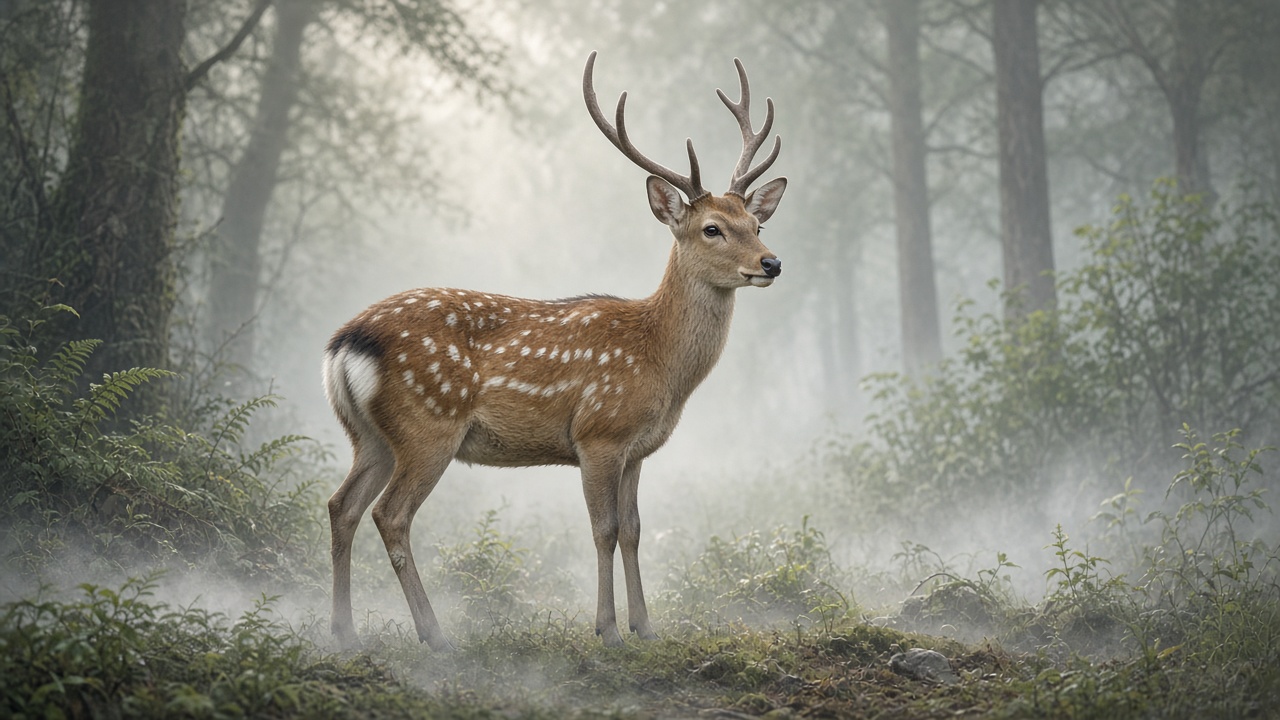
The sika deer is a small to medium-sized deer: 95 to 180 cm in head and body, 64 to 109 cm at the shoulder, with a tail of 7.5 to 13 cm. The coat, from chestnut brown to reddish olive depending on subspecies, is dotted with white spots in seven or eight rows along the upper back; a darker dorsal line runs to a large, erectile white rump patch. Both sexes have a shaggy neck mane that darkens in winter. Only males, on average 9% larger, carry narrow, upright antlers with 2 to 5 tines.
Highly adaptable, it grazes or browses depending on conditions: marsh grasses, fallen leaves, shrubs, herbs, fungi, bamboo, ferns, soybeans and corn. Mostly nocturnal and not very gregarious, adult males are solitary for most of the year. The rut takes place in September and October; a male may gather up to 12 females on his territory and lose 20 to 30% of his body weight. After about 30 weeks of gestation a single calf is born in May or June. Tigers and wolves are among its natural predators.
Habitats and range
Its native range covers the Russian Far East, China, Korea, Japan, Taiwan and Vietnam; MDD considers wild populations in China now very localised. It was introduced in the 19th and 20th centuries to the British Isles, mainland Europe (including France), New Zealand and the United States. Mainly a forest deer, it prefers woodland with a dense understorey but adapts to marshes and grassland, from sea level to 1,800 m, with seasonal altitudinal movements of up to 700 m.
The countries where the species’ presence is established are shown in the tags on this sheet.
Field signs
A very vocal deer with about ten calls: soft whistles between hinds, piercing screams from males and an alarm call described as a high-pitched whistle followed by a guttural bark. Males mark their territory by digging pits up to 1.6 m wide and 0.3 m deep with antlers and forelegs, then urinating in them, and by thrashing vegetation with their antlers. A fleeing animal shows its erectile white rump patch.
Conservation
For conservation status of Cervus nippon, consult the current IUCN assessment and cross with national monitoring programmes in countries of documented presence. Never turn a global IUCN category into a local hunting rule. GBIF occurrences help situate distribution but remain effort-biased.
The IUCN lists it as Least Concern, but ADW describes several Asian subspecies (Taiwan, Ryukyu Islands, northern and east-central China, south-eastern Siberia) as endangered, through overexploitation for meat and trade and the conversion of forest to farmland. Hybridisation with red deer has been reported. MDD includes in the species several forms separated by Groves and Grubb (2011), among them taiouanus and hortulorum.
Limits
This sheet on the Sika Deer publishes no season, quota, hunting method or fee: those rules differ between countries and territories and must be checked in official texts. Being described here does not mean a species may be hunted.
Local densities and management plans are not covered here: they are a matter for the managers of each area.
Sources
Sources consulted for this sheet:
- IUCN Red List — species search (consulted 2026-11-02)
- ASM Mammal Diversity Database — Cervus nippon (consulted 2026-11-02)
- GBIF — species search (consulted 2026-11-02)
- Animal Diversity Web — Cervus nippon (sika deer) (consulted 2026-11-04)
Conclusion
In short: use the scientific name Cervus nippon to cross-check sources, confirm taxonomy and conservation status on the institutional portals listed above, and relate every field sign to the habitat where it was actually found.
Identification
Cervus nippon
Cerf sika · preferred
Ciervo sika · preferred
Sika Deer · preferred
Spotted Deer
Japanese Deer
Classification
Class : Mammalia
Order : Artiodactyla
Family : Cervidae
Genus : Cervus
Conservation
IUCN : LC
CITES : —
iucn · LC (global)
Habitat
Frequently asked questions
How do I recognise Sika Deer?
Use Cervus nippon as the scientific anchor. The sika deer is a small to medium-sized deer: 95 to 180 cm in head and body, 64 to 109 cm at the shoulder, with a tail of 7.5 to 13 cm. The coat, from chestnut brown to reddish olive depending on subspecies, is dotted with white spots in seven or eight rows along the upper back;...
Where does Sika Deer typically live?
Its native range covers the Russian Far East, China, Korea, Japan, Taiwan and Vietnam; MDD considers wild populations in China now very localised. It was introduced in the 19th and 20th centuries to the British Isles, mainland Europe (including France), New Zealand and the United States. Mainly a forest deer, it prefers woodland with a dense understorey but...
What field signs help confirm Sika Deer?
A very vocal deer with about ten calls: soft whistles between hinds, piercing screams from males and an alarm call described as a high-pitched whistle followed by a guttural bark. Males mark their territory by digging pits up to 1.6 m wide and 0.3 m deep with antlers and forelegs, then urinating in them, and by thrashing vegetation with their antlers. A flee...