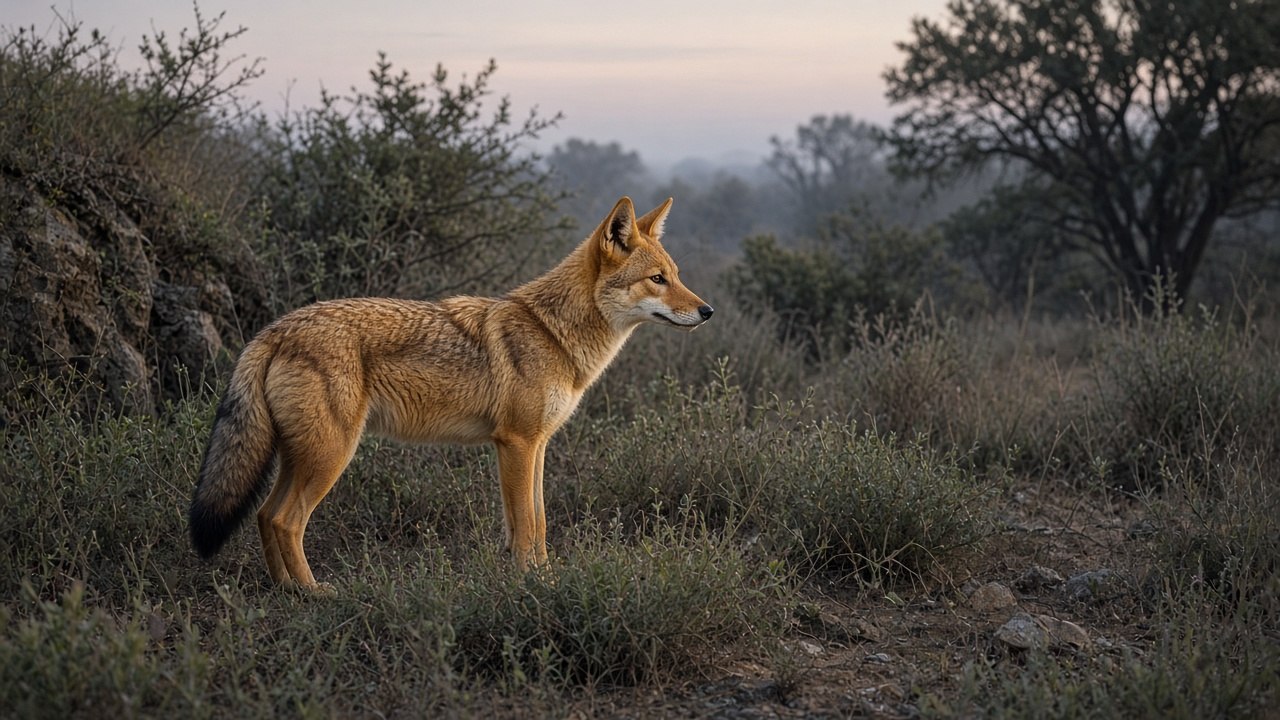
Golden Jackal
Canis aureusGolden Jackal (Canis aureus): coexistence sheet across its documented range — presence, biology and prudence, without an invented hunting status.
Seen in: Austria · Bulgaria · Croatia · Denmark · Estonia
Overview
Golden Jackal (Canis aureus) is a coexistence sheet across its documented range: presence, biology and prudence — not a hunting status claim.
Classification: order Carnivora, family Canidae, genus Canis. Common names: Golden Jackal in English, Chacal doré in French, Chacal dorado in Spanish.
Identification
A medium-sized canid, the golden jackal is 70 to 85 cm long, plus a tail of about 25 cm, stands about 40 cm at the shoulder and weighs 8 to 10 kg. Its coarse, fairly short fur is usually yellow to pale gold with brown tips, but the shade varies with season and region. Its behaviour recalls that of domestic dogs and wolves: males raise a hind leg to spray urine, while females squat.
An opportunistic omnivore, about 54% of its diet is animal food and 46% plant matter: rodents (especially in winter), hares, ground-nesting birds and their eggs, reptiles, frogs, fish, insects, fruit and occasionally carrion. Strictly monogamous, it lives in pairs, often with one or two “helpers”, non-breeding young adults that help raise the next litter. After 60 to 63 days of gestation, 1 to 9 pups are born, usually 2 to 4, in a den; in southeastern Europe births mainly occur in April–May. Weaned at about eight weeks, the young mature at eleven months.
Habitats and range
It is the most northerly and most widely distributed of the jackals. MDD lists it across Europe, from the southeast and the Balkans to France, Spain and Scandinavia, through the Middle East and Central Asia to the Indian subcontinent and on to Thailand, Laos and Vietnam; its range appears to be expanding northward, with records as far as Finland and Norway. It prefers dry open country – arid short grasslands, steppe, savanna – but also uses scrub and forest. It shelters in burrows it digs itself, in rock crevices or in burrows dug by other animals.
The countries where the species’ presence is established are shown in the tags on this sheet.
Field signs
Near human settlements it is strictly nocturnal, though it may be partly diurnal elsewhere. Pair members travel and rest together in highly synchronised fashion. Its wide range of howls, often given in chorus by the pair, betrays its presence. It marks its territory with urine, mainly in the breeding season, and sometimes buries pieces of meat in a trench dug with the forepaws and closed with the ridge of the nose.
Conservation
For conservation status of Canis aureus, consult the current IUCN assessment, then cross with French monitoring programmes when they exist (OFB portal and related publications). Never turn a global IUCN category into a departmental hunting rule. GBIF occurrences help situate documented distribution but remain effort-biased.
The IUCN lists it as Least Concern: it is widespread and not threatened. According to MDD, the species previously included Canis lupaster, now recognised as distinct, and its northward spread in Europe is documented by recent records in Finland. It may raid crops such as corn, sugarcane and watermelon, attack sheep, and may be involved in spreading rabies.
Limits
This sheet on the Golden Jackal covers presence and biology. A species being present in a country does not mean it may be hunted, and no season or quota is published here.
Local densities and management plans are not covered here: they are a matter for the managers of each area. The species has expanded recently in Europe; its distribution in France still needs confirming (OFB, GBIF) before any claim about density.
Sources
Sources consulted for this sheet:
- IUCN Red List — species search (consulted 2026-11-01)
- ASM Mammal Diversity Database — Canis aureus (consulted 2026-11-01)
- GBIF — species search (consulted 2026-11-01)
- Animal Diversity Web — Canis aureus (golden jackal) (consulted 2026-11-04)
Conclusion
In short: use the scientific name Canis aureus to cross-check sources, confirm taxonomy and conservation status on the institutional portals listed above, and relate every field sign to the habitat where it was actually found.
Identification
Canis aureus
Golden Jackal · preferred
Chacal doré · preferred
Chacal dorado · preferred
Asiatic Jackal
Common Jackal
Classification
Class : Mammalia
Order : Carnivora
Family : Canidae
Genus : Canis
Conservation
IUCN : LC
CITES : —
iucn · LC (global)
Habitat
Frequently asked questions
How do I recognise Golden Jackal?
Use Canis aureus as the scientific anchor. A medium-sized canid, the golden jackal is 70 to 85 cm long, plus a tail of about 25 cm, stands about 40 cm at the shoulder and weighs 8 to 10 kg. Its coarse, fairly short fur is usually yellow to pale gold with brown tips, but the shade varies with season and region. Its behavio...
Where does Golden Jackal typically live?
It is the most northerly and most widely distributed of the jackals. MDD lists it across Europe, from the southeast and the Balkans to France, Spain and Scandinavia, through the Middle East and Central Asia to the Indian subcontinent and on to Thailand, Laos and Vietnam; its range appears to be expanding northward, with records as far as Finland and Norway....
What field signs help confirm Golden Jackal?
Near human settlements it is strictly nocturnal, though it may be partly diurnal elsewhere. Pair members travel and rest together in highly synchronised fashion. Its wide range of howls, often given in chorus by the pair, betrays its presence. It marks its territory with urine, mainly in the breeding season, and sometimes buries pieces of meat in a trench du...