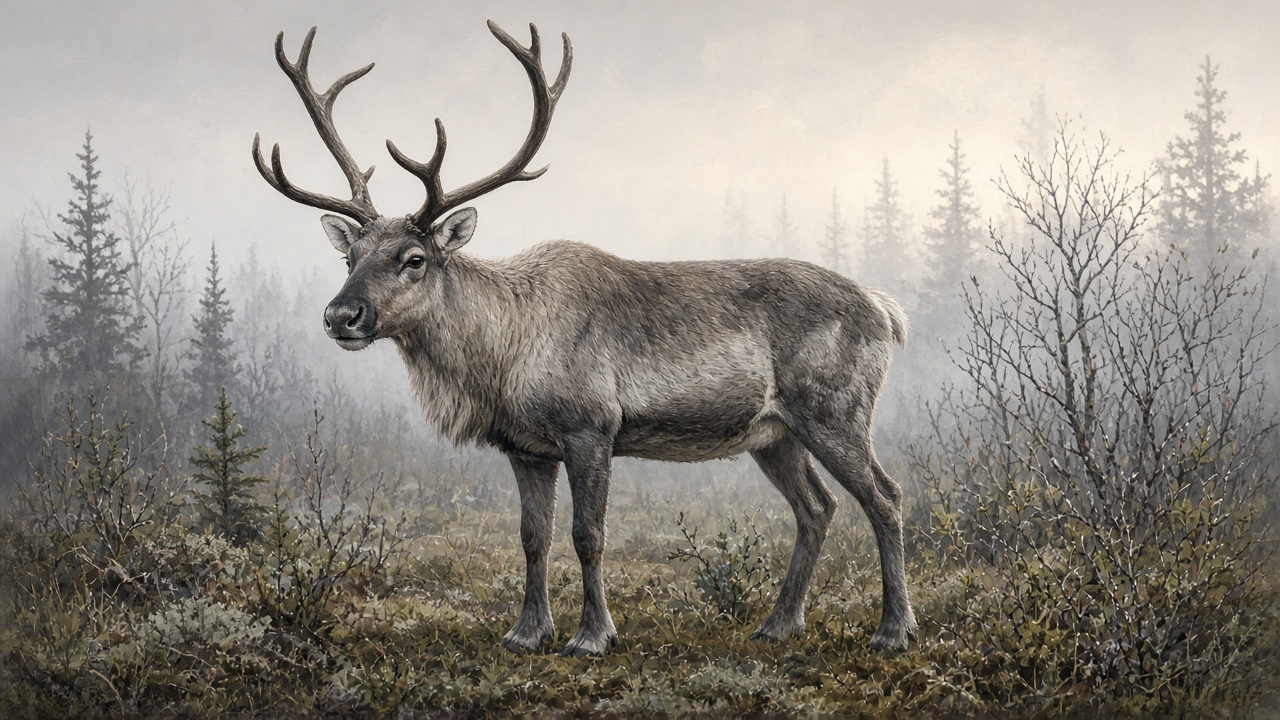
Caribou
Rangifer tarandusCaribou (Rangifer tarandus): biology, habitats and field signs across its documented range, hunting-context reading.
Seen in: Canada · Finland · Iceland · Norway · Sweden
Overview
Caribou (Rangifer tarandus) is presented here in a hunting-context reading across its documented range: biology, habitats and field signs useful to observers — without publishing season, quota or authorisation.
Classification: order Artiodactyla, family Cervidae, genus Rangifer. Common names: Caribou in English, Renne in French, Reno in Spanish.
Identification
Caribou, or reindeer, vary greatly in size between subspecies, the more southerly ones being larger: up to 120 cm at the shoulder, 150 to 230 cm long and 55 to 318 kg; in some subspecies males weigh twice as much as females. The tail is short. The coat of hollow, tapering hairs insulates and adds buoyancy, ranging from the very dark brown of woodland bulls in summer to nearly white in Greenland and the High Arctic, often with white on the belly, neck and above the hooves, which are large and concave. It is the only deer in which both sexes carry antlers, large and complex in mature bulls.
During the rut in October and early November, bulls fight and control groups of 5 to 15 cows, and stop eating. A single calf of 3 to 12 kg is born in May or June about 228 days later; it follows its mother within an hour. In summer caribou graze willow and birch leaves, mushrooms, cotton grass and sedges; lichens matter most in winter. Gregarious and diurnal, they form summer groups of tens of thousands. Wolves, grizzly bears and black bears are their predators, especially of calves in their first week.
Habitats and range
Circumboreal, it lives in Arctic tundra and boreal forest in Svalbard, Norway, Finland, Russia, Alaska, Canada including most Arctic islands, and Greenland, south to northern Mongolia, Sakhalin and the northern United States (northern Idaho and the Great Lakes region). Woodland caribou reach as far south as 46° N, while other subspecies reach 80° N. Most caribou spend the winter in forest, where snow conditions are more favourable.
The countries where the species’ presence is established are shown in the tags on this sheet.
Field signs
As it walks it makes an audible clicking sound, produced by tendons sliding over a bone in the foot. In winter it digs craters in the snow with its front hooves to reach food it locates by smell; dominant animals often take over craters dug by subordinates. Spring and autumn migrations of more than 5,000 km a year, and large summer gatherings that bring relief from mosquitoes and warble and nose bot flies, are characteristic.
Conservation
For conservation status of Rangifer tarandus, consult the current IUCN assessment and cross with national monitoring programmes in countries of documented presence. Never turn a global IUCN category into a local hunting rule. GBIF occurrences help situate distribution but remain effort-biased.
MDD gives its IUCN status as Vulnerable. ADW cites overhunting and habitat loss: the species has been gone from most of Europe since at least the 1600s, woodland caribou are endangered in the United States (the Selkirk herd numbers around 30) and oil and mineral exploration threatens their habitat in Canada. Harding (2022) proposed splitting the species into six, which MDD tentatively does not follow.
Limits
This sheet on the Caribou publishes no season, quota, hunting method or fee: those rules differ between countries and territories and must be checked in official texts. Being described here does not mean a species may be hunted.
Local densities and management plans are not covered here: they are a matter for the managers of each area.
Sources
Sources consulted for this sheet:
- IUCN Red List — species search (consulted 2026-11-02)
- ASM Mammal Diversity Database — Rangifer tarandus (consulted 2026-11-02)
- GBIF — species search (consulted 2026-11-02)
- Animal Diversity Web — Rangifer tarandus (caribou, reindeer) (consulted 2026-11-04)
Conclusion
In short: use the scientific name Rangifer tarandus to cross-check sources, confirm taxonomy and conservation status on the institutional portals listed above, and relate every field sign to the habitat where it was actually found.
Identification
Rangifer tarandus
Caribou · preferred
Renne · preferred
Reno · preferred
Reindeer
Classification
Class : Mammalia
Order : Artiodactyla
Family : Cervidae
Genus : Rangifer
Conservation
IUCN : VU
CITES : —
iucn · VU (global)
Habitat
Frequently asked questions
How do I recognise Caribou?
Use Rangifer tarandus as the scientific anchor. Caribou, or reindeer, vary greatly in size between subspecies, the more southerly ones being larger: up to 120 cm at the shoulder, 150 to 230 cm long and 55 to 318 kg; in some subspecies males weigh twice as much as females. The tail is short. The coat of hollow, tapering hairs i...
Where does Caribou typically live?
Circumboreal, it lives in Arctic tundra and boreal forest in Svalbard, Norway, Finland, Russia, Alaska, Canada including most Arctic islands, and Greenland, south to northern Mongolia, Sakhalin and the northern United States (northern Idaho and the Great Lakes region). Woodland caribou reach as far south as 46° N, while other subspecies reach 80° N. Most car...
What field signs help confirm Caribou?
As it walks it makes an audible clicking sound, produced by tendons sliding over a bone in the foot. In winter it digs craters in the snow with its front hooves to reach food it locates by smell; dominant animals often take over craters dug by subordinates. Spring and autumn migrations of more than 5,000 km a year, and large summer gatherings that bring reli...