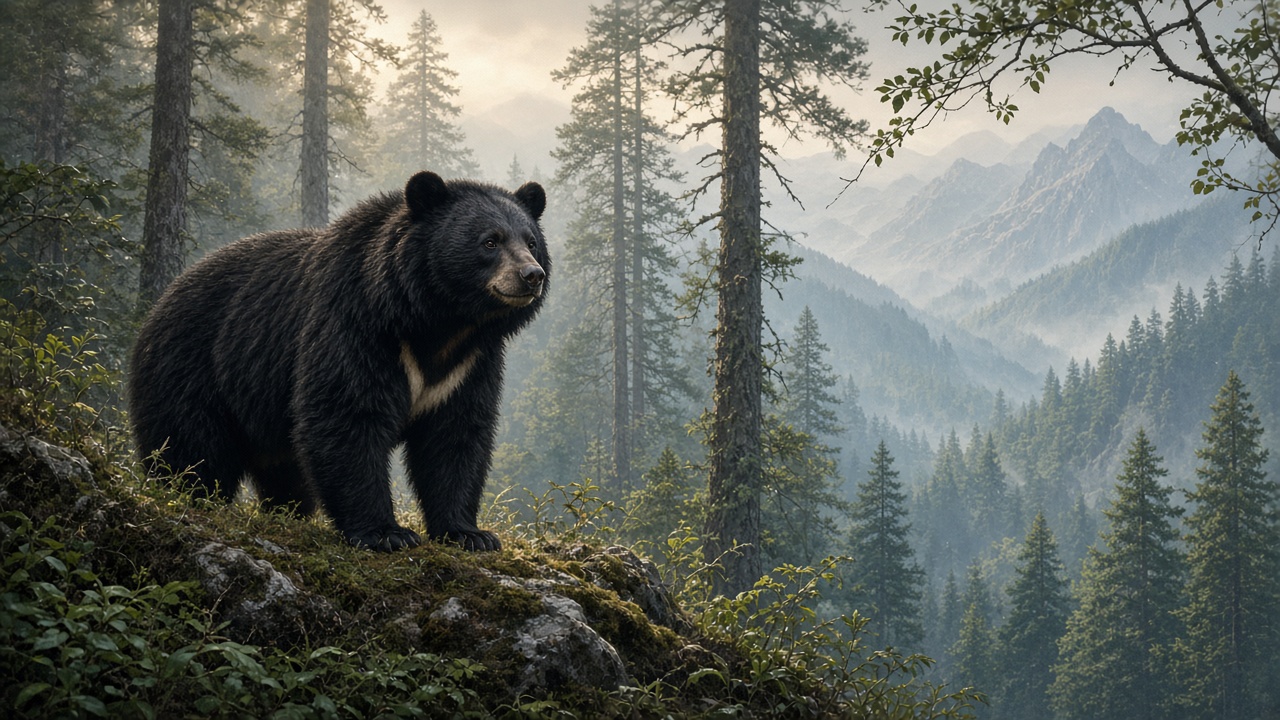
Asian Black Bear (Ursus thibetanus): coexistence sheet across its documented range — presence, biology and prudence, without an invented hunting status.
Seen in: Japan
Overview
Asian Black Bear (Ursus thibetanus) is a coexistence sheet across its documented range: presence, biology and prudence — not a hunting status claim.
Classification: order Carnivora, family Ursidae, genus Ursus. Common names: Asian Black Bear in English, Ours à collier in French, Oso negro asiático in Spanish.
Identification
The Asian black bear is a medium-sized, heavy-bodied bear with thick, strong legs and broad paws; it walks on the whole sole of the foot. Males usually weigh 110 to 150 kg and females 65 to 90 kg, with a head-and-body length of 120 to 180 cm. The head is large and rounded, the eyes small and the ears large and set farther apart than in the American black bear. The long, coarse black coat almost hides the tail (6.5 to 10.6 cm) and carries a light beige to white “V” on the chest, a small pale crescent across the throat and a white spot on the chin.
An omnivore that eats mostly plants, it takes fruit, roots and tubers, small invertebrates and vertebrates, and carrion; in autumn, nuts from Fagaceae trees (acorns, beechnuts) dominate. Its sense of smell lets it locate grubs up to about 1 m underground. It forages by day and by night, with more night activity in autumn, and often spends the day in a tree hollow or a cave. Many individuals hibernate. Mating takes place from June to October depending on the population; after 7 to 8 months of gestation, usually two cubs are born, and they stay with their mother for 2 to 3 years. The Siberian tiger is its main predator.
Habitats and range
According to MDD, its range covers Iran, Afghanistan and Pakistan, the Himalaya (India, Nepal, Bhutan), Bangladesh, Myanmar, Thailand and Indochina, China and Taiwan, both Koreas, Japan and south-eastern Primorsky Krai in Russia. It lives in moist forests, on steep mountain slopes and in dense vegetation, from sea level to 3,600 m (1,000 m on average). It moves higher in summer and comes down in winter; in early autumn it shifts to lower broadleaf forests rich in nuts, and sometimes leaves the forest to forage on plains.
The countries where the species’ presence is established are shown in the tags on this sheet.
Field signs
A skilled climber thanks to its short claws (about 5 cm), it leaves marks on trees: bark stripped when food is scarce, and rubbing, urine and droppings left as scent marks for other bears. Raided crops, mostly at night, and attacked livestock also reveal its presence. A bear giving low guttural sounds is apprehensive; clicking the teeth signals aggression, and in a fight it rears up on its hind legs.
Conservation
For conservation status of Ursus thibetanus, consult the current IUCN assessment and cross with national monitoring programmes in countries of documented presence. Never turn a global IUCN category into a local hunting rule. GBIF occurrences help situate distribution but remain effort-biased.
The IUCN lists it as Vulnerable. ADW points to deforestation and uncontrolled harvesting of its habitat, which increasingly isolate populations: in Japan, studies in 2001 found genetic differentiation between neighbouring populations and declining genetic diversity. Its bile and gallbladder are harvested for traditional medicine in several Asian countries, and bears that raid livestock or crops are often killed.
Limits
This sheet on the Asian Black Bear covers presence and biology. A species being present in a country does not mean it may be hunted, and no season or quota is published here.
Local densities and management plans are not covered here: they are a matter for the managers of each area.
Sources
Sources consulted for this sheet:
- IUCN Red List — species search (consulted 2026-11-02)
- ASM Mammal Diversity Database — Ursus thibetanus (consulted 2026-11-02)
- GBIF — species search (consulted 2026-11-02)
- Animal Diversity Web — Ursus thibetanus (Asiatic black bear) (consulted 2026-11-04)
Conclusion
In short: use the scientific name Ursus thibetanus to cross-check sources, confirm taxonomy and conservation status on the institutional portals listed above, and relate every field sign to the habitat where it was actually found.
Identification
Ursus thibetanus
Ours à collier · preferred
Oso negro asiático · preferred
Asian Black Bear · preferred
Himalayan Black Bear
Moon Bear
White-breasted Bear
Classification
Class : Mammalia
Order : Carnivora
Family : Ursidae
Genus : Ursus
Conservation
IUCN : VU
CITES : —
iucn · VU (global)
Habitat
Frequently asked questions
How do I recognise Asian Black Bear?
Use Ursus thibetanus as the scientific anchor. The Asian black bear is a medium-sized, heavy-bodied bear with thick, strong legs and broad paws; it walks on the whole sole of the foot. Males usually weigh 110 to 150 kg and females 65 to 90 kg, with a head-and-body length of 120 to 180 cm. The head is large and rounded, the ey...
Where does Asian Black Bear typically live?
According to MDD, its range covers Iran, Afghanistan and Pakistan, the Himalaya (India, Nepal, Bhutan), Bangladesh, Myanmar, Thailand and Indochina, China and Taiwan, both Koreas, Japan and south-eastern Primorsky Krai in Russia. It lives in moist forests, on steep mountain slopes and in dense vegetation, from sea level to 3,600 m (1,000 m on average). It mo...
What field signs help confirm Asian Black Bear?
A skilled climber thanks to its short claws (about 5 cm), it leaves marks on trees: bark stripped when food is scarce, and rubbing, urine and droppings left as scent marks for other bears. Raided crops, mostly at night, and attacked livestock also reveal its presence. A bear giving low guttural sounds is apprehensive; clicking the teeth signals aggression, a...