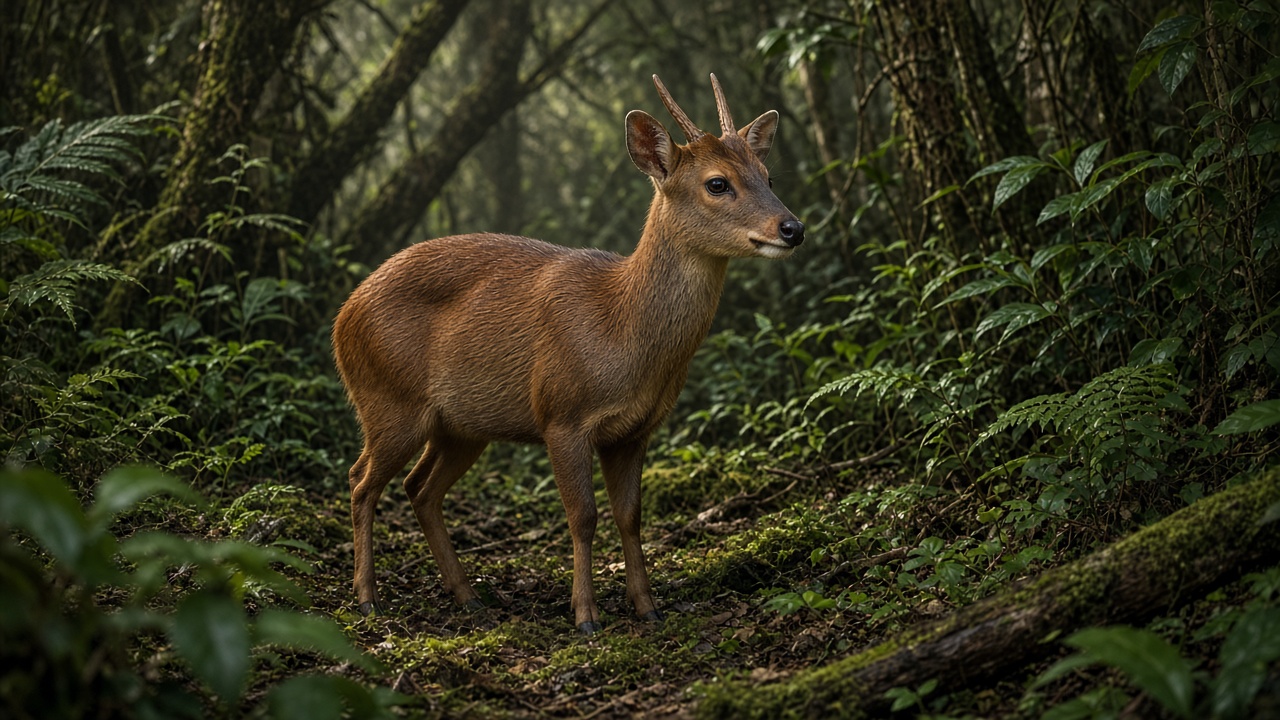
Southern Pudu (Pudu puda): biology, habitats and field signs across its documented range, hunting-context reading.
Seen in: Chile
Overview
Southern Pudu (Pudu puda) is presented here in a hunting-context reading across its documented range: biology, habitats and field signs useful to observers — without publishing season, quota or authorisation.
Classification: order Artiodactyla, family Cervidae, genus Pudu. Common names: Southern Pudu in English, Pudu du Sud in French, Pudú del sur in Spanish.
Identification
The second-smallest deer in the world: 35 to 45 cm at the shoulder, no more than 85 cm long and 6.5 to 13.5 kg, females weighing about 1 kg less than males. Stocky and short-legged, it has a rump that is not raised, a short snout, unpointed ears and a hidden tail of 3 to 4 cm. The stiff, sparse coat is dark reddish brown, with red markings on the ears and chin. Males carry tiny antlers of 6 to 9 cm. The northern pudu is smaller, with dark brown to black face and legs and no visible preorbital glands.
A highly selective browser, it eats leaves of ferns, trees, vines, herbs and shrubs, and stands on its hind legs or on fallen logs to reach food. Active by day and night, it rests at midday. Mating takes place from April to June; after about seven months a fawn, sometimes twins, is born, mostly between November and January, and keeps its spots until eight weeks. Pumas are its main predator; foxes, kodkods, eagle owls and domestic dogs also take it.
Habitats and range
Endemic to southern Chile and south-western Argentina, between the Maule River in the north and Chiloé Province in the south, it is more common on Chiloé Island than on the mainland. It lives in temperate evergreen rainforest, deciduous forest and above all second-growth forest with a dense understorey (quila, colihue, maqui, chilco), often near water. Heat-intolerant, it generally stays below 1,700 m and may move down to valleys in winter.
The countries where the species’ presence is established are shown in the tags on this sheet.
Field signs
Solitary, secretive and sedentary, it moves along a network of trails and tunnels that it keeps open in the understorey, and browses mostly at forest edges or in clearings. It marks objects by rubbing its large preorbital glands on them, rubs its antlers and scrapes its teeth on trees. It is more active on windy days; when chased, it hides in small tunnels or burrows.
Conservation
For conservation status of Pudu puda, consult the current IUCN assessment and cross with national monitoring programmes in countries of documented presence. Never turn a global IUCN category into a local hunting rule. GBIF occurrences help situate distribution but remain effort-biased.
MDD gives its IUCN status as Near Threatened; ADW cites an earlier Vulnerable assessment and CITES Appendix I. Numbers, estimated in the thousands, are falling because of domestic dogs (attacks and disease), road collisions, habitat loss, parasites and taking for meat and fur. Chital, introduced to Argentina in 1906, compete with it, and introduced red deer damage its forests. Captive breeding programmes exist in Chile.
Limits
This sheet on the Southern Pudu publishes no season, quota, hunting method or fee: those rules differ between countries and territories and must be checked in official texts. Being described here does not mean a species may be hunted.
Local densities and management plans are not covered here: they are a matter for the managers of each area.
Sources
Sources consulted for this sheet:
- IUCN Red List — species search (consulted 2026-11-02)
- ASM Mammal Diversity Database — Pudu puda (consulted 2026-11-02)
- GBIF — species search (consulted 2026-11-02)
- Animal Diversity Web — Pudu puda (southern pudu) (consulted 2026-11-04)
Conclusion
In short: use the scientific name Pudu puda to cross-check sources, confirm taxonomy and conservation status on the institutional portals listed above, and relate every field sign to the habitat where it was actually found.
Identification
Pudu puda
Southern Pudu · preferred
Pudu du Sud · preferred
Pudú del sur · preferred
Chilean Pudu
Classification
Class : Mammalia
Order : Artiodactyla
Family : Cervidae
Genus : Pudu
Conservation
IUCN : NT
CITES : —
iucn · NT (global)
Habitat
Frequently asked questions
How do I recognise Southern Pudu?
Use Pudu puda as the scientific anchor. The second-smallest deer in the world: 35 to 45 cm at the shoulder, no more than 85 cm long and 6.5 to 13.5 kg, females weighing about 1 kg less than males. Stocky and short-legged, it has a rump that is not raised, a short snout, unpointed ears and a hidden tail of 3 to 4 cm. Th...
Where does Southern Pudu typically live?
Endemic to southern Chile and south-western Argentina, between the Maule River in the north and Chiloé Province in the south, it is more common on Chiloé Island than on the mainland. It lives in temperate evergreen rainforest, deciduous forest and above all second-growth forest with a dense understorey (quila, colihue, maqui, chilco), often near water. Heat-...
What field signs help confirm Southern Pudu?
Solitary, secretive and sedentary, it moves along a network of trails and tunnels that it keeps open in the understorey, and browses mostly at forest edges or in clearings. It marks objects by rubbing its large preorbital glands on them, rubs its antlers and scrapes its teeth on trees. It is more active on windy days; when chased, it hides in small tunnels o...