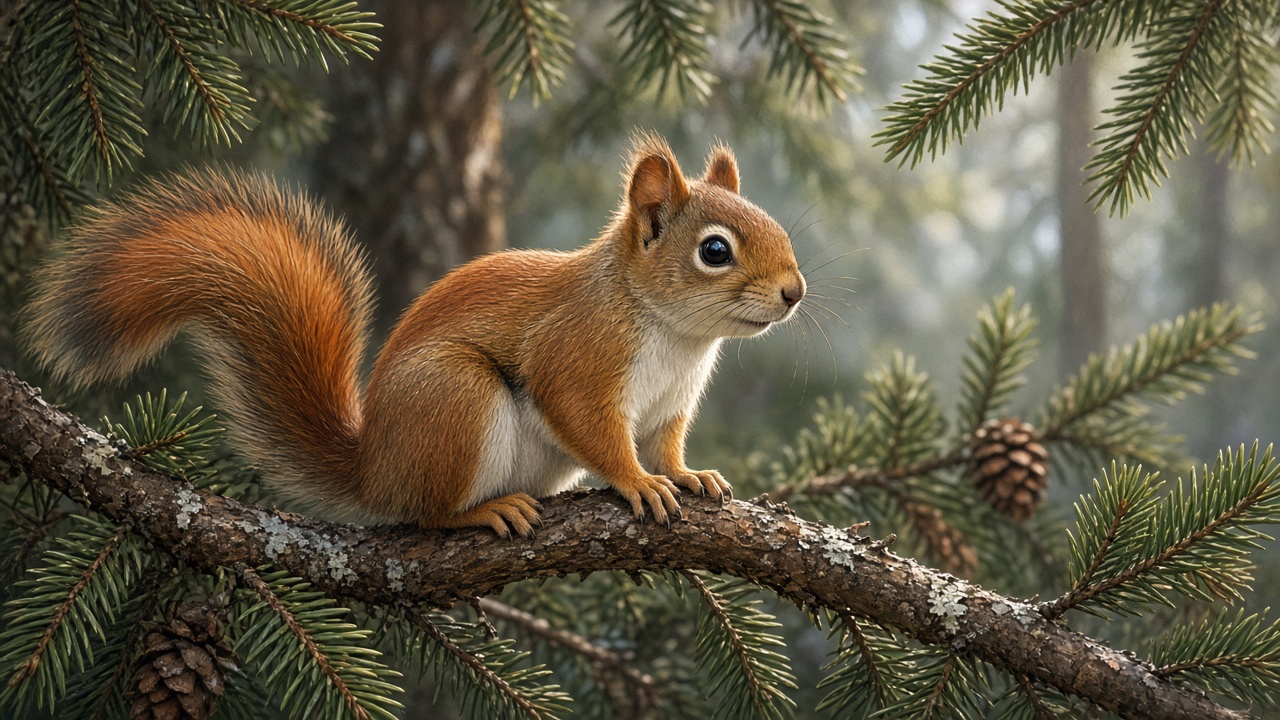
North American Red Squirrel
Tamiasciurus hudsonicusNorth American Red Squirrel (Tamiasciurus hudsonicus): ecology sheet across its documented range — natural history and habitats, without hunting framing.
Seen in: Canada · United States
Overview
North American Red Squirrel (Tamiasciurus hudsonicus) is an ecology sheet across its documented range: natural history and habitats, without any hunting framing.
Classification: order Rodentia, family Sciuridae, genus Tamiasciurus. Common names: North American Red Squirrel in English, Écureuil roux d'Amérique in French, Ardilla roja americana in Spanish.
Identification
A small squirrel, 27 to 38.5 cm in total length including a 9 to 16 cm tail, weighing 200 to 280 g: less than 30% the size of the grey squirrel. The back is reddish and the belly white, separated by a dark line that is clearest in summer. A white eye ring shows year-round and ear tufts grow in winter. The tail, smaller and flatter than in other tree squirrels, has a black band. Where it meets the Douglas squirrel, the latter has a rusty belly and white-tipped tail hairs.
Diurnal, it lives mainly on conifer seeds, especially white spruce, and many kinds of mushrooms, as well as buds, flowers, fruit, sap, bark, insects, bird eggs and young snowshoe hares. In late summer and autumn it harvests cones and piles them in one or a few large central caches. Females are receptive for a single day per season; after about 35 days, 1 to 8 young are born, four on average, and nursed for 70 days. Depending on the region there are one or two litters a year. Goshawks, hawks, great horned owls, martens, fishers and lynx are among its predators.
Habitats and range
MDD gives its range as Alaska and all of Canada south of the tundra, including Vancouver Island, the mountain states of the western United States, and the north-east south to north-western South Carolina. It lives mainly in boreal conifer forest rich in seeds, fungi and interlocking canopies; it also uses mixed and deciduous forest, and suburbs or towns where cool, dense conifers remain.
The countries where the species’ presence is established are shown in the tags on this sheet.
Field signs
Its central midden, a heap of cones kept cool and moist, is the most characteristic sign; where natural cavities are lacking it builds leaf nests 2 to 20 m up, usually within 30 m of the caches. Very vocal, it defends its territory with rattles, screeches, growls and buzzes, especially in autumn. It also strips bark from trees in winter and spring.
Conservation
For conservation status of Tamiasciurus hudsonicus, consult the current IUCN assessment and cross with national monitoring programmes in countries of documented presence. Never turn a global IUCN category into a local hunting rule. GBIF occurrences help situate distribution but remain effort-biased.
The IUCN lists it as Least Concern: widespread and common, with no major threats. The Mount Graham subspecies (grahamensis), restricted to south-eastern Arizona, is however endangered, with about 150 animals according to ADW. MDD notes that the species formerly included Tamiasciurus fremonti, now treated as separate.
Limits
This sheet on the North American Red Squirrel covers biology and ecology only; it publishes no hunting season, quota or authorisation.
Local densities and management plans are not covered here: they are a matter for the managers of each area.
Sources
Sources consulted for this sheet:
- IUCN Red List — species search (consulted 2026-11-02)
- ASM Mammal Diversity Database — Tamiasciurus hudsonicus (consulted 2026-11-02)
- GBIF — species search (consulted 2026-11-02)
- Animal Diversity Web — Tamiasciurus hudsonicus (red squirrel) (consulted 2026-11-04)
Conclusion
In short: use the scientific name Tamiasciurus hudsonicus to cross-check sources, confirm taxonomy and conservation status on the institutional portals listed above, and relate every field sign to the habitat where it was actually found.
Identification
Tamiasciurus hudsonicus
North American Red Squirrel · preferred
Écureuil roux d'Amérique · preferred
Ardilla roja americana · preferred
Pine Squirrel
Classification
Class : Mammalia
Order : Rodentia
Family : Sciuridae
Genus : Tamiasciurus
Conservation
IUCN : LC
CITES : —
iucn · LC (global)
Habitat
Frequently asked questions
How do I recognise North American Red Squirrel?
Use Tamiasciurus hudsonicus as the scientific anchor. A small squirrel, 27 to 38.5 cm in total length including a 9 to 16 cm tail, weighing 200 to 280 g: less than 30% the size of the grey squirrel. The back is reddish and the belly white, separated by a dark line that is clearest in summer. A white eye ring shows year-round and ear...
Where does North American Red Squirrel typically live?
MDD gives its range as Alaska and all of Canada south of the tundra, including Vancouver Island, the mountain states of the western United States, and the north-east south to north-western South Carolina. It lives mainly in boreal conifer forest rich in seeds, fungi and interlocking canopies; it also uses mixed and deciduous forest, and suburbs or towns wher...
What field signs help confirm North American Red Squirrel?
Its central midden, a heap of cones kept cool and moist, is the most characteristic sign; where natural cavities are lacking it builds leaf nests 2 to 20 m up, usually within 30 m of the caches. Very vocal, it defends its territory with rattles, screeches, growls and buzzes, especially in autumn. It also strips bark from trees in winter and spring.