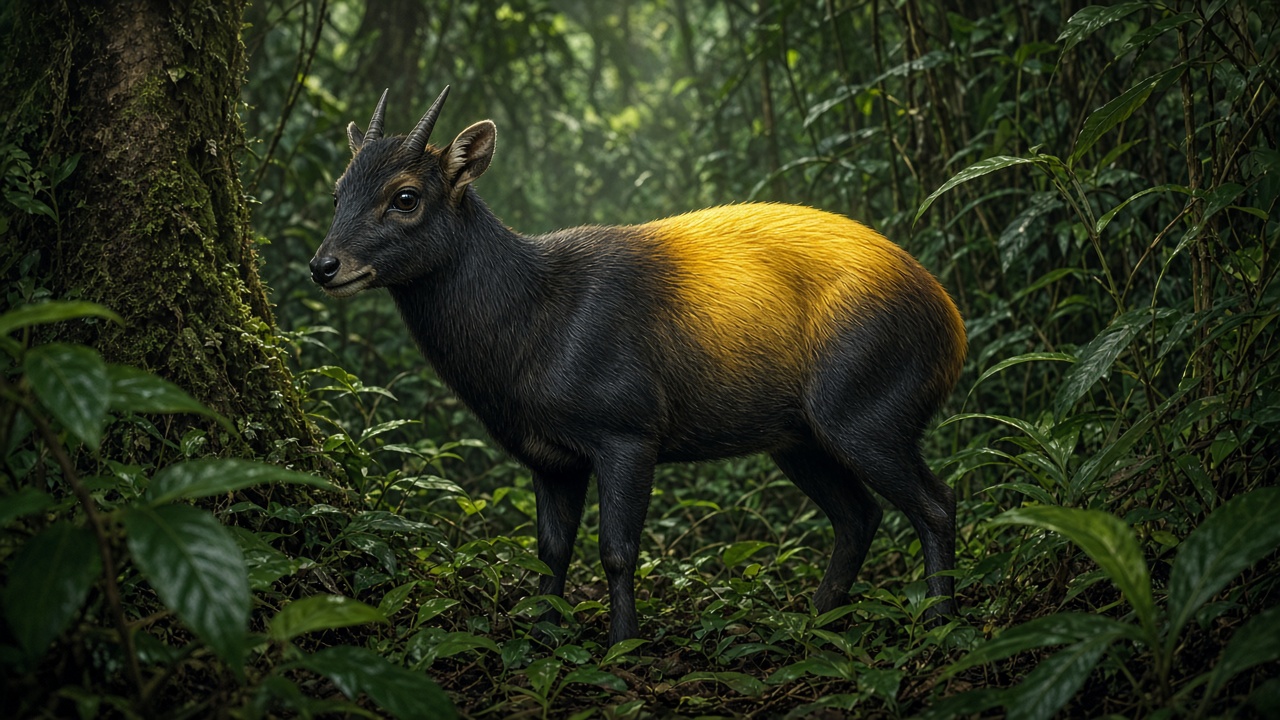
Yellow-backed Duiker
Cephalophus silvicultorNo solid country presence documented yet.
Yellow-backed Duiker (Cephalophus silvicultor): coexistence sheet across its documented range — presence, biology and prudence, without an invented hunting status.
Overview
Yellow-backed Duiker (Cephalophus silvicultor) is a coexistence sheet across its documented range: presence, biology and prudence — not a hunting status claim.
Classification: order Artiodactyla, family Bovidae, genus Cephalophus. Common names: Yellow-backed Duiker in English, Céphalophe à dos jaune in French, Duiker de lomo amarillo in Spanish.
Identification
One of the largest forest duikers: 45 to 80 kg, 115 to 145 cm long, with an 11 to 18 cm tail. The black or brown coat bears a yellow triangular patch near the tail, which appears at about one month and is fully developed only at around ten months. A light grey muzzle surrounds white lips. Both sexes have short, conical horns 8.5 to 21 cm long; females are slightly larger than males. The back is arched, with short forelegs and longer hind legs. Young are born dark brown with spotted flanks and red undersides.
A selective fruit eater, it takes mainly fallen fruit, including fruit or seeds too large or hard for primates, plus leaves, seeds, buds, bark and shoots, and occasionally kills small animals such as birds. It searches the ground with hooves and snout. In captivity, females come into oestrus every month throughout the year; after about 7 months of gestation one calf, occasionally two, is born, and a female may breed twice a year. Lions, African wild dogs and leopards are among its predators.
Habitats and range
MDD records it in dense vegetation across West and Central Africa, from southern Senegal, Guinea-Bissau and Sierra Leone to South Sudan, Uganda, Kenya and Tanzania, and south to northern Angola and Zambia. It has the widest range of any forest duiker. It prefers forest with dense undergrowth but also uses savanna and farmland; the larger Jentink’s duiker can push it out of preferred habitat.
The countries where the species’ presence is established are shown in the tags on this sheet.
Field signs
Nocturnal and solitary, it rests by day in regularly used forms under fallen trees, in dense undergrowth or among roots, and has been seen perched on termite mounds. When alarmed it raises its dorsal crest and yellow rump hairs, gives a shrill whistle and dives into cover. It also grunts and gives shrill bleats, and marks its territory with its preorbital glands.
Conservation
For conservation status of Cephalophus silvicultor, consult the current IUCN assessment and cross with national monitoring programmes in countries of documented presence. Never turn a global IUCN category into a local hunting rule. GBIF occurrences help situate distribution but remain effort-biased.
MDD gives its IUCN status as Near Threatened (ADW showed Least Concern). The conversion of mature forest to farmland affects it directly, as its large size requires dense cover to hide; it is also an important source of bushmeat in West and Central Africa. MDD includes curticeps, which Groves and Grubb (2011) treated as a separate species.
Limits
This sheet on the Yellow-backed Duiker covers presence and biology. A species being present in a country does not mean it may be hunted, and no season or quota is published here.
Local densities and management plans are not covered here: they are a matter for the managers of each area.
Sources
Sources consulted for this sheet:
- IUCN Red List — species search (consulted 2026-11-02)
- ASM Mammal Diversity Database — Cephalophus silvicultor (consulted 2026-11-02)
- GBIF — species search (consulted 2026-11-02)
- Animal Diversity Web — Cephalophus silvicultor (yellow-backed duiker) (consulted 2026-11-04)
Conclusion
In short: use the scientific name Cephalophus silvicultor to cross-check sources, confirm taxonomy and conservation status on the institutional portals listed above, and relate every field sign to the habitat where it was actually found.
Identification
Cephalophus silvicultor
Céphalophe à dos jaune · preferred
Duiker de lomo amarillo · preferred
Yellow-backed Duiker · preferred
Western Yellow-backed Duiker
Eastern Yellow-backed Duiker
Classification
Class : Mammalia
Order : Artiodactyla
Family : Bovidae
Genus : Cephalophus
Conservation
IUCN : NT
CITES : —
iucn · NT (global)
Frequently asked questions
How do I recognise Yellow-backed Duiker?
Use Cephalophus silvicultor as the scientific anchor. One of the largest forest duikers: 45 to 80 kg, 115 to 145 cm long, with an 11 to 18 cm tail. The black or brown coat bears a yellow triangular patch near the tail, which appears at about one month and is fully developed only at around ten months. A light grey muzzle surrounds wh...
Where does Yellow-backed Duiker typically live?
MDD records it in dense vegetation across West and Central Africa, from southern Senegal, Guinea-Bissau and Sierra Leone to South Sudan, Uganda, Kenya and Tanzania, and south to northern Angola and Zambia. It has the widest range of any forest duiker. It prefers forest with dense undergrowth but also uses savanna and farmland; the larger Jentink’s duiker can...
What field signs help confirm Yellow-backed Duiker?
Nocturnal and solitary, it rests by day in regularly used forms under fallen trees, in dense undergrowth or among roots, and has been seen perched on termite mounds. When alarmed it raises its dorsal crest and yellow rump hairs, gives a shrill whistle and dives into cover. It also grunts and gives shrill bleats, and marks its territory with its preorbital gl...