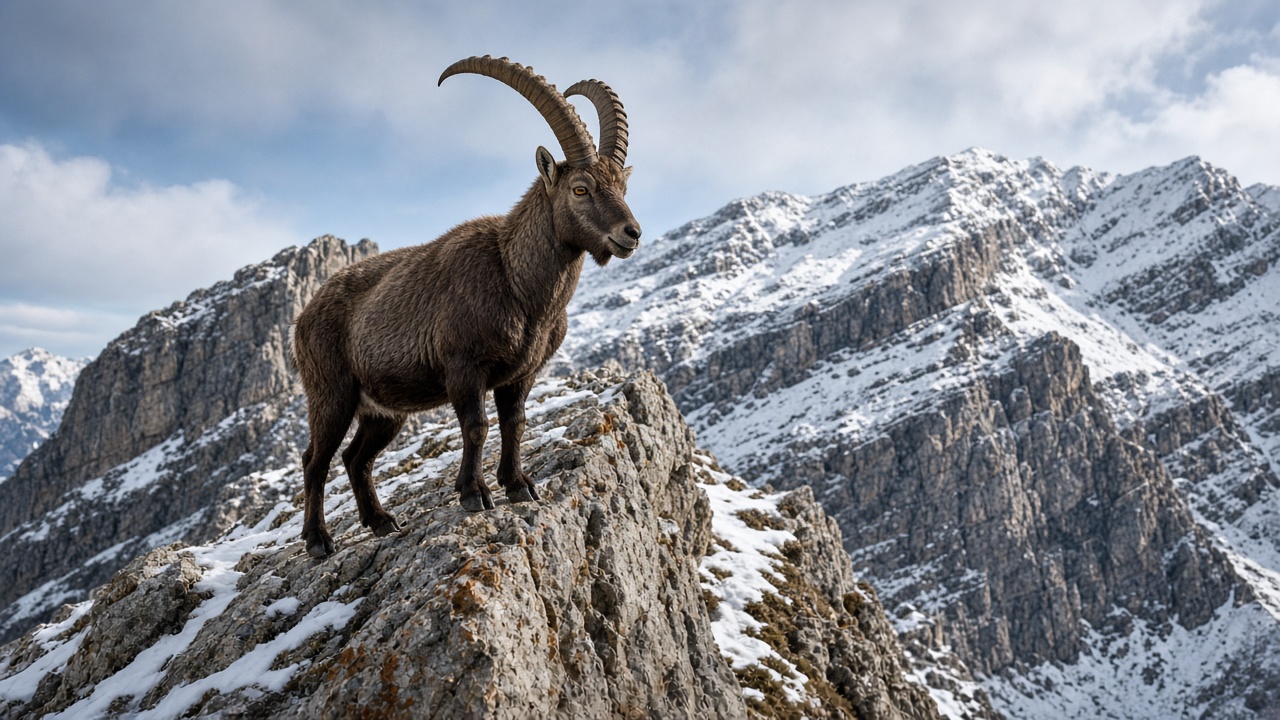
Alpine Ibex
Capra ibexAlpine Ibex (Capra ibex): coexistence sheet across its documented range — presence, biology and prudence, without an invented hunting status.
Seen in: Austria · France · Germany · Italy · Switzerland
Overview
Alpine Ibex (Capra ibex) is a coexistence sheet across its documented range: presence, biology and prudence — not a hunting status claim.
Classification: order Artiodactyla, family Bovidae, genus Capra. Common names: Alpine Ibex in English, Bouquetin des Alpes in French, Íbice alpino in Spanish.
Identification
The Alpine ibex is strongly sexually dimorphic: males have more than twice the body mass and horn size of females. Adult males measure about 150 cm in length and 93 cm at the withers and weigh 67 to 117 kg, peaking in November before the rut and dropping to a minimum in April. The scimitar-shaped horns have a flat front surface broken by prominent transverse ridges; they reach 69 to 98 cm in males and 18 to 35 cm in females, and grow throughout life, so their annual rings reveal age. The coat is grey-brown and males carry a beard.
Mainly a grazer, it draws 82 to 94% of its diet from herbaceous plants, 60% of it grasses; in winter and spring it adds twigs and leaves of shrubs such as green alder, juniper and rhododendron, mosses, lichens, and the needles and bark of young fir, larch and spruce. The rut lasts about six weeks from December. After 167 days of gestation a single kid is born, sometimes twins; according to ADW, it can follow its mother over rock the day after birth. Females first give birth at about 2 years in newly established populations, but at 3 to 4 years where density is high.
Habitats and range
MDD states that it formerly occupied the Alps of Austria, France, Germany, northern Italy and Switzerland, died out everywhere except Italy and has been reintroduced into its former range. It lives at 1,600 to 3,200 m; in Gran Paradiso it moves to 2,100–2,900 m in spring and 2,300–3,300 m in summer. In winter both sexes select steep rocky slopes where little snow settles, and females depend more on steep terrain throughout the year. It usually avoids large woodlands, although translocated populations can live as low as 1,500 m where cliffs are available.
The countries where the species’ presence is established are shown in the tags on this sheet.
Field signs
Gregarious, it forms groups of adult males, of 2- to 3-year-olds, of females with kids and yearlings, or mixed groups; the sexes come together only during the rut in December and January, and the largest groups are seen in June and July. Males clash by rearing on their hind legs and bringing their horns down on an opponent, or display by walking side by side. In spring it rubs against rocks and bushes to shed its woolly winter undercoat, which falls out in tufts.
Conservation
For conservation status of Capra ibex, consult the current IUCN assessment, then cross with French monitoring programmes when they exist (OFB portal and related publications). Never turn a global IUCN category into a departmental hunting rule. GBIF occurrences help situate documented distribution but remain effort-biased.
MDD gives its IUCN status as Least Concern. According to the Mammalian Species account, overexploitation and poaching wiped it out in Switzerland, Germany and France by the 18th century; it survived only in Gran Paradiso, and all living ibex descend from that remnant – perhaps fewer than 100 animals, and unlikely more than 200 to 300. These bottlenecks explain its very low genetic variability. It now numbers more than 20,000, but remains vulnerable to diseases passed on by domestic ungulates, such as infectious keratoconjunctivitis, outbreaks of which can kill 30% of a population, and sarcoptic mange.
Limits
This sheet on the Alpine Ibex covers presence and biology. A species being present in a country does not mean it may be hunted, and no season or quota is published here.
Local densities and management plans are not covered here: they are a matter for the managers of each area.
Sources
Sources consulted for this sheet:
- IUCN Red List — species search (consulted 2026-11-01)
- ASM Mammal Diversity Database — Capra ibex (consulted 2026-11-01)
- GBIF — species search (consulted 2026-11-01)
- Mammalian Species 830 — Capra ibex (Parrini, Cain & Krausman 2009), Oxford Academic (consulted 2026-11-05)
- Animal Diversity Web — Capra ibex (ibex) (consulted 2026-11-05)
Conclusion
In short: use the scientific name Capra ibex to cross-check sources, confirm taxonomy and conservation status on the institutional portals listed above, and relate every field sign to the habitat where it was actually found.
Identification
Capra ibex
Bouquetin des Alpes · preferred
Íbice alpino · preferred
Alpine Ibex · preferred
European Ibex
Classification
Class : Mammalia
Order : Artiodactyla
Family : Bovidae
Genus : Capra
Conservation
IUCN : LC
CITES : —
iucn · LC (global)
Habitat
Practices
Frequently asked questions
How do I recognise Alpine Ibex?
Use Capra ibex as the scientific anchor. The Alpine ibex is strongly sexually dimorphic: males have more than twice the body mass and horn size of females. Adult males measure about 150 cm in length and 93 cm at the withers and weigh 67 to 117 kg, peaking in November before the rut and dropping to a minimum in April. Th...
Where does Alpine Ibex typically live?
MDD states that it formerly occupied the Alps of Austria, France, Germany, northern Italy and Switzerland, died out everywhere except Italy and has been reintroduced into its former range. It lives at 1,600 to 3,200 m; in Gran Paradiso it moves to 2,100–2,900 m in spring and 2,300–3,300 m in summer. In winter both sexes select steep rocky slopes where little...
What field signs help confirm Alpine Ibex?
Gregarious, it forms groups of adult males, of 2- to 3-year-olds, of females with kids and yearlings, or mixed groups; the sexes come together only during the rut in December and January, and the largest groups are seen in June and July. Males clash by rearing on their hind legs and bringing their horns down on an opponent, or display by walking side by side...