Arctic Fox
Vulpes lagopusArctic Fox (Vulpes lagopus): biology, habitats and field signs across its documented range, hunting-context reading.
Seen in: Finland · Iceland · Norway · Sweden
Overview
Arctic Fox (Vulpes lagopus) is presented here in a hunting-context reading across its documented range: biology, habitats and field signs useful to observers — without publishing season, quota or authorisation.
Classification: order Carnivora, family Canidae, genus Vulpes. Common names: Arctic Fox in English, Renard polaire in French, Zorro ártico in Spanish.
Identification
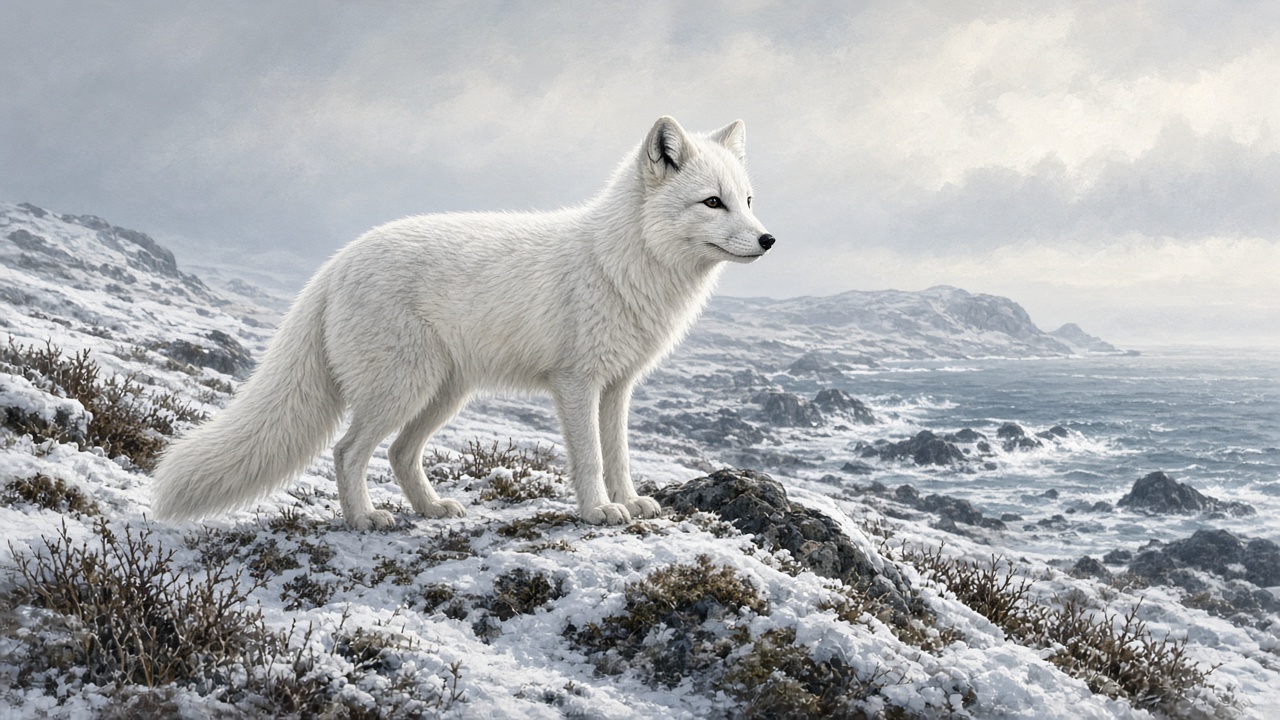
The Arctic fox weighs 5.2 kg on average. Its fur moults twice a year: in winter it is pure white; in summer the back turns grey to brown and the belly somewhat paler. In areas with a milder climate, some animals keep the darker coat all year. In winter the soles of the paws are covered in dense fur, unlike other canids: hence its scientific name lagopus, meaning “hare-footed”. MDD also gives the name polar fox and notes the former genus Alopex.
An opportunist, it eats almost any animal, alive or dead, with a preference for small mammals: mostly lemmings in summer and inland, marine mammals, seals, seabirds, fish and invertebrates in winter, as well as insects, berries, carrion and dung. It does not hibernate. Pairs are monogamous, often for life; mating takes place from April to July and gestation lasts about 49 to 57 days. Litter size, usually 5 to 8 and up to 25, depends on lemming numbers; the male helps provision the young.
Habitats and range
According to MDD, it is circumpolar, occupying the entire Holarctic tundra zone including most Arctic islands: Canada, Alaska, Greenland, Iceland, Norway, Sweden, Finland and Russia. It lives in treeless Arctic and alpine tundra, usually near the coast.
The countries where the species’ presence is established are shown in the tags on this sheet.
Field signs
Dens are the most visible signs: dug into a low mound 1 to 4 m high on open tundra or into a rock pile at the foot of a cliff, they have 4 to 8 entrances and a tunnel system covering about 30 m²; some have been used for centuries. In summer it caches surplus food under stones near the den. It also roams the tundra in small nomadic bands looking for food.
Conservation
For conservation status of Vulpes lagopus, consult the current IUCN assessment and cross with national monitoring programmes in countries of documented presence. Never turn a global IUCN category into a local hunting rule. GBIF occurrences help situate distribution but remain effort-biased.
The IUCN lists it as Least Concern and its populations have remained relatively stable. It has nonetheless been driven out of some regions, such as northern Scandinavia, by predators like the red fox. It has long been trapped for its fur and is kept on fur farms, for example on the Pribilof Islands since 1865. In Iceland it is persecuted because it takes lambs.
Limits
This sheet on the Arctic Fox publishes no season, quota, hunting method or fee: those rules differ between countries and territories and must be checked in official texts. Being described here does not mean a species may be hunted.
Local densities and management plans are not covered here: they are a matter for the managers of each area.
Sources
Sources consulted for this sheet:
- IUCN Red List — species search (consulted 2026-11-02)
- ASM Mammal Diversity Database — Vulpes lagopus (consulted 2026-11-02)
- GBIF — species search (consulted 2026-11-02)
- Animal Diversity Web — Vulpes lagopus (Arctic fox) (consulted 2026-11-04)
Conclusion
In short: use the scientific name Vulpes lagopus to cross-check sources, confirm taxonomy and conservation status on the institutional portals listed above, and relate every field sign to the habitat where it was actually found.
Identification
Vulpes lagopus
Renard polaire · preferred
Zorro ártico · preferred
Arctic Fox · preferred
Polar Fox
Classification
Class : Mammalia
Order : Carnivora
Family : Canidae
Genus : Vulpes
Conservation
IUCN : LC
CITES : —
iucn · LC (global)
Habitat
Frequently asked questions
How do I recognise Arctic Fox?
Use Vulpes lagopus as the scientific anchor. The Arctic fox weighs 5.2 kg on average. Its fur moults twice a year: in winter it is pure white; in summer the back turns grey to brown and the belly somewhat paler. In areas with a milder climate, some animals keep the darker coat all year. In winter the soles of the paws are c...
Where does Arctic Fox typically live?
According to MDD, it is circumpolar, occupying the entire Holarctic tundra zone including most Arctic islands: Canada, Alaska, Greenland, Iceland, Norway, Sweden, Finland and Russia. It lives in treeless Arctic and alpine tundra, usually near the coast.
What field signs help confirm Arctic Fox?
Dens are the most visible signs: dug into a low mound 1 to 4 m high on open tundra or into a rock pile at the foot of a cliff, they have 4 to 8 entrances and a tunnel system covering about 30 m²; some have been used for centuries. In summer it caches surplus food under stones near the den. It also roams the tundra in small nomadic bands looking for food.