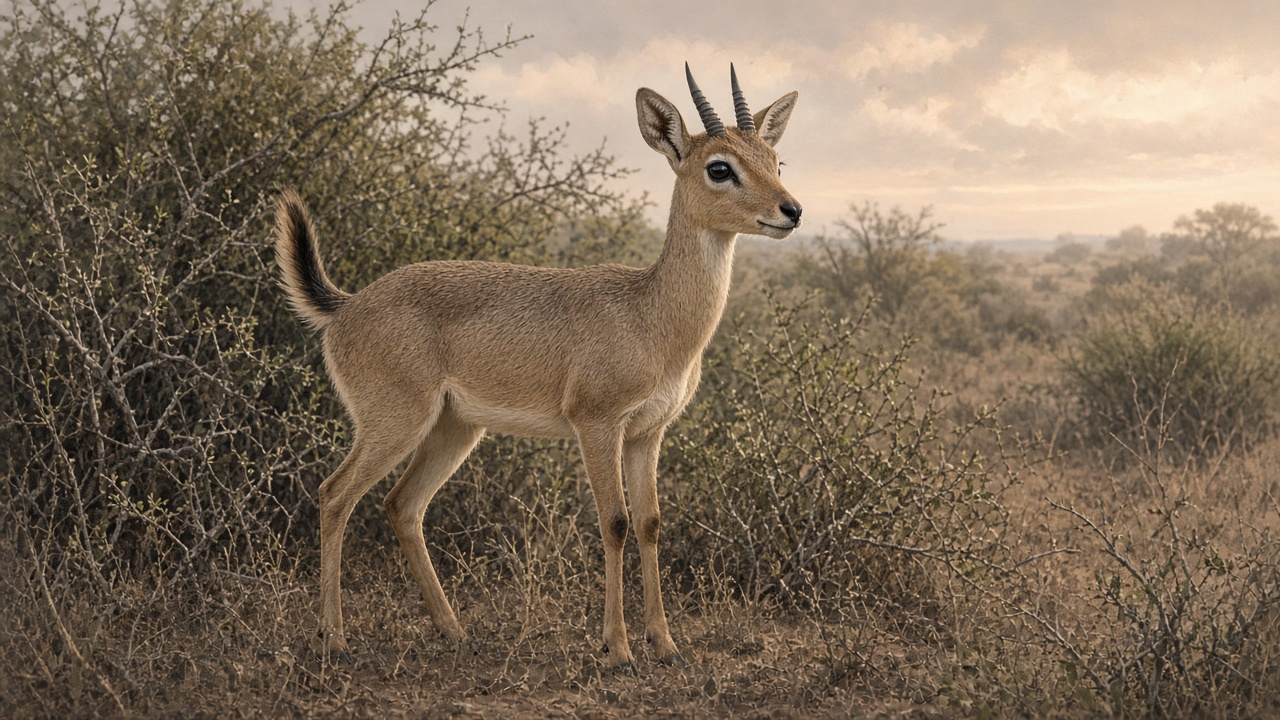
Bush Duiker
Sylvicapra grimmiaBush Duiker (Sylvicapra grimmia): coexistence sheet across its documented range — presence, biology and prudence, without an invented hunting status.
Seen in: Namibia · South Africa
Overview
Bush Duiker (Sylvicapra grimmia) is a coexistence sheet across its documented range: presence, biology and prudence — not a hunting status claim.
Classification: order Artiodactyla, family Bovidae, genus Sylvicapra. Common names: Bush Duiker in English, Céphalophe de Grimm in French, Duiker común in Spanish.
Identification
The bush duiker is a small antelope standing about 60 cm at the shoulder and 1 m long, weighing 12 to 25 kg. Unusually, females are 2 to 4 kg heavier than males from the same area. Normally only males carry horns, simple spikes of 7 to 18 cm, heavily ridged at the base; some females have stunted horns. The ears measure 9.5 to 14.5 cm and are longer in open, arid country. The coat ranges from pale in dry areas to dark grey in moist ones; mountain animals have longer, thicker coats.
Pairs are monogamous and breed year-round with no clear peak. After four to seven months of gestation, the female gives birth in thick cover to a single young, occasionally two, which both parents defend; it reaches adult size at six months. Its diet is very broad: leaves and shoots, fruit and flowers dropped by birds, monkeys and fruit bats, roots, tubers and bulbs dug up with the hooves, bark, resin, insects, and occasionally lizards, frogs, rodents or birds. It gets its water from the plants it eats.
Habitats and range
MDD records it in non-forested habitats across most of sub-Saharan Africa, from Senegal and Gambia to Eritrea, Ethiopia and Somalia, and south to South Africa. It uses savannas, grasslands and woodlands with enough cover, as well as mountains, where it ranges higher than any other African ungulate. It avoids deserts and dense forest such as rainforest.
The countries where the species’ presence is established are shown in the tags on this sheet.
Field signs
Active in the early morning, evening and at night, it beds down during the hot hours: females beside a well-hidden trunk or log, males on raised spots with a view of the surroundings. It marks its territory with secretions from its preorbital glands and by horning vegetation. It also digs up potatoes and groundnuts in fields.
Conservation
For conservation status of Sylvicapra grimmia, consult the current IUCN assessment and cross with national monitoring programmes in countries of documented presence. Never turn a global IUCN category into a local hunting rule. GBIF occurrences help situate distribution but remain effort-biased.
The IUCN lists it as Least Concern. MDD includes the forms coronata and pallidior, which Groves and Grubb (2011) treated as separate species; it is also known as the common, grey or crowned duiker. Its horns are formidable: pythons have been found dead, punctured by a duiker they were digesting.
Limits
This sheet on the Bush Duiker covers presence and biology. A species being present in a country does not mean it may be hunted, and no season or quota is published here.
Local densities and management plans are not covered here: they are a matter for the managers of each area.
Sources
Sources consulted for this sheet:
- IUCN Red List — species search (consulted 2026-11-02)
- ASM Mammal Diversity Database — Sylvicapra grimmia (consulted 2026-11-02)
- GBIF — species search (consulted 2026-11-02)
- Animal Diversity Web — Sylvicapra grimmia (bush duiker) (consulted 2026-11-04)
Conclusion
In short: use the scientific name Sylvicapra grimmia to cross-check sources, confirm taxonomy and conservation status on the institutional portals listed above, and relate every field sign to the habitat where it was actually found.
Identification
Sylvicapra grimmia
Céphalophe de Grimm · preferred
Duiker común · preferred
Bush Duiker · preferred
Crowned Duiker
Common Duiker
Gray Duiker
Grimm's Duiker
Sahel Duiker
Chad Crowned Duiker
Classification
Class : Mammalia
Order : Artiodactyla
Family : Bovidae
Genus : Sylvicapra
Conservation
IUCN : LC
CITES : —
iucn · LC (global)
Habitat
Frequently asked questions
How do I recognise Bush Duiker?
Use Sylvicapra grimmia as the scientific anchor. The bush duiker is a small antelope standing about 60 cm at the shoulder and 1 m long, weighing 12 to 25 kg. Unusually, females are 2 to 4 kg heavier than males from the same area. Normally only males carry horns, simple spikes of 7 to 18 cm, heavily ridged at the base; some fema...
Where does Bush Duiker typically live?
MDD records it in non-forested habitats across most of sub-Saharan Africa, from Senegal and Gambia to Eritrea, Ethiopia and Somalia, and south to South Africa. It uses savannas, grasslands and woodlands with enough cover, as well as mountains, where it ranges higher than any other African ungulate. It avoids deserts and dense forest such as rainforest.
What field signs help confirm Bush Duiker?
Active in the early morning, evening and at night, it beds down during the hot hours: females beside a well-hidden trunk or log, males on raised spots with a view of the surroundings. It marks its territory with secretions from its preorbital glands and by horning vegetation. It also digs up potatoes and groundnuts in fields.