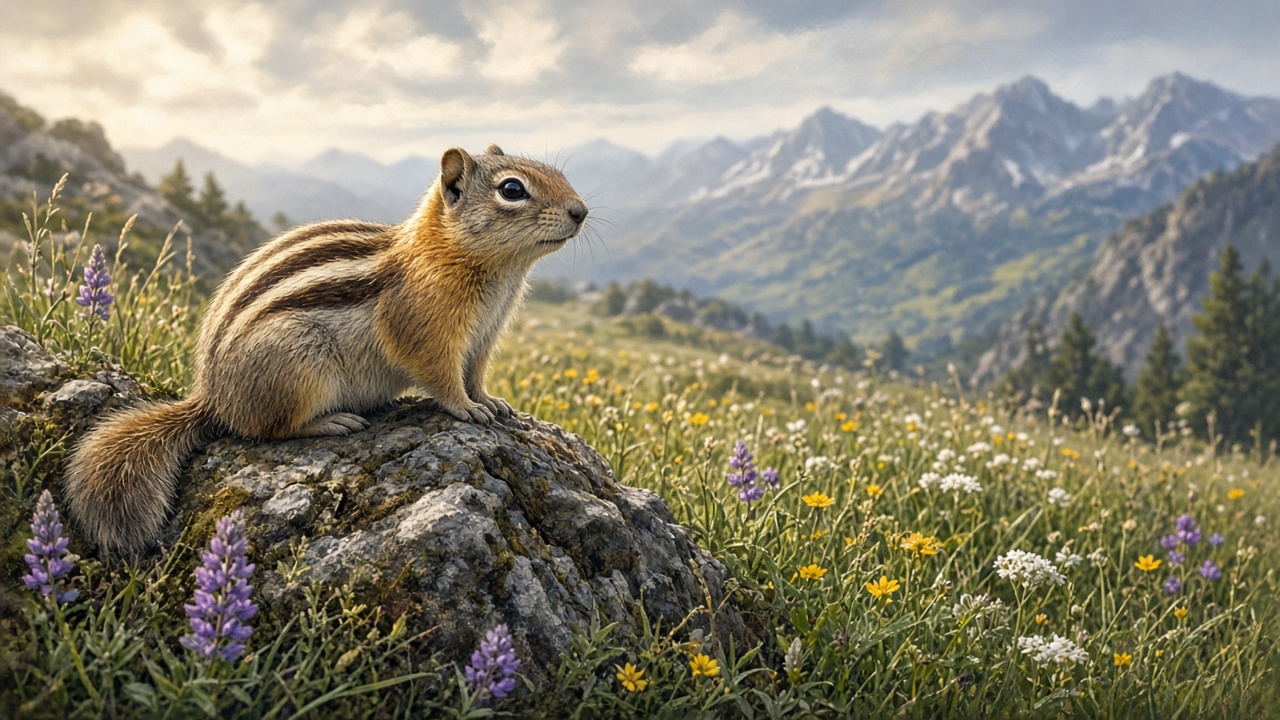
Common Golden-mantled Ground Squirrel
Callospermophilus lateralisCommon Golden-mantled Ground Squirrel (Callospermophilus lateralis): ecology sheet across its documented range — natural history and habitats, without hunting framing.
Seen in: United States
Overview
Common Golden-mantled Ground Squirrel (Callospermophilus lateralis) is an ecology sheet across its documented range: natural history and habitats, without any hunting framing.
Classification: order Rodentia, family Sciuridae, genus Callospermophilus. Common names: Common Golden-mantled Ground Squirrel in English, Spermophile à manteau doré in French, Ardilla terrestre de manto dorado in Spanish.
Identification
The golden-mantled ground squirrel measures 23.5 to 29.5 cm and weighs 120 to 394 g. Its golden-red “mantle” covers the head and runs down over the shoulders. A white stripe bordered by two black stripes runs along the body, as in chipmunks; but where a chipmunk has a stripe through the eye, this squirrel has no facial stripes, only a whitish eye ring. The back is grey, brownish or buff, the underside whitish or yellowish-grey; the tail is brownish-black above and reddish-brown below. The winter coat is greyer with a duller mantle, and males have a brighter red mantle.
An omnivore, it digs up underground fungi located by smell and relies on pine seeds as a staple, along with other nuts, acorns, seeds, flowers, bulbs and fruit; it also takes insects, birds and eggs, voles, lizards and carrion. Mostly diurnal, it hibernates where the ground freezes, from between late August and November until late March to May depending on elevation. Mating follows emergence (March to May); after 26 to 33 days, 2 to 8 young are born, five on average. Largely asocial, it drives other squirrels out of its area. Hawks, coyotes, bobcats, skunks, weasels and snakes prey on it.
Habitats and range
It lives in montane western North America: along the Rockies from central British Columbia to southern New Mexico, and from the Columbia River south to southern California and Nevada. It occurs from 1,200 to 3,965 m (Pikes Peak, Colorado), in the mixed conifer forests of the Klamath, Cascade and Sierra Nevada ranges, up to and above the timberline where cover allows, as well as in forest-edge meadows, rocky slopes and the chaparral of southern California.
The countries where the species’ presence is established are shown in the tags on this sheet.
Field signs
Burrow entrances are preferably placed under large rocks or stumps, with several openings around the areas where it forages. The squirrel keeps watch from rocks and logs, sometimes sitting bolt upright; when alarmed it calls while jerking its tail, and yellow-bellied marmots respond to its alarms too. It is abundant in campgrounds, where it takes human handouts, and vanishes from view during hibernation.
Conservation
For conservation status of Callospermophilus lateralis, consult the current IUCN assessment and cross with national monitoring programmes in countries of documented presence. Never turn a global IUCN category into a local hunting rule. GBIF occurrences help situate distribution but remain effort-biased.
The IUCN lists it as Least Concern, and ADW describes it as common where it occurs. Originally described as Sciurus lateralis, it was long placed in Spermophilus (the name ADW still uses); MDD places it in Callospermophilus following the generic revision by Helgen et al. (2009). MDD also lists the name Green River Basin golden-mantled ground squirrel.
Limits
This sheet on the Common Golden-mantled Ground Squirrel covers biology and ecology only; it publishes no hunting season, quota or authorisation.
Local densities and management plans are not covered here: they are a matter for the managers of each area.
Sources
Sources consulted for this sheet:
- IUCN Red List — species search (consulted 2026-11-02)
- ASM Mammal Diversity Database — Callospermophilus lateralis (consulted 2026-11-02)
- GBIF — species search (consulted 2026-11-02)
- Animal Diversity Web — Spermophilus lateralis (golden-mantled ground squirrel) (consulted 2026-11-04)
Conclusion
In short: use the scientific name Callospermophilus lateralis to cross-check sources, confirm taxonomy and conservation status on the institutional portals listed above, and relate every field sign to the habitat where it was actually found.
Identification
Callospermophilus lateralis
Spermophile à manteau doré · preferred
Ardilla terrestre de manto dorado · preferred
Common Golden-mantled Ground Squirrel · preferred
Green River Basin Golden-mantled Ground Squirrel
Spermophilus lateralis
Classification
Class : Mammalia
Order : Rodentia
Family : Sciuridae
Genus : Callospermophilus
Conservation
IUCN : LC
CITES : —
iucn · LC (global)
Habitat
Frequently asked questions
How do I recognise Common Golden-mantled Ground Squirrel?
Use Callospermophilus lateralis as the scientific anchor. The golden-mantled ground squirrel measures 23.5 to 29.5 cm and weighs 120 to 394 g. Its golden-red “mantle” covers the head and runs down over the shoulders. A white stripe bordered by two black stripes runs along the body, as in chipmunks; but where a chipmunk has a stripe thro...
Where does Common Golden-mantled Ground Squirrel typically live?
It lives in montane western North America: along the Rockies from central British Columbia to southern New Mexico, and from the Columbia River south to southern California and Nevada. It occurs from 1,200 to 3,965 m (Pikes Peak, Colorado), in the mixed conifer forests of the Klamath, Cascade and Sierra Nevada ranges, up to and above the timberline where cove...
What field signs help confirm Common Golden-mantled Ground Squirrel?
Burrow entrances are preferably placed under large rocks or stumps, with several openings around the areas where it forages. The squirrel keeps watch from rocks and logs, sometimes sitting bolt upright; when alarmed it calls while jerking its tail, and yellow-bellied marmots respond to its alarms too. It is abundant in campgrounds, where it takes human hando...