Southern Chamois
Rupicapra pyrenaicaSouthern Chamois (Rupicapra pyrenaica): coexistence sheet across its documented range — presence, biology and prudence, without an invented hunting status.
Seen in: France · Italy · Spain
Overview
Southern Chamois (Rupicapra pyrenaica) is a coexistence sheet across its documented range: presence, biology and prudence — not a hunting status claim.
Classification: order Artiodactyla, family Bovidae, genus Rupicapra. Common names: Southern Chamois in English, Isard in French, Rebeco pirenaico in Spanish.
Identification
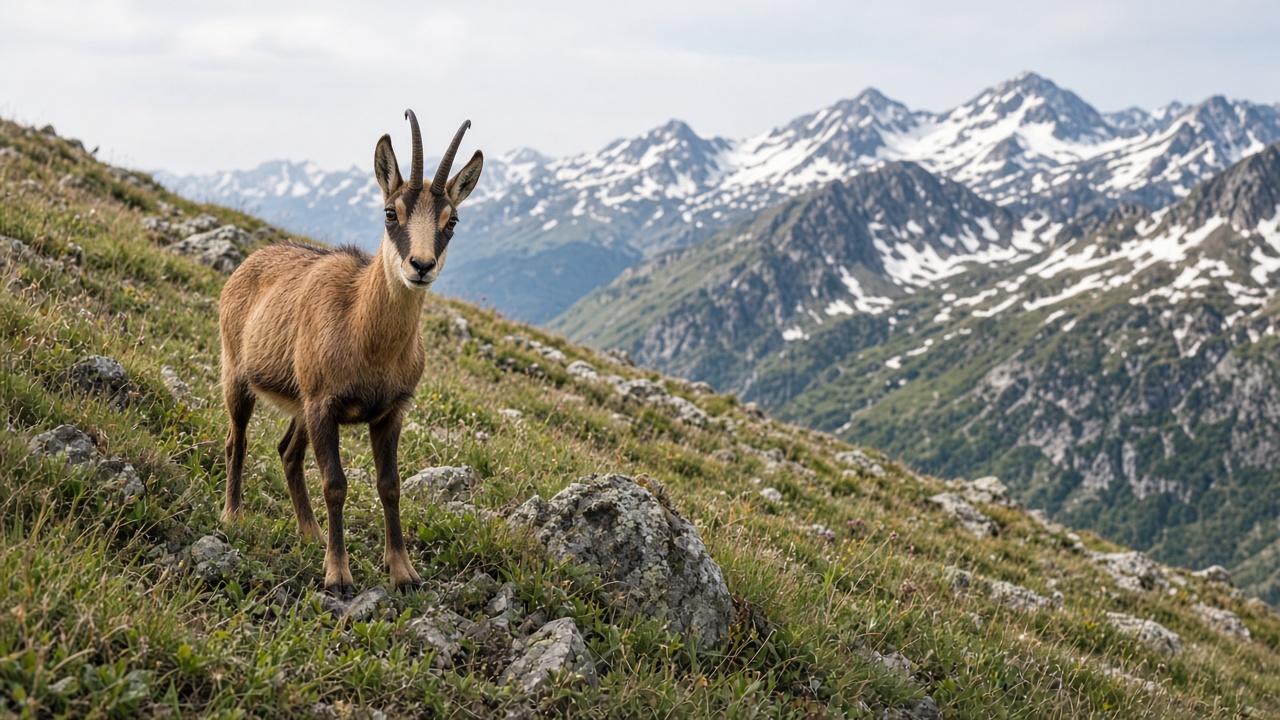
The Pyrenean chamois measures 90 to 130 cm in length and 76 to 81 cm at the shoulder, and usually weighs 24 to 50 kg; the tail is only 3 to 4 cm long. The summer coat is reddish; the much thicker winter coat is blackish-brown with white markings on the throat, neck, shoulders and flanks. Both sexes carry slender black horns 15 to 20 cm long, set very close together, rising vertically and then bending sharply back into hooks. The slightly hollowed, somewhat elastic hooves give a firm grip on rough ground.
In summer it feeds mainly on herbs and flowers; in winter it adds lichens, mosses and young pine shoots, and it can fast for two weeks when snow covers everything. The rut takes place in autumn and births in spring, after about 170 days of gestation, in a shelter of lichens and mosses; there is usually a single kid, sometimes twins or triplets, able to follow its mother almost at once. Females and young form herds of 15 to 30 animals; adult males live alone for most of the year.
Habitats and range
MDD gives it three mountain ranges: the Apennines in Italy, the Cantabrian Mountains in Spain and the Pyrenees, in France and northern Spain. In the warmer months it generally stays above 1,800 m in alpine meadows. In late autumn and winter it may come down below 1,100 m, while keeping to steep slopes; it rarely enters forest.
The countries where the species’ presence is established are shown in the tags on this sheet.
Field signs
In summer it is mostly seen in herds of females and young on high meadows, while adult males are often alone; they join the herds in late summer. Very agile, it can clear almost 2 m in height and 6 m in length and run at 50 km/h over uneven ground. The hooked horns, present in both sexes, and the contrasting winter coat are the best features.
Conservation
For conservation status of Rupicapra pyrenaica, consult the current IUCN assessment, then cross with French monitoring programmes when they exist (OFB portal and related publications). Never turn a global IUCN category into a departmental hunting rule. GBIF occurrences help situate documented distribution but remain effort-biased.
The IUCN lists it as Least Concern. According to ADW, numbers had declined because of hunting, then rose again and have nearly stabilised. The Abruzzo subspecies, R. p. ornata, is classed as Endangered and listed in CITES Appendix I. MDD includes the forms parva (Cantabrian) and ornata in the species, which Groves and Grubb (2011) treated as distinct.
Limits
This sheet on the Southern Chamois covers presence and biology. A species being present in a country does not mean it may be hunted, and no season or quota is published here.
Local densities and management plans are not covered here: they are a matter for the managers of each area.
Sources
Sources consulted for this sheet:
- IUCN Red List — species search (consulted 2026-11-01)
- ASM Mammal Diversity Database — Rupicapra pyrenaica (consulted 2026-11-01)
- GBIF — species search (consulted 2026-11-01)
- Animal Diversity Web — Rupicapra pyrenaica (Pyrenean chamois) (consulted 2026-11-04)
Conclusion
In short: use the scientific name Rupicapra pyrenaica to cross-check sources, confirm taxonomy and conservation status on the institutional portals listed above, and relate every field sign to the habitat where it was actually found.
Identification
Rupicapra pyrenaica
Southern Chamois · preferred
Isard · preferred
Rebeco pirenaico · preferred
Pyrenean Chamois
Cantabrian Chamois
Abruzzi Chamois
Apennine Chamois
Classification
Class : Mammalia
Order : Artiodactyla
Family : Bovidae
Genus : Rupicapra
Conservation
IUCN : LC
CITES : —
iucn · LC (global)
Habitat
Practices
Frequently asked questions
How do I recognise Southern Chamois?
Use Rupicapra pyrenaica as the scientific anchor. The Pyrenean chamois measures 90 to 130 cm in length and 76 to 81 cm at the shoulder, and usually weighs 24 to 50 kg; the tail is only 3 to 4 cm long. The summer coat is reddish; the much thicker winter coat is blackish-brown with white markings on the throat, neck, shoulders and...
Where does Southern Chamois typically live?
MDD gives it three mountain ranges: the Apennines in Italy, the Cantabrian Mountains in Spain and the Pyrenees, in France and northern Spain. In the warmer months it generally stays above 1,800 m in alpine meadows. In late autumn and winter it may come down below 1,100 m, while keeping to steep slopes; it rarely enters forest.
What field signs help confirm Southern Chamois?
In summer it is mostly seen in herds of females and young on high meadows, while adult males are often alone; they join the herds in late summer. Very agile, it can clear almost 2 m in height and 6 m in length and run at 50 km/h over uneven ground. The hooked horns, present in both sexes, and the contrasting winter coat are the best features.