Harbor Seal
Phoca vitulinaHarbor Seal (Phoca vitulina): coexistence sheet across its documented range — presence, biology and prudence, without an invented hunting status.
Seen in: Belgium · Denmark · Finland · France · Germany
Overview
Harbor Seal (Phoca vitulina) is a coexistence sheet across its documented range: presence, biology and prudence — not a hunting status claim.
Classification: order Carnivora, family Phocidae, genus Phoca. Common names: Harbor Seal in English, Phoque commun in French, Foca común in Spanish.
Identification
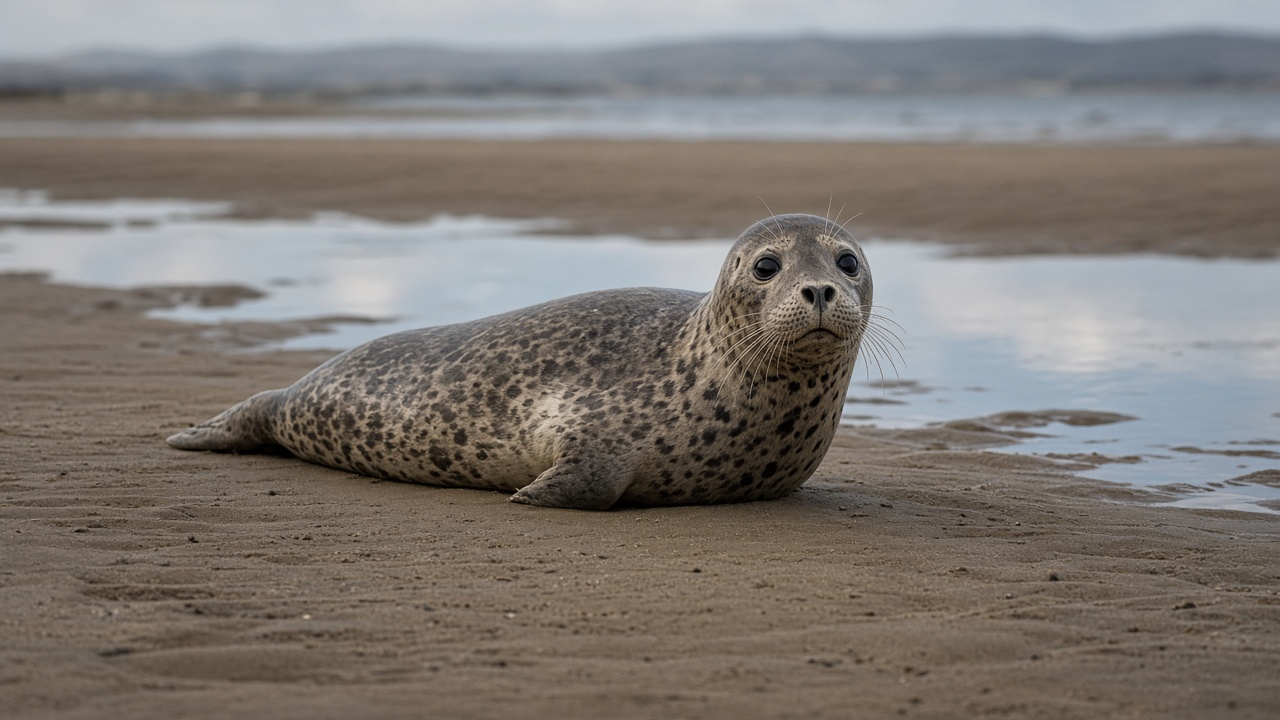
The harbour seal has a large, round head with no external ears, narrow nostrils that close while swimming and long, flat flippers with five webbed digits. Males, slightly larger, measure 160 to 190 cm and weigh 80 to 170 kg; females 160 to 170 cm and 60 to 145 kg. The coat comes in a “light phase”, yellowish with small black spots ringed in pale, and a “dark phase”, black with dark spots ringed in light, mainly on the back. Unlike some seals, pups shed their downy lanugo before birth.
It eats mostly fish – cod, hake, mackerel and herring – swallowed whole or head first, as well as octopus, squid, crabs and shrimp; a 100 kg seal eats about 5 to 7 kg a day. Mating takes place in the water. After delayed implantation of about 2.5 months, total gestation is about 10.5 months; a single 8 to 12 kg pup is born near the shore or on land, between late winter and summer. Fed on milk of about 50% fat, it is weaned at 4 to 6 weeks. Sharks and killer whales are among its predators.
Habitats and range
It is the pinniped with the largest range, along Northern Hemisphere coasts of the Pacific and Atlantic. In the northeast Atlantic it occurs from the French coast to the North Sea and north to the Barents Sea; MDD lists it in France, Belgium, the Netherlands, the United Kingdom, Ireland, Spain and Portugal among others. It uses shallow coastal waters, bays, rocky islets, estuaries and even freshwater lakes, preferring cold waters without annual sea ice. It forages at an average depth of 91 m, down to 427 m.
The countries where the species’ presence is established are shown in the tags on this sheet.
Field signs
Diurnal and mostly solitary, it regularly hauls out on land or ice and usually stays within 50 m of these sites. Numbers at haul-outs peak during pupping and the moult, 2 to 3 months later. Fairly quiet, it makes sounds likened to burps, grunts and yelps, and sometimes slaps the water vigorously with its flippers. Until weaning, pups cling to their mothers’ backs in the water.
Conservation
For conservation status of Phoca vitulina, consult the current IUCN assessment, then cross with French monitoring programmes when they exist (OFB portal and related publications). Never turn a global IUCN category into a departmental hunting rule. GBIF occurrences help situate documented distribution but remain effort-biased.
The IUCN lists it as Least Concern and numbers have been rising since around the 1970s, despite major recent die-offs from disease. As a coastal species it is vulnerable to pollution and can become entangled in nets. Two subspecies are on the brink of extinction: P. v. stejnegeri in Japan, declining since the 1980s due to excessive hunting, and P. v. mellonae of Canada’s Ungava Peninsula, with only 120 to 600 seals.
Limits
This sheet on the Harbor Seal covers presence and biology. A species being present in a country does not mean it may be hunted, and no season or quota is published here.
Local densities and management plans are not covered here: they are a matter for the managers of each area.
Sources
Sources consulted for this sheet:
- IUCN Red List — species search (consulted 2026-11-01)
- ASM Mammal Diversity Database — Phoca vitulina (consulted 2026-11-01)
- GBIF — species search (consulted 2026-11-01)
- Animal Diversity Web — Phoca vitulina (harbor seal) (consulted 2026-11-04)
Conclusion
In short: use the scientific name Phoca vitulina to cross-check sources, confirm taxonomy and conservation status on the institutional portals listed above, and relate every field sign to the habitat where it was actually found.
Identification
Phoca vitulina
Harbor Seal · preferred
Phoque commun · preferred
Foca común · preferred
Common Seal
Harbour Seal
Eastern Atlantic Harbor Seal
Western Atlantic Harbor Seal
Eastern Pacific Harbor Seal
Kuril Seal
Western Pacific Harbor Seal
Classification
Class : Mammalia
Order : Carnivora
Family : Phocidae
Genus : Phoca
Conservation
IUCN : LC
CITES : —
iucn · LC (global)
Habitat
Frequently asked questions
How do I recognise Harbor Seal?
Use Phoca vitulina as the scientific anchor. The harbour seal has a large, round head with no external ears, narrow nostrils that close while swimming and long, flat flippers with five webbed digits. Males, slightly larger, measure 160 to 190 cm and weigh 80 to 170 kg; females 160 to 170 cm and 60 to 145 kg. The coat comes...
Where does Harbor Seal typically live?
It is the pinniped with the largest range, along Northern Hemisphere coasts of the Pacific and Atlantic. In the northeast Atlantic it occurs from the French coast to the North Sea and north to the Barents Sea; MDD lists it in France, Belgium, the Netherlands, the United Kingdom, Ireland, Spain and Portugal among others. It uses shallow coastal waters, bays,...
What field signs help confirm Harbor Seal?
Diurnal and mostly solitary, it regularly hauls out on land or ice and usually stays within 50 m of these sites. Numbers at haul-outs peak during pupping and the moult, 2 to 3 months later. Fairly quiet, it makes sounds likened to burps, grunts and yelps, and sometimes slaps the water vigorously with its flippers. Until weaning, pups cling to their mothers’...