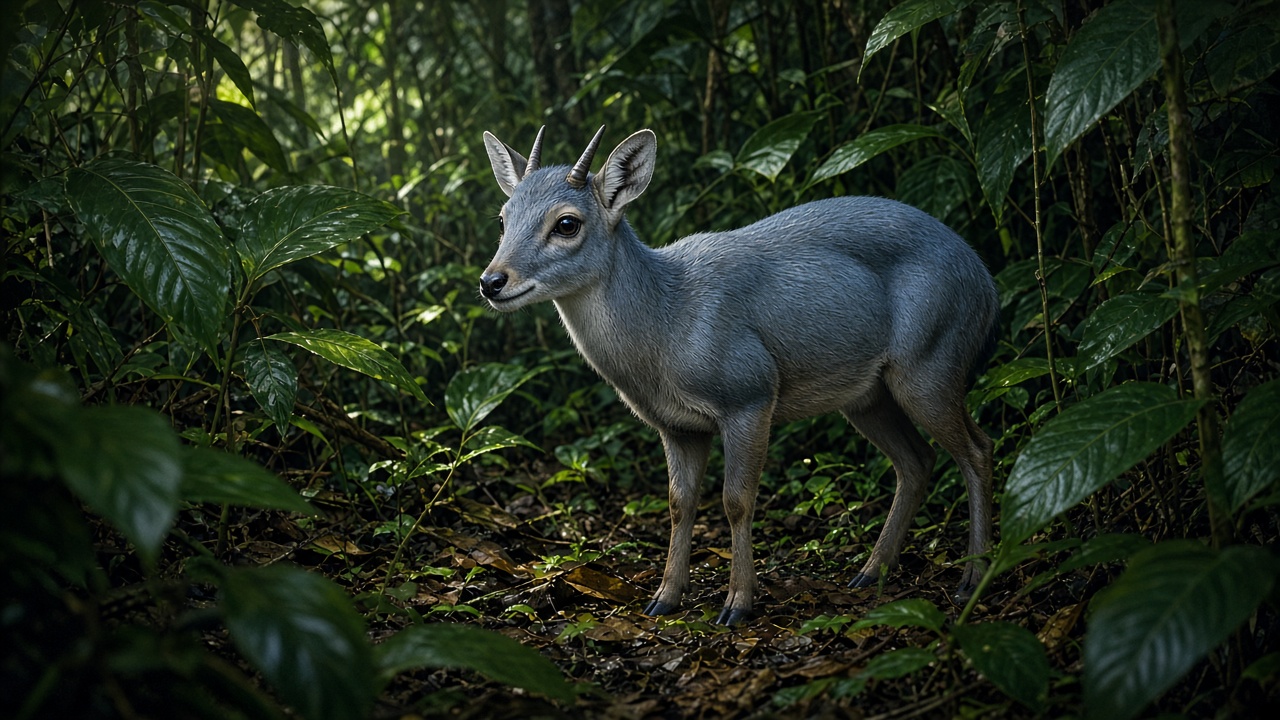
Blue Duiker (Philantomba monticola): coexistence sheet across its documented range — presence, biology and prudence, without an invented hunting status.
Seen in: South Africa
Overview
Blue Duiker (Philantomba monticola) is a coexistence sheet across its documented range: presence, biology and prudence — not a hunting status claim.
Classification: order Artiodactyla, family Bovidae, genus Philantomba. Common names: Blue Duiker in English, Céphalophe bleu in French, Duiker azul in Spanish.
Identification
It is the smallest of the duikers: 4 to 6 kg and 55 to 72 cm long, with a 7 to 12.5 cm tail that is black above and white below. The coat varies across the range but is usually brown, often with a bluish tint. Males carry a pair of small grooved horns about 5 cm high; females sometimes have them too, though less often. It closely resembles Maxwell’s duiker, from which it differs mainly in its smaller skull and narrower nasal passages. Its long hind legs make it an excellent jumper.
Diurnal, it lives in monogamous pairs that stay together all year on a home range of 2.5 to 4 ha, which partners defend with a low-horn display, occasionally ending in a fight. A fruit-eater, it takes fallen ripe and unripe fruit, seeds, flowers and fungi, and spends 67 to 76% of its waking hours foraging, often beneath monkeys that knock fruit down. It breeds all year round: after 196 to 216 days a single calf is born, able to run within 20 minutes of birth and weaned at 2.5 to 3 months. Leopards, golden cats, crowned eagles, pythons and baboons prey on it.
Habitats and range
According to MDD, it lives in forest habitats of central, eastern and southern Africa: from Nigeria east of the Cross River, Cameroon, Bioko and Gabon to Kenya, Tanzania (including Pemba and Zanzibar), Zambia, Mozambique, eastern Zimbabwe and South Africa (Eastern Cape, KwaZulu-Natal). It uses rainforest, riverine forest, dense thickets and montane forest; it often lives near houses, uses plantations as corridors and can make do with forest patches of 0.7 ha.
The countries where the species’ presence is established are shown in the tags on this sheet.
Field signs
It rests in the open or at the base of a tree, keeping a clear view, and sometimes in hollows in piles of dead wood or logs. When alarmed it flicks its black tail to show the white underside, snorts, whistles, stamps or strikes objects with its horns, then dives into dense vegetation: “duiker” comes from the Afrikaans word for diver. Pairs scent-mark trees and each other with their preorbital glands.
Conservation
For conservation status of Philantomba monticola, consult the current IUCN assessment and cross with national monitoring programmes in countries of documented presence. Never turn a global IUCN category into a local hunting rule. GBIF occurrences help situate distribution but remain effort-biased.
The IUCN lists it as Least Concern. It is one of the duikers most often taken for bushmeat, a source of food and income near the Congo Basin. Its tolerance of disturbed habitats and small area needs explain its wide distribution. MDD includes nine forms in the species (aequatorialis, anchietae, bicolor, congica, defriesi, hecki, lugens, melanorhea, simpsoni) that Groves and Grubb (2011) treated as distinct.
Limits
This sheet on the Blue Duiker covers presence and biology. A species being present in a country does not mean it may be hunted, and no season or quota is published here.
Local densities and management plans are not covered here: they are a matter for the managers of each area.
Sources
Sources consulted for this sheet:
- IUCN Red List — species search (consulted 2026-11-02)
- ASM Mammal Diversity Database — Philantomba monticola (consulted 2026-11-02)
- GBIF — species search (consulted 2026-11-02)
- Animal Diversity Web — Philantomba monticola (blue duiker) (consulted 2026-11-04)
Conclusion
In short: use the scientific name Philantomba monticola to cross-check sources, confirm taxonomy and conservation status on the institutional portals listed above, and relate every field sign to the habitat where it was actually found.
Identification
Philantomba monticola
Blue Duiker · preferred
Céphalophe bleu · preferred
Duiker azul · preferred
Classification
Class : Mammalia
Order : Artiodactyla
Family : Bovidae
Genus : Philantomba
Conservation
IUCN : LC
CITES : —
iucn · LC (global)
Frequently asked questions
How do I recognise Blue Duiker?
Use Philantomba monticola as the scientific anchor. It is the smallest of the duikers: 4 to 6 kg and 55 to 72 cm long, with a 7 to 12.5 cm tail that is black above and white below. The coat varies across the range but is usually brown, often with a bluish tint. Males carry a pair of small grooved horns about 5 cm high; females som...
Where does Blue Duiker typically live?
According to MDD, it lives in forest habitats of central, eastern and southern Africa: from Nigeria east of the Cross River, Cameroon, Bioko and Gabon to Kenya, Tanzania (including Pemba and Zanzibar), Zambia, Mozambique, eastern Zimbabwe and South Africa (Eastern Cape, KwaZulu-Natal). It uses rainforest, riverine forest, dense thickets and montane forest; i...
What field signs help confirm Blue Duiker?
It rests in the open or at the base of a tree, keeping a clear view, and sometimes in hollows in piles of dead wood or logs. When alarmed it flicks its black tail to show the white underside, snorts, whistles, stamps or strikes objects with its horns, then dives into dense vegetation: “duiker” comes from the Afrikaans word for diver. Pairs scent-mark trees a...