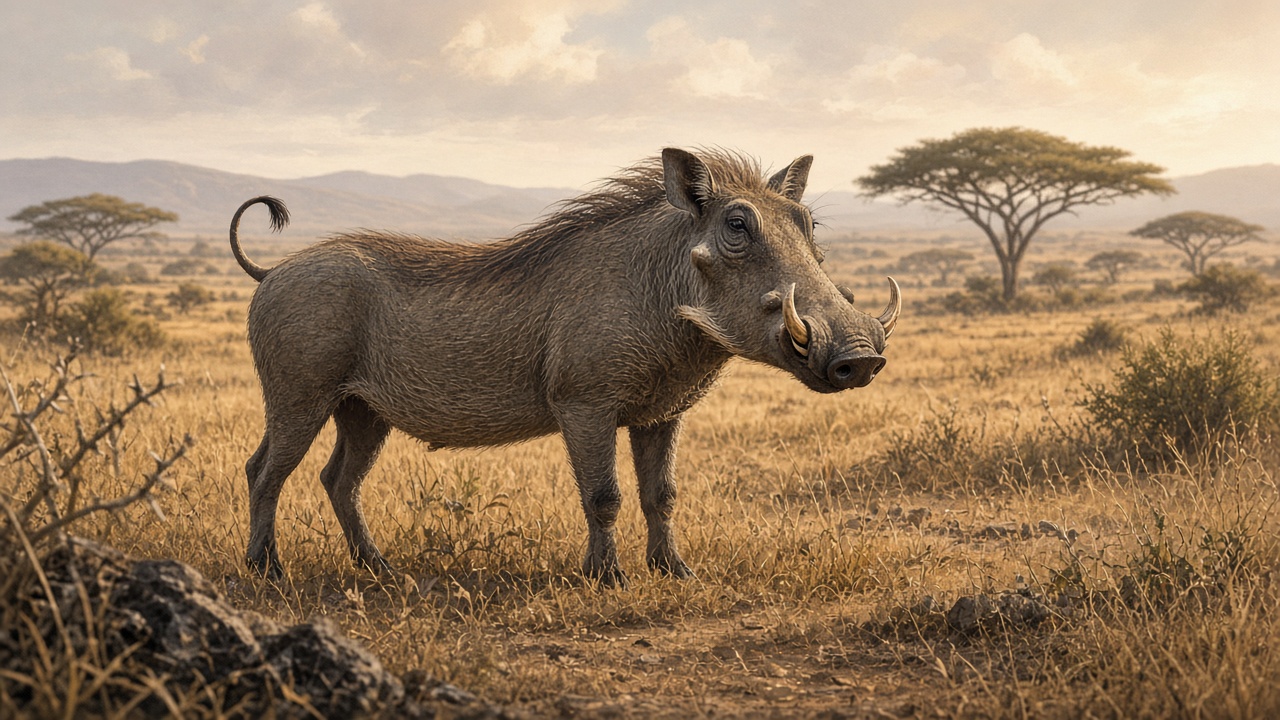
Common Warthog
Phacochoerus africanusCommon Warthog (Phacochoerus africanus): biology, habitats and field signs across its documented range, hunting-context reading.
Seen in: Namibia · South Africa
Overview
Common Warthog (Phacochoerus africanus) is presented here in a hunting-context reading across its documented range: biology, habitats and field signs useful to observers — without publishing season, quota or authorisation.
Classification: order Artiodactyla, family Suidae, genus Phacochoerus. Common names: Common Warthog in English, Phacochère commun in French, Facóquero común in Spanish.
Identification
The common warthog weighs 50 to 150 kg, females being 15 to 20% lighter; it measures 90 to 150 cm long and 63.5 to 85 cm at the shoulder. The upper tusks reach 25.5 to 63.5 cm in males and 15.2 to 25.5 cm in females. The large head bears three pairs of warts: below the eyes (up to 15 cm in males), in front of the eyes and on the jaws, the latter with white bristles. A mane runs to the middle of the back; the black or brown body is almost bare. It differs from the Cape warthog by its incisors, which the latter lacks.
Mainly a grazer of short grass, it kneels on its calloused wrists to graze and digs up rhizomes and bulbs with its snout and tusks; it also eats roots, berries, bark and occasionally carrion. Females and young form groups called soundings of up to 18; adult males are solitary or in bachelor groups. Diurnal, it spends the night in a burrow, often one dug by an aardvark. Young are born in the dry season: 1 to 7 piglets (3 on average) after 170 to 175 days. Lions are its main predator, along with leopards and cheetahs.
Habitats and range
MDD gives it outside the rainforest zone, from Mauritania and Senegal to Ethiopia and northern Somalia, and south to Namibia and South Africa. It uses open and wooded savanna, grass steppe and semi-desert, as well as former woodland cleared for pasture, but avoids rainforest and severe desert; it reaches 3,000 m on Kilimanjaro. It needs wallows to cool off and burrows for the night. Its undefended home ranges cover 0.62 to 3.3 km².
The countries where the species’ presence is established are shown in the tags on this sheet.
Field signs
It runs off with its tail held straight up, an alarm signal to other warthogs. It is seen grazing on its knees, wallowing in mud or retiring at dusk into an aardvark burrow. Rooted-up soil, oxpeckers on its back, and grunting and teeth grinding during fights give it away. Where people disturb it, it becomes more nocturnal.
Conservation
For conservation status of Phacochoerus africanus, consult the current IUCN assessment and cross with national monitoring programmes in countries of documented presence. Never turn a global IUCN category into a local hunting rule. GBIF occurrences help situate distribution but remain effort-biased.
The IUCN lists it as Least Concern, but ADW reports serious declines in many populations outside reserves due to overharvesting. It can carry the tick-borne African swine fever virus, dangerous to domestic pigs, and hosts the tsetse fly. It sometimes damages rice fields and peanut crops.
Limits
This sheet on the Common Warthog publishes no season, quota, hunting method or fee: those rules differ between countries and territories and must be checked in official texts. Being described here does not mean a species may be hunted.
Local densities and management plans are not covered here: they are a matter for the managers of each area.
Sources
Sources consulted for this sheet:
- IUCN Red List — species search (consulted 2026-11-02)
- ASM Mammal Diversity Database — Phacochoerus africanus (consulted 2026-11-02)
- GBIF — species search (consulted 2026-11-02)
- Animal Diversity Web — Phacochoerus africanus (common warthog) (consulted 2026-11-04)
Conclusion
In short: use the scientific name Phacochoerus africanus to cross-check sources, confirm taxonomy and conservation status on the institutional portals listed above, and relate every field sign to the habitat where it was actually found.
Identification
Phacochoerus africanus
Common Warthog · preferred
Phacochère commun · preferred
Facóquero común · preferred
Classification
Class : Mammalia
Order : Artiodactyla
Family : Suidae
Genus : Phacochoerus
Conservation
IUCN : LC
CITES : —
iucn · LC (global)
Habitat
Practices
Frequently asked questions
How do I recognise Common Warthog?
Use Phacochoerus africanus as the scientific anchor. The common warthog weighs 50 to 150 kg, females being 15 to 20% lighter; it measures 90 to 150 cm long and 63.5 to 85 cm at the shoulder. The upper tusks reach 25.5 to 63.5 cm in males and 15.2 to 25.5 cm in females. The large head bears three pairs of warts: below the eyes (up t...
Where does Common Warthog typically live?
MDD gives it outside the rainforest zone, from Mauritania and Senegal to Ethiopia and northern Somalia, and south to Namibia and South Africa. It uses open and wooded savanna, grass steppe and semi-desert, as well as former woodland cleared for pasture, but avoids rainforest and severe desert; it reaches 3,000 m on Kilimanjaro. It needs wallows to cool off a...
What field signs help confirm Common Warthog?
It runs off with its tail held straight up, an alarm signal to other warthogs. It is seen grazing on its knees, wallowing in mud or retiring at dusk into an aardvark burrow. Rooted-up soil, oxpeckers on its back, and grunting and teeth grinding during fights give it away. Where people disturb it, it becomes more nocturnal.