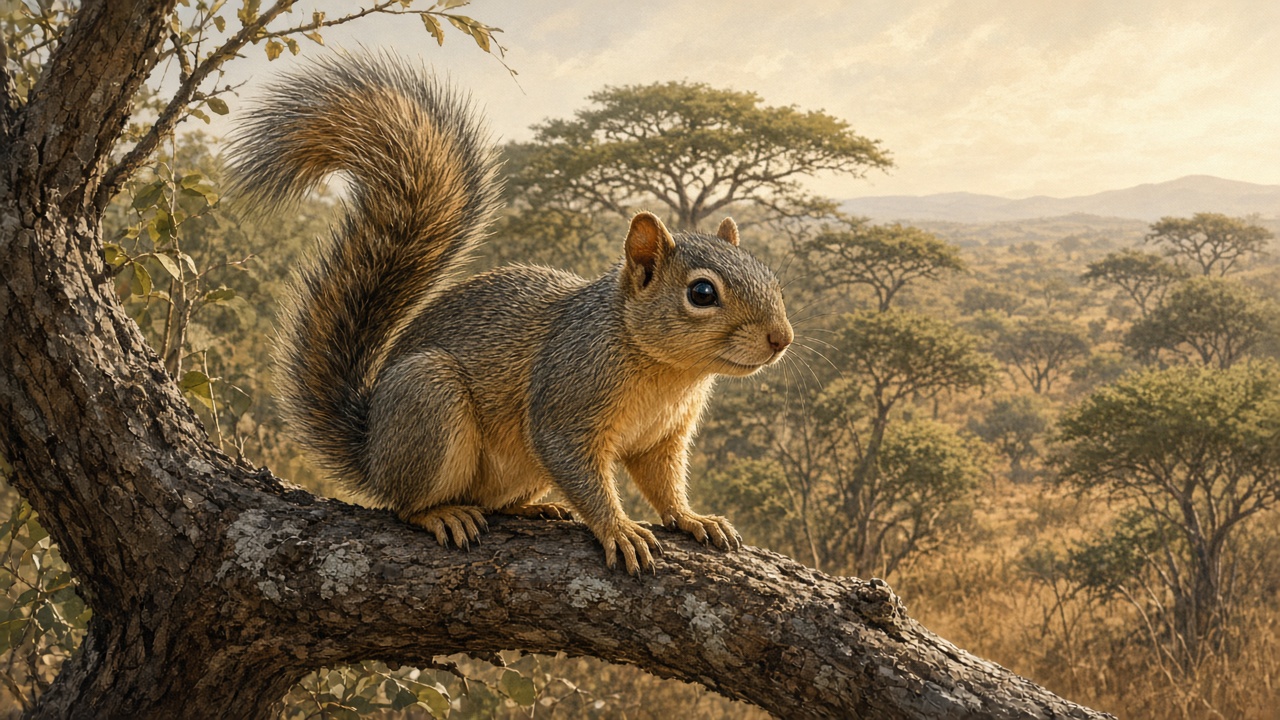
Smith's Bush Squirrel
Paraxerus cepapiSmith's Bush Squirrel (Paraxerus cepapi): ecology sheet across its documented range — natural history and habitats, without hunting framing.
Seen in: Namibia · South Africa
Overview
Smith's Bush Squirrel (Paraxerus cepapi) is an ecology sheet across its documented range: natural history and habitats, without any hunting framing.
Classification: order Rodentia, family Sciuridae, genus Paraxerus. Common names: Smith's Bush Squirrel in English, Écureuil de Smith in French, Ardilla arbórea de Smith in Spanish.
Identification
A medium-sized African bush squirrel: about 24 cm long (238.5 mm on average) and around 223 g. The back is brownish yellow or grey, the belly white or grey with a buff wash on the chest; white stripes run above and below the eye and the cheeks are a subtle brownish yellow. The long, bushy tail mixes black with yellow or brown. The sexes look alike, but colour varies by region and subspecies, some greyer, darker or with grey-white paws. ADW also gives the name yellow-footed squirrel.
Diurnal and arboreal, it comes down to the ground to collect fallen fruit. Mostly vegetarian (seeds, berries, flowers, leaves), it prefers acacia seeds and gum and aloe seeds and flowers, also eats termites and, in East Africa, insects and bird eggs. It stores food at the base of trees, which disperses savanna plant seeds. After a 56-day gestation an average of two young are born; in South Africa, births fall mainly between October and January. Snakes, raptors and carnivores are its predators.
Habitats and range
Its range runs from southern Angola, northern Namibia and Botswana to Zambia, south-eastern DR Congo, Malawi, south-western Tanzania, Mozambique, Zimbabwe and north-eastern South Africa. It settles wherever it finds suitable nesting holes, most often in savanna and in mopane and acacia woodland; it also nests in holes in the ground, between rocks and in house roofs.
The countries where the species’ presence is established are shown in the tags on this sheet.
Field signs
It lives in family groups of 2 to 12 that share a nest. When disturbed it grunts and growls; its low-intensity alarm is three “chir” or click notes, its high-intensity alarm six or seven high-pitched notes like a bird’s whistle, with tail flicking and head bobbing. It marks a territory of 0.3 to 1.26 ha by mouth wiping, urinating and anal dragging.
Conservation
For conservation status of Paraxerus cepapi, consult the current IUCN assessment and cross with national monitoring programmes in countries of documented presence. Never turn a global IUCN category into a local hunting rule. GBIF occurrences help situate distribution but remain effort-biased.
The IUCN lists it as Least Concern (MDD, ADW), and ADW knows of no adverse effects on people. MDD places it in the tribe Protoxerini and lists 20 associated names, including subspecies described by ADW (yulei, soccatus, bororensis, chobiensis, phalaena, sindi); these forms, spread on both sides of the Zambezi, differ mainly in coat colour.
Limits
This sheet on the Smith's Bush Squirrel covers biology and ecology only; it publishes no hunting season, quota or authorisation.
Local densities and management plans are not covered here: they are a matter for the managers of each area.
Sources
Sources consulted for this sheet:
- IUCN Red List — species search (consulted 2026-11-02)
- ASM Mammal Diversity Database — Paraxerus cepapi (consulted 2026-11-02)
- GBIF — species search (consulted 2026-11-02)
- Animal Diversity Web — Paraxerus cepapi (Smith’s bush squirrel) (consulted 2026-11-04)
Conclusion
In short: use the scientific name Paraxerus cepapi to cross-check sources, confirm taxonomy and conservation status on the institutional portals listed above, and relate every field sign to the habitat where it was actually found.
Identification
Paraxerus cepapi
Smith's Bush Squirrel · preferred
Écureuil de Smith · preferred
Ardilla arbórea de Smith · preferred
Classification
Class : Mammalia
Order : Rodentia
Family : Sciuridae
Genus : Paraxerus
Conservation
IUCN : LC
CITES : —
iucn · LC (global)
Habitat
Frequently asked questions
How do I recognise Smith's Bush Squirrel?
Use Paraxerus cepapi as the scientific anchor. A medium-sized African bush squirrel: about 24 cm long (238.5 mm on average) and around 223 g. The back is brownish yellow or grey, the belly white or grey with a buff wash on the chest; white stripes run above and below the eye and the cheeks are a subtle brownish yellow. The lo...
Where does Smith's Bush Squirrel typically live?
Its range runs from southern Angola, northern Namibia and Botswana to Zambia, south-eastern DR Congo, Malawi, south-western Tanzania, Mozambique, Zimbabwe and north-eastern South Africa. It settles wherever it finds suitable nesting holes, most often in savanna and in mopane and acacia woodland; it also nests in holes in the ground, between rocks and in hous...
What field signs help confirm Smith's Bush Squirrel?
It lives in family groups of 2 to 12 that share a nest. When disturbed it grunts and growls; its low-intensity alarm is three “chir” or click notes, its high-intensity alarm six or seven high-pitched notes like a bird’s whistle, with tail flicking and head bobbing. It marks a territory of 0.3 to 1.26 ha by mouth wiping, urinating and anal dragging.