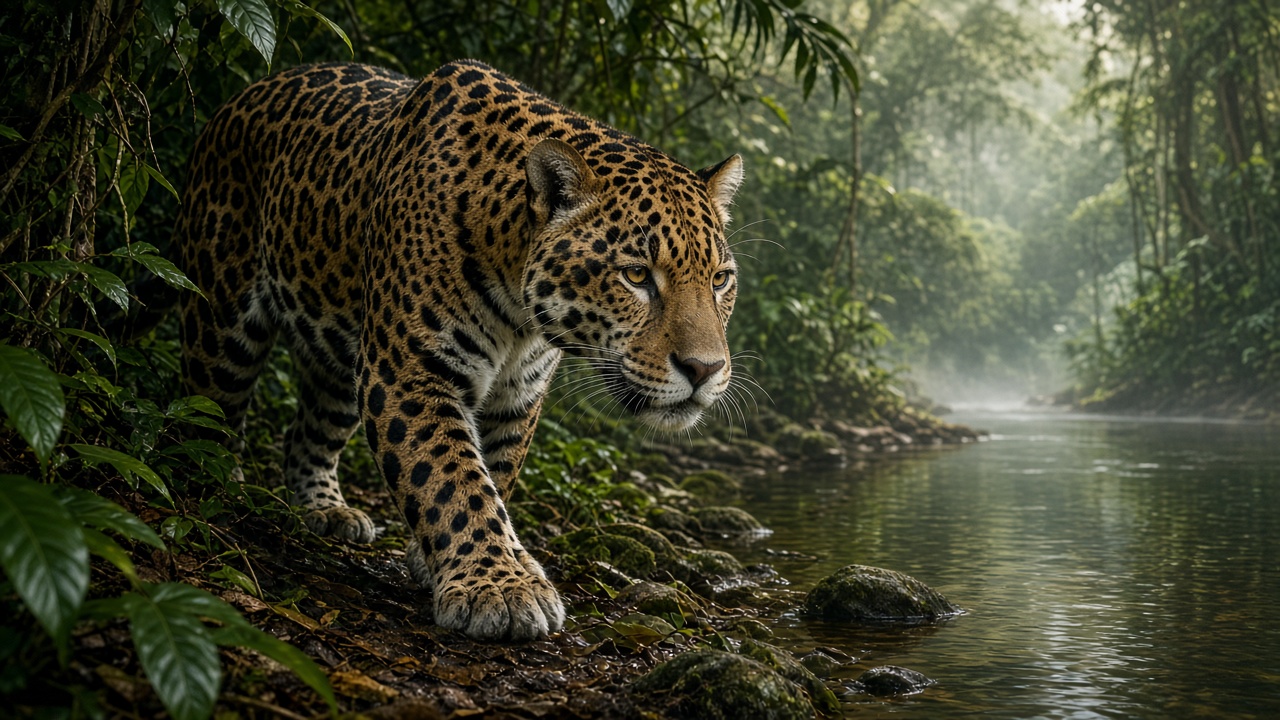
Jaguar
Panthera oncaJaguar (Panthera onca): coexistence sheet across its documented range — presence, biology and prudence, without an invented hunting status.
Seen in: Brazil · Mexico · United States
Overview
Jaguar (Panthera onca) is a coexistence sheet across its documented range: presence, biology and prudence — not a hunting status claim.
Classification: order Carnivora, family Felidae, genus Panthera. Common names: Jaguar in English, Jaguar in French, Jaguar in Spanish.
Identification
The largest cat in the Americas and the only American member of the genus Panthera, the jaguar measures 150 to 180 cm plus a 70 to 90 cm tail, stands up to 75 cm at the shoulder and weighs 68 to 136 kg. Heavily built, it has broad, square jaws and muscular limbs. The base coat ranges from pale yellow to reddish brown, with black rosettes on the neck, body and limbs; the belly is off-white. Melanistic animals, fairly common especially in forest, show only faint spots. Males are 10 to 20% larger than females.
Strictly carnivorous, it takes more than 85 prey species, preferring large animals (peccaries, tapirs, deer) but also caimans, turtles, snakes, capybaras, fish and large birds. It pounces from cover and kills with a bite to the neck or by piercing the skull, then drags its prey to a secluded spot. Solitary outside mating, it can breed year-round, with more matings from December to March; females usually give birth to 2 cubs (1 to 4) after 91 to 111 days, dependent for almost two years.
Habitats and range
MDD lists it from Mexico to northern Argentina, through Central America and Amazonia; it is recently extinct in El Salvador and Uruguay, with Arizona now holding only isolated animals. Its current range, about 8.75 million km², is 46% of its historical range. It prefers dense tropical moist lowland forest, always near water, but also uses scrub, reed thickets, coastal forest and swamps; reported up to 3,800 m in Costa Rica, it is not found above 2,700 m in the Andes.
The countries where the species’ presence is established are shown in the tags on this sheet.
Field signs
Mostly active at dawn and dusk, it rests in deep shade, under thick vegetation, in caves or under large rocks, often near river banks. It marks its territory by scraping the ground and trees and by leaving urine and scats in prominent places. Its call is a series of seven to a dozen hoarse grunts; an excellent swimmer, it frequents rivers, lagoons and swamps.
Conservation
For conservation status of Panthera onca, consult the current IUCN assessment and cross with national monitoring programmes in countries of documented presence. Never turn a global IUCN category into a local hunting rule. GBIF occurrences help situate distribution but remain effort-biased.
The IUCN lists it as Near Threatened; it is on CITES Appendix I and listed as endangered in the United States. Many populations remain stable, but it is threatened over most of its range by poaching (pelts, paws, teeth), habitat destruction and persecution in cattle-ranching areas. A top predator, it is considered a keystone species; it does not attack people unprovoked.
Limits
This sheet on the Jaguar covers presence and biology. A species being present in a country does not mean it may be hunted, and no season or quota is published here.
Local densities and management plans are not covered here: they are a matter for the managers of each area.
Sources
Sources consulted for this sheet:
- IUCN Red List — species search (consulted 2026-11-02)
- ASM Mammal Diversity Database — Panthera onca (consulted 2026-11-02)
- GBIF — species search (consulted 2026-11-02)
- Animal Diversity Web — Panthera onca (jaguar) (consulted 2026-11-04)
Conclusion
In short: use the scientific name Panthera onca to cross-check sources, confirm taxonomy and conservation status on the institutional portals listed above, and relate every field sign to the habitat where it was actually found.
Identification
Panthera onca
Jaguar · preferred
Jaguar · preferred
Jaguar · preferred
Classification
Class : Mammalia
Order : Carnivora
Family : Felidae
Genus : Panthera
Conservation
IUCN : NT
CITES : —
iucn · NT (global)
Frequently asked questions
How do I recognise Jaguar?
Use Panthera onca as the scientific anchor. The largest cat in the Americas and the only American member of the genus Panthera, the jaguar measures 150 to 180 cm plus a 70 to 90 cm tail, stands up to 75 cm at the shoulder and weighs 68 to 136 kg. Heavily built, it has broad, square jaws and muscular limbs. The base coat ra...
Where does Jaguar typically live?
MDD lists it from Mexico to northern Argentina, through Central America and Amazonia; it is recently extinct in El Salvador and Uruguay, with Arizona now holding only isolated animals. Its current range, about 8.75 million km², is 46% of its historical range. It prefers dense tropical moist lowland forest, always near water, but also uses scrub, reed thicket...
What field signs help confirm Jaguar?
Mostly active at dawn and dusk, it rests in deep shade, under thick vegetation, in caves or under large rocks, often near river banks. It marks its territory by scraping the ground and trees and by leaving urine and scats in prominent places. Its call is a series of seven to a dozen hoarse grunts; an excellent swimmer, it frequents rivers, lagoons and swamps...