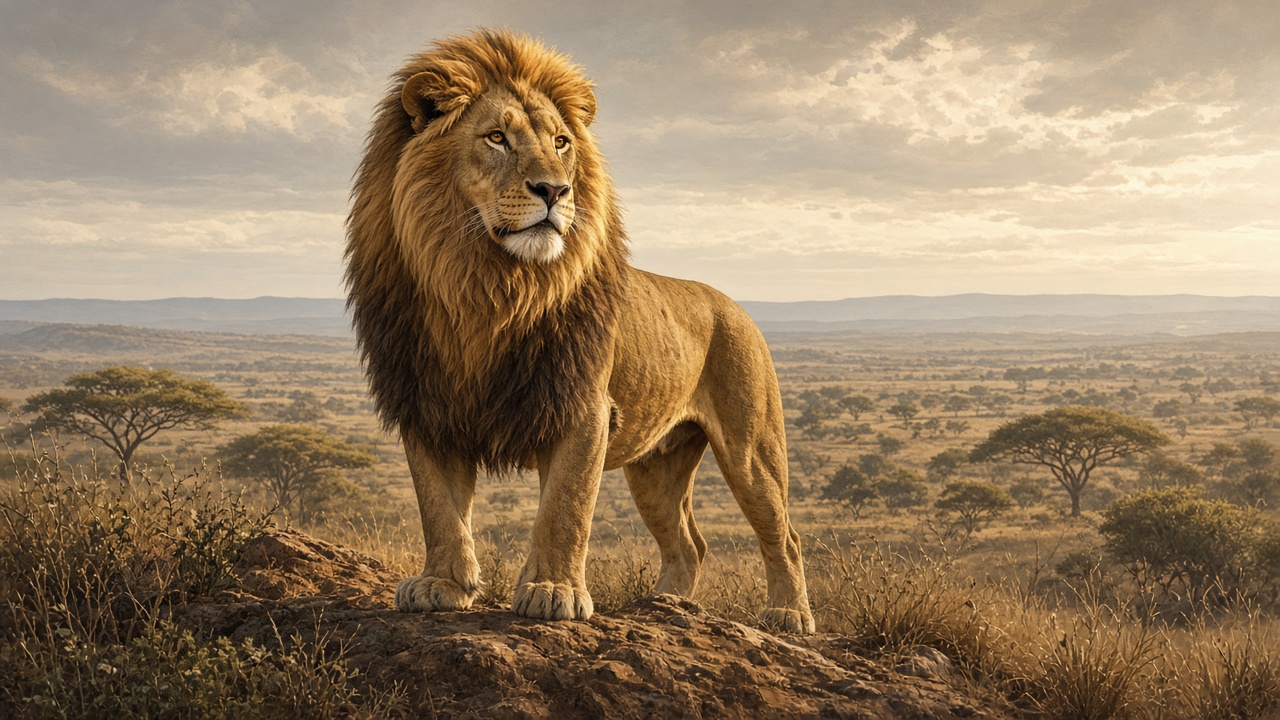
Lion (Panthera leo): coexistence sheet across its documented range — presence, biology and prudence, without an invented hunting status.
Seen in: Namibia · South Africa
Overview
Lion (Panthera leo) is a coexistence sheet across its documented range: presence, biology and prudence — not a hunting status claim.
Classification: order Carnivora, family Felidae, genus Panthera. Common names: Lion in English, Lion in French, León in Spanish.
Identification
A large cat with a short tawny coat, white underparts and a long tail ending in a black tuft, the lion measures 2.4 to 3.3 m long, including 0.6 to 1 m of tail. Males, the only cats with a mane, average 189 kg (record 272 kg) and females 126 kg; the mane grows from about three years old, blond to black, fuller in open habitats. Cubs have a greyish coat with brown spots until three months. The Asiatic lion is slightly smaller, with a shorter mane and a fold of skin along the belly.
It lives in prides of 2 to 40 (13 on average in Kruger and the Serengeti) made up of related females, taken over by coalitions of males that often kill the cubs of their predecessors. It breeds year-round with a peak in the rainy season: 1 to 6 cubs are born after three and a half months and weaned at 7 to 10 months. Females do most of the hunting, mainly zebra, wildebeest, impala and gazelles, sometimes buffalo or giraffe, at night and in the early morning; lions also scavenge by following hyenas and vultures.
Habitats and range
MDD gives it across much of sub-Saharan Africa and in India; it has recently disappeared from North Africa and the Middle East (Morocco, Algeria, Egypt, Turkey, Iraq and Syria, among others). It prefers plains and savanna with plenty of ungulates and some cover, but also lives in wooded, shrubby, mountainous or semi-desert country, never in tropical rainforest or true desert; one population reaches 4,240 m in Ethiopia’s Bale Mountains. The Asiatic lion survives in the scrub and teak forest of Gir, India.
The countries where the species’ presence is established are shown in the tags on this sheet.
Field signs
The roar, louder and deeper in males, advertises the territory and is often given in chorus. Resident males spray vegetation with urine and scuff the ground. Where prey is plentiful it sleeps about twenty hours a day; prides become active in the late afternoon, greeting with head rubs and raised tails. Home ranges cover 20 to 400 km².
Conservation
For conservation status of Panthera leo, consult the current IUCN assessment and cross with national monitoring programmes in countries of documented presence. Never turn a global IUCN category into a local hunting rule. GBIF occurrences help situate distribution but remain effort-biased.
The IUCN lists it as Vulnerable. ADW describes a steep decline in West Africa, populations often confined to protected areas and at risk of genetic isolation, and poaching with snares and poisoned carcasses. The Asiatic lion of Gir numbers fewer than 200 adults. The Barbary and Cape lions are extinct subspecies; the validity of African subspecies is still debated.
Limits
This sheet on the Lion covers presence and biology. A species being present in a country does not mean it may be hunted, and no season or quota is published here.
Local densities and management plans are not covered here: they are a matter for the managers of each area.
Sources
Sources consulted for this sheet:
- IUCN Red List — species search (consulted 2026-11-02)
- ASM Mammal Diversity Database — Panthera leo (consulted 2026-11-02)
- GBIF — species search (consulted 2026-11-02)
- Animal Diversity Web — Panthera leo (lion) (consulted 2026-11-04)
Conclusion
In short: use the scientific name Panthera leo to cross-check sources, confirm taxonomy and conservation status on the institutional portals listed above, and relate every field sign to the habitat where it was actually found.
Identification
Panthera leo
Lion · preferred
Lion · preferred
León · preferred
Classification
Class : Mammalia
Order : Carnivora
Family : Felidae
Genus : Panthera
Conservation
IUCN : VU
CITES : —
iucn · VU (global)
Habitat
Frequently asked questions
How do I recognise Lion?
Use Panthera leo as the scientific anchor. A large cat with a short tawny coat, white underparts and a long tail ending in a black tuft, the lion measures 2.4 to 3.3 m long, including 0.6 to 1 m of tail. Males, the only cats with a mane, average 189 kg (record 272 kg) and females 126 kg; the mane grows from about three ye...
Where does Lion typically live?
MDD gives it across much of sub-Saharan Africa and in India; it has recently disappeared from North Africa and the Middle East (Morocco, Algeria, Egypt, Turkey, Iraq and Syria, among others). It prefers plains and savanna with plenty of ungulates and some cover, but also lives in wooded, shrubby, mountainous or semi-desert country, never in tropical rainfore...
What field signs help confirm Lion?
The roar, louder and deeper in males, advertises the territory and is often given in chorus. Resident males spray vegetation with urine and scuff the ground. Where prey is plentiful it sleeps about twenty hours a day; prides become active in the late afternoon, greeting with head rubs and raised tails. Home ranges cover 20 to 400 km².