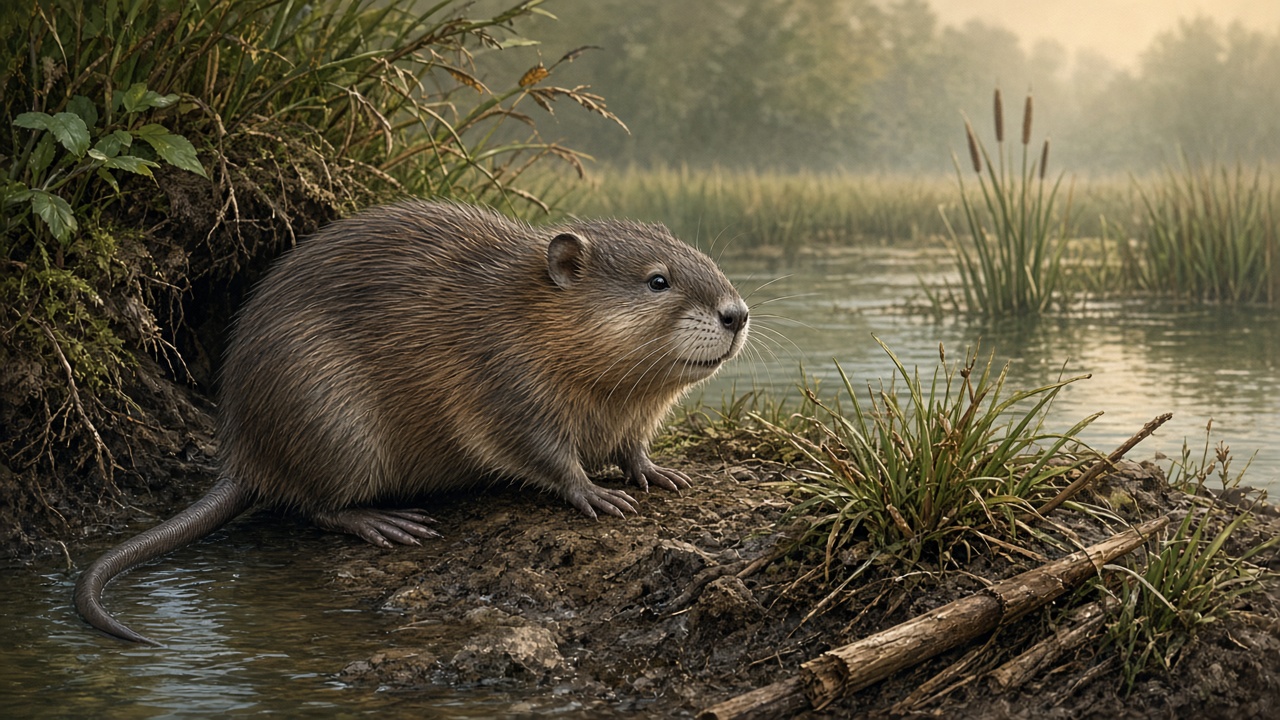
Common Muskrat
Ondatra zibethicusCommon Muskrat (Ondatra zibethicus): ecology sheet across its documented range — natural history and habitats, without hunting framing.
Seen in: Belgium · Czechia · Denmark · France · Germany
Overview
Common Muskrat (Ondatra zibethicus) is an ecology sheet across its documented range: natural history and habitats, without any hunting framing.
Classification: order Rodentia, family Cricetidae, genus Ondatra. Common names: Common Muskrat in English, Rat musqué in French, Rata almizclera in Spanish.
Identification
The muskrat is a large aquatic rodent, 41 to 62 cm in total length, about 24 cm of it tail, and 680 g to 1.8 kg (1.1 kg on average). The tail is flattened and scaly. Dense fur traps air for insulation and buoyancy; the glossy dark brown upperparts are darker in winter than in summer. The head is large, the ears almost hidden in the fur, and the legs short with large paws, the hind ones slightly webbed. Males and females look alike.
Southern populations breed all year, northern ones from March to August. After 29 to 30 days of gestation an average of six young are born, more in the north, in a grass-lined nest; they swim at 10 days and are weaned at 3 to 4 weeks. Muskrats live in large family groups on defined territories. Active at any hour, mostly from mid-afternoon until just after dusk, they can stay underwater for 12 to 17 minutes. Mainly vegetarian, a muskrat eats a third of its weight daily: roots of aquatic plants in summer, crops and sometimes animals. American mink, raccoons, river otters, coyotes, owls and harriers prey on it.
Habitats and range
Native to North America, it ranges from the treeline, including Newfoundland, south to the Gulf of Mexico and the Rio Grande and lower Colorado valleys. It lives in marshes, swamps, ponds, lakes and streams, favouring marshes with a constant water level and 1.2 to 1.8 m of water. It shelters in burrows dug into banks or in lodges of piled vegetation built on a base such as a stump, often in 40 cm to 1 m of water. Introduced to the Czech Republic in 1905, it is now widespread across much of the Palearctic.
The countries where the species’ presence is established are shown in the tags on this sheet.
Field signs
Lodges of heaped vegetation in shallow water and burrows dug into banks give it away. It is mostly seen swimming, from mid-afternoon to dusk; slow on land, it dives to escape. In winter it swims under the ice to reach plants. It scent-marks with musk, which also warns intruders, and gives squeaks and squeals. Its tunnels weaken dikes and it sometimes plugs farm drain tiles.
Conservation
For conservation status of Ondatra zibethicus, consult the current IUCN assessment and cross with national monitoring programmes in countries of documented presence. Never turn a global IUCN category into a local hunting rule. GBIF occurrences help situate distribution but remain effort-biased.
The IUCN lists it as Least Concern: widespread and abundant, it keeps its numbers up through rapid breeding despite disease and predation. Outside its native range, MDD records it in central and northern Europe, most of Ukraine, Russia and Siberia, Mongolia, China, north-eastern Korea, Honshu (Japan) and southernmost Argentina.
Limits
This sheet on the Common Muskrat covers biology and ecology only; it publishes no hunting season, quota or authorisation.
Local densities and management plans are not covered here: they are a matter for the managers of each area.
Sources
Sources consulted for this sheet:
- IUCN Red List — species search (consulted 2026-11-02)
- ASM Mammal Diversity Database — Ondatra zibethicus (consulted 2026-11-02)
- GBIF — species search (consulted 2026-11-02)
- Animal Diversity Web — Ondatra zibethicus (muskrat) (consulted 2026-11-04)
Conclusion
In short: use the scientific name Ondatra zibethicus to cross-check sources, confirm taxonomy and conservation status on the institutional portals listed above, and relate every field sign to the habitat where it was actually found.
Identification
Ondatra zibethicus
Rat musqué · preferred
Rata almizclera · preferred
Common Muskrat · preferred
Muskbeaver
Classification
Class : Mammalia
Order : Rodentia
Family : Cricetidae
Genus : Ondatra
Conservation
IUCN : LC
CITES : —
iucn · LC (global)
Habitat
Frequently asked questions
How do I recognise Common Muskrat?
Use Ondatra zibethicus as the scientific anchor. The muskrat is a large aquatic rodent, 41 to 62 cm in total length, about 24 cm of it tail, and 680 g to 1.8 kg (1.1 kg on average). The tail is flattened and scaly. Dense fur traps air for insulation and buoyancy; the glossy dark brown upperparts are darker in winter than in sum...
Where does Common Muskrat typically live?
Native to North America, it ranges from the treeline, including Newfoundland, south to the Gulf of Mexico and the Rio Grande and lower Colorado valleys. It lives in marshes, swamps, ponds, lakes and streams, favouring marshes with a constant water level and 1.2 to 1.8 m of water. It shelters in burrows dug into banks or in lodges of piled vegetation built on...
What field signs help confirm Common Muskrat?
Lodges of heaped vegetation in shallow water and burrows dug into banks give it away. It is mostly seen swimming, from mid-afternoon to dusk; slow on land, it dives to escape. In winter it swims under the ice to reach plants. It scent-marks with musk, which also warns intruders, and gives squeaks and squeals. Its tunnels weaken dikes and it sometimes plugs f...