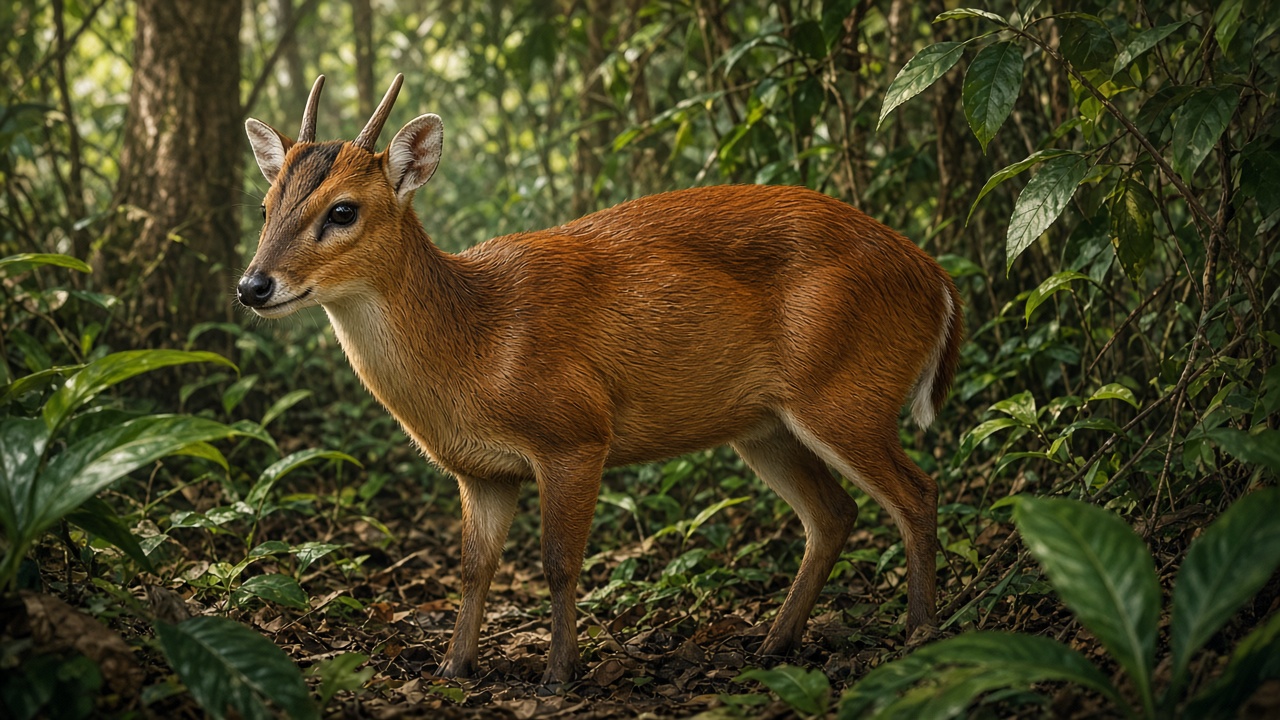
Southern Red Muntjac
Muntiacus muntjakNo solid country presence documented yet.
Southern Red Muntjac (Muntiacus muntjak): biology, habitats and field signs across its documented range, hunting-context reading.
Overview
Southern Red Muntjac (Muntiacus muntjak) is presented here in a hunting-context reading across its documented range: biology, habitats and field signs useful to observers — without publishing season, quota or authorisation.
Classification: order Artiodactyla, family Cervidae, genus Muntiacus. Common names: Southern Red Muntjac in English, Muntjac de Sumatra in French, Muntíaco rojo in Spanish.
Identification
A small deer with a short coat, golden tan on the back and white below, with dark brown legs and face and almost hairless ears. ADW, which describes the species in the broad sense, including the mainland red muntjacs now treated as separate, gives a length of 89 to 135 cm, 40 to 65 cm at the shoulder, a 13 to 23 cm tail and 14 to 35 kg, males being larger. Males carry short antlers and tusk-like upper canines about 2.5 cm long; females have only tufts of hair and small bony knobs where the antlers would be.
An omnivore, it eats herbs, fruit, sprouts, seeds and grasses, as well as bird eggs and small animals, which it catches by biting with its canines and striking with its forelegs. Adult males and females live alone, and their ranges overlap only briefly during the rut. Breeding is not seasonal: after a gestation of about 180 days, usually a single young of 550 to 650 g is born, and it leaves its mother’s territory at about six months. It is active by day and by night. ADW lists pythons, tigers, leopards and crocodiles among its predators.
Habitats and range
As currently defined (MDD), it lives in Peninsular Malaysia and the Sunda Islands: Sumatra, Borneo, Java, Bali, Lombok and many smaller Indonesian islands, covering Brunei, Indonesia, Malaysia, Thailand and possibly Singapore, where the Biodiversity of Singapore site treats it as native but locally extirpated. It uses rainforest, areas of dense vegetation, hilly country and monsoon forest, preferably close to water.
The countries where the species’ presence is established are shown in the tags on this sheet.
Field signs
Its English name of barking deer comes from its call: when it senses a predator it gives dog-like barks, sometimes for more than an hour, and more often when vegetation limits visibility. Solitary, it is usually seen alone, by day or by night. Where it is numerous, it strips the bark from many trees, leaving clearly visible damage.
Conservation
For conservation status of Muntiacus muntjak, consult the current IUCN assessment and cross with national monitoring programmes in countries of documented presence. Never turn a global IUCN category into a local hunting rule. GBIF occurrences help situate distribution but remain effort-biased.
The IUCN lists it as Least Concern. According to MDD, the species formerly included M. vaginalis, to which the name malabaricus was tentatively attached, and M. montanus: older descriptions and figures, including those of ADW, therefore apply to the whole complex. In Malay it is called kijang.
Limits
This sheet on the Southern Red Muntjac publishes no season, quota, hunting method or fee: those rules differ between countries and territories and must be checked in official texts. Being described here does not mean a species may be hunted.
Local densities and management plans are not covered here: they are a matter for the managers of each area.
Sources
Sources consulted for this sheet:
- IUCN Red List — species search (consulted 2026-11-02)
- ASM Mammal Diversity Database — Muntiacus muntjak (consulted 2026-11-02)
- GBIF — species search (consulted 2026-11-02)
- Animal Diversity Web — Muntiacus muntjak (Indian muntjac, broad sense) (consulted 2026-11-04)
- Biodiversity of Singapore (Lee Kong Chian Natural History Museum) — Muntiacus muntjak (consulted 2026-11-04)
Conclusion
In short: use the scientific name Muntiacus muntjak to cross-check sources, confirm taxonomy and conservation status on the institutional portals listed above, and relate every field sign to the habitat where it was actually found.
Identification
Muntiacus muntjak
Muntjac de Sumatra · preferred
Muntíaco rojo · preferred
Southern Red Muntjac · preferred
Sundaic Red Muntjak
Classification
Class : Mammalia
Order : Artiodactyla
Family : Cervidae
Genus : Muntiacus
Conservation
IUCN : LC
CITES : —
iucn · LC (global)
Frequently asked questions
How do I recognise Southern Red Muntjac?
Use Muntiacus muntjak as the scientific anchor. A small deer with a short coat, golden tan on the back and white below, with dark brown legs and face and almost hairless ears. ADW, which describes the species in the broad sense, including the mainland red muntjacs now treated as separate, gives a length of 89 to 135 cm, 40 to...
Where does Southern Red Muntjac typically live?
As currently defined (MDD), it lives in Peninsular Malaysia and the Sunda Islands: Sumatra, Borneo, Java, Bali, Lombok and many smaller Indonesian islands, covering Brunei, Indonesia, Malaysia, Thailand and possibly Singapore, where the Biodiversity of Singapore site treats it as native but locally extirpated. It uses rainforest, areas of dense vegetation, h...
What field signs help confirm Southern Red Muntjac?
Its English name of barking deer comes from its call: when it senses a predator it gives dog-like barks, sometimes for more than an hour, and more often when vegetation limits visibility. Solitary, it is usually seen alone, by day or by night. Where it is numerous, it strips the bark from many trees, leaving clearly visible damage.