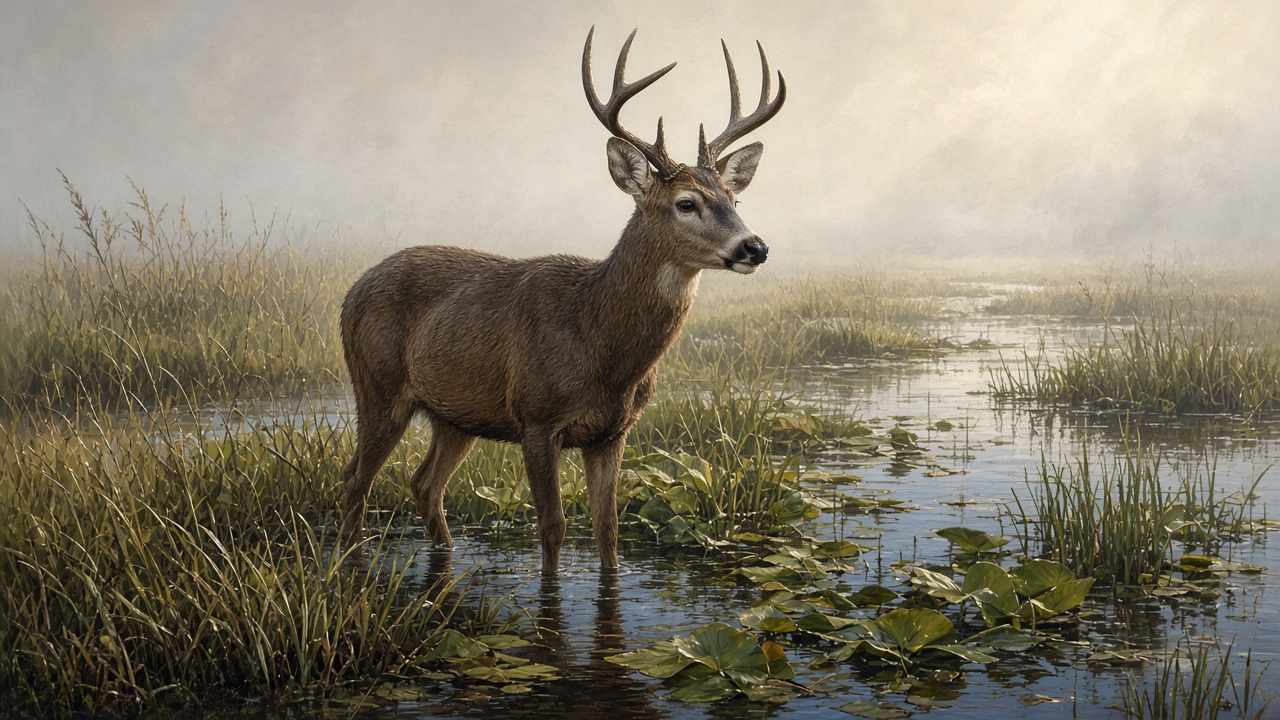
Marsh Deer (Blastocerus dichotomus): biology, habitats and field signs across its documented range, hunting-context reading.
Seen in: Argentina
Overview
Marsh Deer (Blastocerus dichotomus) is presented here in a hunting-context reading across its documented range: biology, habitats and field signs useful to observers — without publishing season, quota or authorisation.
Classification: order Artiodactyla, family Cervidae, genus Blastocerus. Common names: Marsh Deer in English, Cerf des marais in French, Ciervo de los pantanos in Spanish.
Identification
The marsh deer is the largest South American deer: just under 2 m long, 1 to 1.2 m at the shoulder and 89 to 125 kg, averaging 109 kg. Mature males carry large, branched antlers with eight to ten points. The coat is reddish brown in summer and darker in winter; the bushy, reddish-orange tail measures 10 to 15 cm. The legs are black below the wrist and hock, a black band crosses the muzzle, and the eyes and ear edges are ringed with white. Its large hooves are joined by an elastic membrane, which may help keep it from sinking into mud.
A herbivore, it eats mainly aquatic and riverside plants: water lilies and other leaves, grasses and browse; in one study grasses made up about half of the diet and legumes 31%. Generally crepuscular, it may become diurnal or nocturnal depending on season and disturbance. The rut mostly takes place in October–November, though not at a fixed time, and males are not particularly aggressive towards each other. Fawns are born singly and without spots. Males do not shed their antlers at a set time and may keep them for nearly two years.
Habitats and range
MDD gives its range as northern Argentina, Bolivia, Brazil south of the Amazon, Paraguay and eastern Peru; it is probably extinct in Uruguay. Its core range lies in the Paraguay and Paraná river basins. It seeks marshy ground with standing water and dense vegetation, uses flooded savannas in the wet season and stays close to reed beds by permanent water in the dry season.
The countries where the species’ presence is established are shown in the tags on this sheet.
Field signs
It is mostly seen at dawn and dusk, alone or in small groups of two to five. Scattered in the wet season, it concentrates near water in the dry season, when it is easier to observe. In the Paraná basin, densities of about 0.5 deer per km² have been recorded. The male’s large branched antlers, the black legs and the orange tail are useful field marks.
Conservation
For conservation status of Blastocerus dichotomus, consult the current IUCN assessment and cross with national monitoring programmes in countries of documented presence. Never turn a global IUCN category into a local hunting rule. GBIF occurrences help situate distribution but remain effort-biased.
The IUCN lists it as Vulnerable. Uncontrolled hunting and habitat destruction have reduced it to small, highly fragmented populations; large water projects, such as the Hidrovia scheme on the Paraguay and Paraná rivers and hydroelectric dams, threaten what remains, and it is very susceptible to cattle diseases. Once common in Argentina, only a few hundred may survive there. The genus name is sometimes wrongly spelled “Blastoceros”.
Limits
This sheet on the Marsh Deer publishes no season, quota, hunting method or fee: those rules differ between countries and territories and must be checked in official texts. Being described here does not mean a species may be hunted.
Local densities and management plans are not covered here: they are a matter for the managers of each area.
Sources
Sources consulted for this sheet:
- IUCN Red List — species search (consulted 2026-11-02)
- ASM Mammal Diversity Database — Blastocerus dichotomus (consulted 2026-11-02)
- GBIF — species search (consulted 2026-11-02)
- Animal Diversity Web — Blastocerus dichotomus (marsh deer) (consulted 2026-11-04)
Conclusion
In short: use the scientific name Blastocerus dichotomus to cross-check sources, confirm taxonomy and conservation status on the institutional portals listed above, and relate every field sign to the habitat where it was actually found.
Identification
Blastocerus dichotomus
Marsh Deer · preferred
Cerf des marais · preferred
Ciervo de los pantanos · preferred
Classification
Class : Mammalia
Order : Artiodactyla
Family : Cervidae
Genus : Blastocerus
Conservation
IUCN : VU
CITES : —
iucn · VU (global)
Habitat
Frequently asked questions
How do I recognise Marsh Deer?
Use Blastocerus dichotomus as the scientific anchor. The marsh deer is the largest South American deer: just under 2 m long, 1 to 1.2 m at the shoulder and 89 to 125 kg, averaging 109 kg. Mature males carry large, branched antlers with eight to ten points. The coat is reddish brown in summer and darker in winter; the bushy, reddish...
Where does Marsh Deer typically live?
MDD gives its range as northern Argentina, Bolivia, Brazil south of the Amazon, Paraguay and eastern Peru; it is probably extinct in Uruguay. Its core range lies in the Paraguay and Paraná river basins. It seeks marshy ground with standing water and dense vegetation, uses flooded savannas in the wet season and stays close to reed beds by permanent water in t...
What field signs help confirm Marsh Deer?
It is mostly seen at dawn and dusk, alone or in small groups of two to five. Scattered in the wet season, it concentrates near water in the dry season, when it is easier to observe. In the Paraná basin, densities of about 0.5 deer per km² have been recorded. The male’s large branched antlers, the black legs and the orange tail are useful field marks.