Sloth Bear
Melursus ursinusNo solid country presence documented yet.
Sloth Bear (Melursus ursinus): coexistence sheet across its documented range — presence, biology and prudence, without an invented hunting status.
Overview
Sloth Bear (Melursus ursinus) is a coexistence sheet across its documented range: presence, biology and prudence — not a hunting status claim.
Classification: order Carnivora, family Ursidae, genus Melursus. Common names: Sloth Bear in English, Ours lippu in French, Oso bezudo in Spanish.
Identification
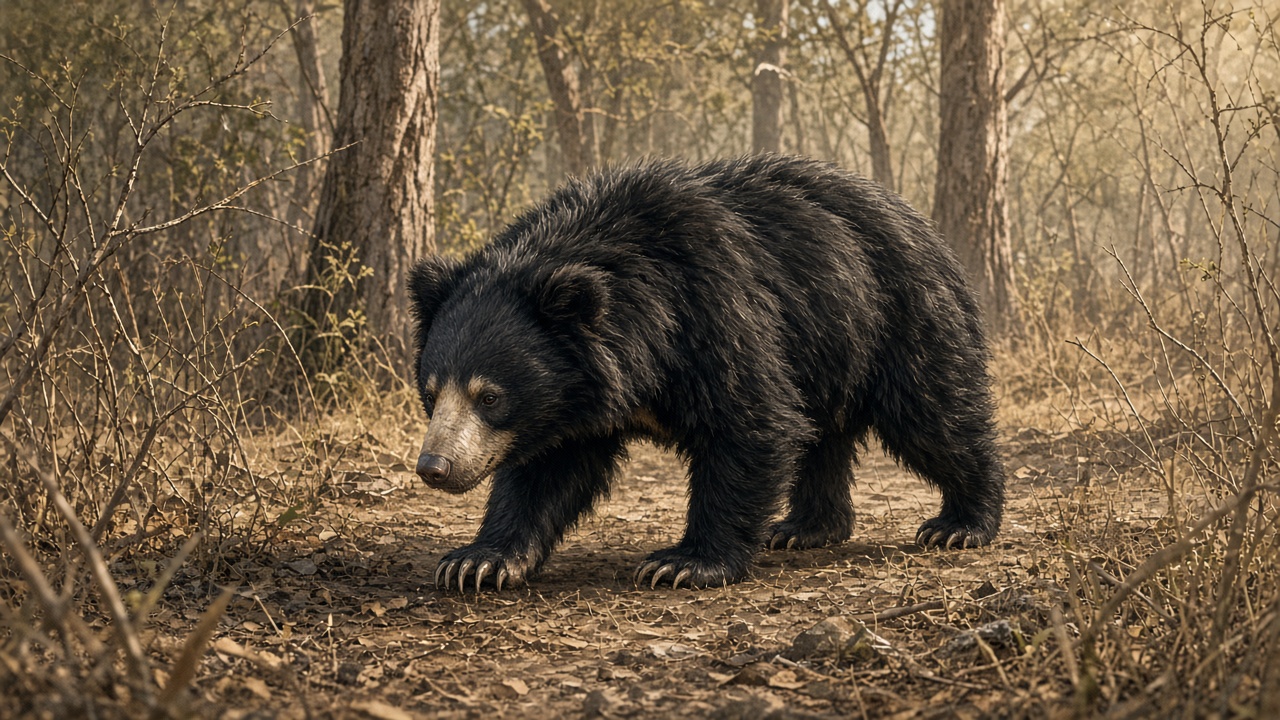
The sloth bear stands 60 to 90 cm at the shoulder and measures 1.5 to 1.9 m; females weigh 55 to 95 kg and males, 30 to 40% heavier, 80 to 140 kg. Its shaggy black coat is especially thick over the shoulders; brown and grey hairs give some bears a cinnamon tinge. The grey face looks almost naked. The snout is long and mobile, the tongue very large, and it can close its nostrils at will. A light U- or Y-shaped chest patch, white to yellow or chestnut brown, and enormous claws complete the picture.
An omnivore, it eats a large share of insects, especially termites and bees, plus leaves, honey, flowers and fruit; from March to June fruit can make up half the diet. Mainly nocturnal and solitary apart from mothers with cubs, it does not hibernate but is inactive during the rainy season. In India it mates mostly in June; births of one or two cubs cluster from September to January after 6 to 7 months of gestation. Cubs often ride on their mother’s back. Tigers and leopards are its predators.
Habitats and range
MDD lists it from Bangladesh, Bhutan, India (north to the Indian desert and the Himalayan foothills), Nepal and Sri Lanka. It lives mainly in tropical areas, in forest and grassland, more often at low elevations, and seems to prefer drier forests and areas with rocky outcrops. ADW notes it was fairly common in India and Sri Lanka until about twenty years before and has since become harder to find.
The countries where the species’ presence is established are shown in the tags on this sheet.
Field signs
It spends the day in caves, especially along river banks. Termite mounds ripped open by its claws reveal its presence: it pushes its snout in, blows away the earth and sucks up the termites, with puffing and belching audible up to 185 m away. Its poor sight and hearing let people come close, and it defends itself vigorously when threatened. It enters sugar cane and maize fields.
Conservation
For conservation status of Melursus ursinus, consult the current IUCN assessment and cross with national monitoring programmes in countries of documented presence. Never turn a global IUCN category into a local hunting rule. GBIF occurrences help situate distribution but remain effort-biased.
The IUCN lists it as Vulnerable; it is on CITES Appendix I. Numbers are falling fast as forests are destroyed (Sri Lanka lost about 1.85 million hectares of natural high forest between 1956 and 1983) and termite mounds are dug up. It has also been killed for its aggressive reputation and crop damage; in central India it causes many attacks on people. Its gall bladder and fat are used in traditional medicine.
Limits
This sheet on the Sloth Bear covers presence and biology. A species being present in a country does not mean it may be hunted, and no season or quota is published here.
Local densities and management plans are not covered here: they are a matter for the managers of each area.
Sources
Sources consulted for this sheet:
- IUCN Red List — species search (consulted 2026-11-02)
- ASM Mammal Diversity Database — Melursus ursinus (consulted 2026-11-02)
- GBIF — species search (consulted 2026-11-02)
- Animal Diversity Web — Melursus ursinus (sloth bear) (consulted 2026-11-04)
Conclusion
In short: use the scientific name Melursus ursinus to cross-check sources, confirm taxonomy and conservation status on the institutional portals listed above, and relate every field sign to the habitat where it was actually found.
Identification
Melursus ursinus
Ours lippu · preferred
Oso bezudo · preferred
Sloth Bear · preferred
Honey Bear
Lip Bear
Classification
Class : Mammalia
Order : Carnivora
Family : Ursidae
Genus : Melursus
Conservation
IUCN : VU
CITES : —
iucn · VU (global)
Frequently asked questions
How do I recognise Sloth Bear?
Use Melursus ursinus as the scientific anchor. The sloth bear stands 60 to 90 cm at the shoulder and measures 1.5 to 1.9 m; females weigh 55 to 95 kg and males, 30 to 40% heavier, 80 to 140 kg. Its shaggy black coat is especially thick over the shoulders; brown and grey hairs give some bears a cinnamon tinge. The grey face lo...
Where does Sloth Bear typically live?
MDD lists it from Bangladesh, Bhutan, India (north to the Indian desert and the Himalayan foothills), Nepal and Sri Lanka. It lives mainly in tropical areas, in forest and grassland, more often at low elevations, and seems to prefer drier forests and areas with rocky outcrops. ADW notes it was fairly common in India and Sri Lanka until about twenty years bef...
What field signs help confirm Sloth Bear?
It spends the day in caves, especially along river banks. Termite mounds ripped open by its claws reveal its presence: it pushes its snout in, blows away the earth and sucks up the termites, with puffing and belching audible up to 185 m away. Its poor sight and hearing let people come close, and it defends itself vigorously when threatened. It enters sugar c...