Himalayan Marmot
Marmota himalayanaNo solid country presence documented yet.
Himalayan Marmot (Marmota himalayana): ecology sheet across its documented range — natural history and habitats, without hunting framing.
Overview
Himalayan Marmot (Marmota himalayana) is an ecology sheet across its documented range: natural history and habitats, without any hunting framing.
Classification: order Rodentia, family Sciuridae, genus Marmota. Common names: Himalayan Marmot in English, Marmotte de l'Himalaya in French, Marmota del Himalaya in Spanish.
Identification
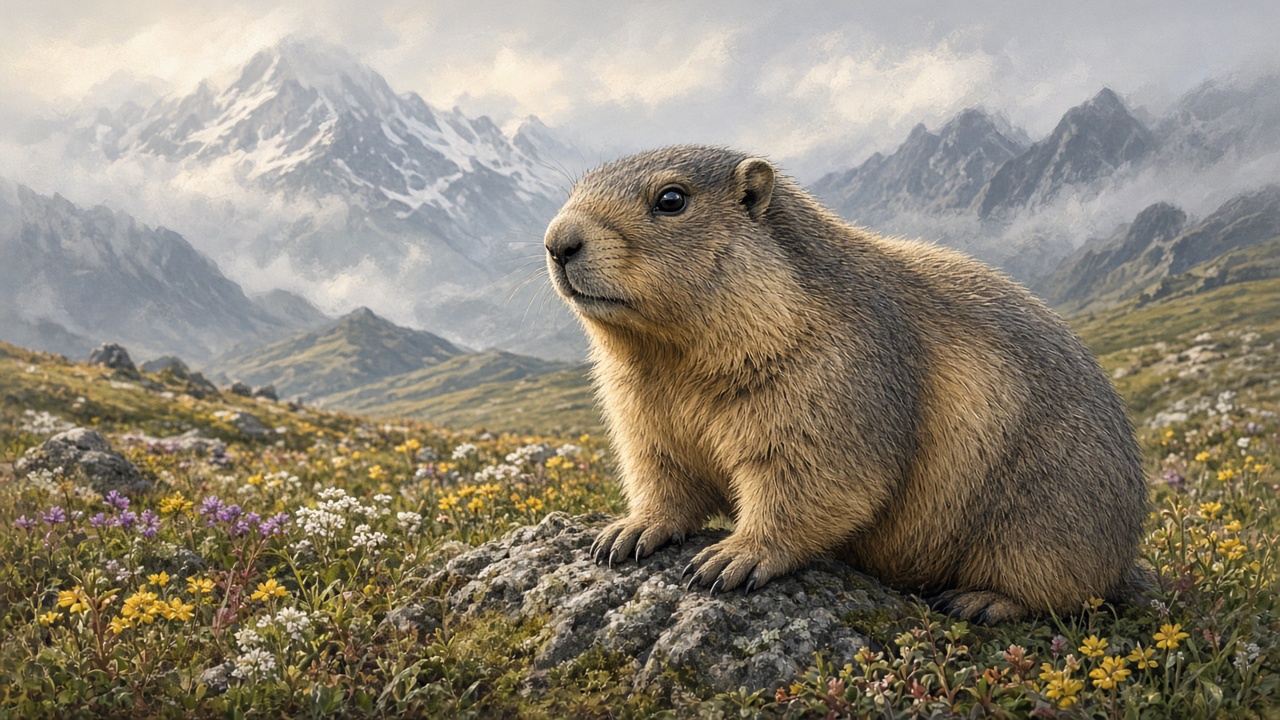
About the size of a house cat, it is a particularly stout marmot, generally larger than other marmots in its range: 475 to 670 mm long and 4 to 9.2 kg, with the subspecies robusta exceeding 6 kg. The tail (125 to 150 mm) and ears (23 to 30 mm) are short, the hind paws very large (76 to 100 mm). The back is yellow to brown, often with irregular black or blackish-brown spots, especially on the face and muzzle; the belly is buff-yellow to russet. No sexual dimorphism has been reported.
Diurnal and social, it lives in colonies of up to 30 animals depending on resources. It hibernates for 6 to 8 months. Mating takes place in February–March, gestation lasts up to a month and young are born in late spring: 2 to 11 per litter, about 7 on average at low density and 4.8 at high density, nursed for about 15 days. A herbivore, it avoids bitter old growth and sometimes grazes the same pastures as yaks. Snow leopards, Tibetan wolves, bearded vultures, golden eagles and brown bears prey on it.
Habitats and range
MDD lists it for China, India, Nepal and Pakistan, in the mountains of western China, Nepal and northern India to Ladakh; ADW highlights the Tibetan Plateau. It lives mostly between the treeline and the snowline, at 3,500 to 5,200 m (from 2,500 m), in dry, open habitats such as alpine meadows, grasslands and deserts, on light, deep soils suitable for digging.
The countries where the species’ presence is established are shown in the tags on this sheet.
Field signs
Its burrows are very deep, 2 to 3.5 m, and up to 10 m for hibernation. Most active in the morning and late afternoon, marmots greet each other nose to nose on leaving the burrow and play-fight. Adult males stay out on watch for long periods until August. The alarm call is a series of very short notes, repeated every 5 to 20 seconds.
Conservation
For conservation status of Marmota himalayana, consult the current IUCN assessment and cross with national monitoring programmes in countries of documented presence. Never turn a global IUCN category into a local hunting rule. GBIF occurrences help situate distribution but remain effort-biased.
The IUCN lists it as Least Concern; locally abundant, it shows no sign of decline and lives largely in habitats protected for the snow leopard, for which it makes up nearly 20% of the diet. MDD also gives the name Karakoram Marmot and lists robusta, described from Sichuan, among its synonyms. Its flesh has been used in traditional Tibetan medicine.
Limits
This sheet on the Himalayan Marmot covers biology and ecology only; it publishes no hunting season, quota or authorisation.
Local densities and management plans are not covered here: they are a matter for the managers of each area.
Sources
Sources consulted for this sheet:
- IUCN Red List — species search (consulted 2026-11-02)
- ASM Mammal Diversity Database — Marmota himalayana (consulted 2026-11-02)
- GBIF — species search (consulted 2026-11-02)
- Animal Diversity Web — Marmota himalayana (Himalayan marmot) (consulted 2026-11-04)
Conclusion
In short: use the scientific name Marmota himalayana to cross-check sources, confirm taxonomy and conservation status on the institutional portals listed above, and relate every field sign to the habitat where it was actually found.
Identification
Marmota himalayana
Marmotte de l'Himalaya · preferred
Marmota del Himalaya · preferred
Himalayan Marmot · preferred
Karakoram Marmot
Classification
Class : Mammalia
Order : Rodentia
Family : Sciuridae
Genus : Marmota
Conservation
IUCN : LC
CITES : —
iucn · LC (global)
Habitat
Frequently asked questions
How do I recognise Himalayan Marmot?
Use Marmota himalayana as the scientific anchor. About the size of a house cat, it is a particularly stout marmot, generally larger than other marmots in its range: 475 to 670 mm long and 4 to 9.2 kg, with the subspecies robusta exceeding 6 kg. The tail (125 to 150 mm) and ears (23 to 30 mm) are short, the hind paws very large...
Where does Himalayan Marmot typically live?
MDD lists it for China, India, Nepal and Pakistan, in the mountains of western China, Nepal and northern India to Ladakh; ADW highlights the Tibetan Plateau. It lives mostly between the treeline and the snowline, at 3,500 to 5,200 m (from 2,500 m), in dry, open habitats such as alpine meadows, grasslands and deserts, on light, deep soils suitable for digging...
What field signs help confirm Himalayan Marmot?
Its burrows are very deep, 2 to 3.5 m, and up to 10 m for hibernation. Most active in the morning and late afternoon, marmots greet each other nose to nose on leaving the burrow and play-fight. Adult males stay out on watch for long periods until August. The alarm call is a series of very short notes, repeated every 5 to 20 seconds.