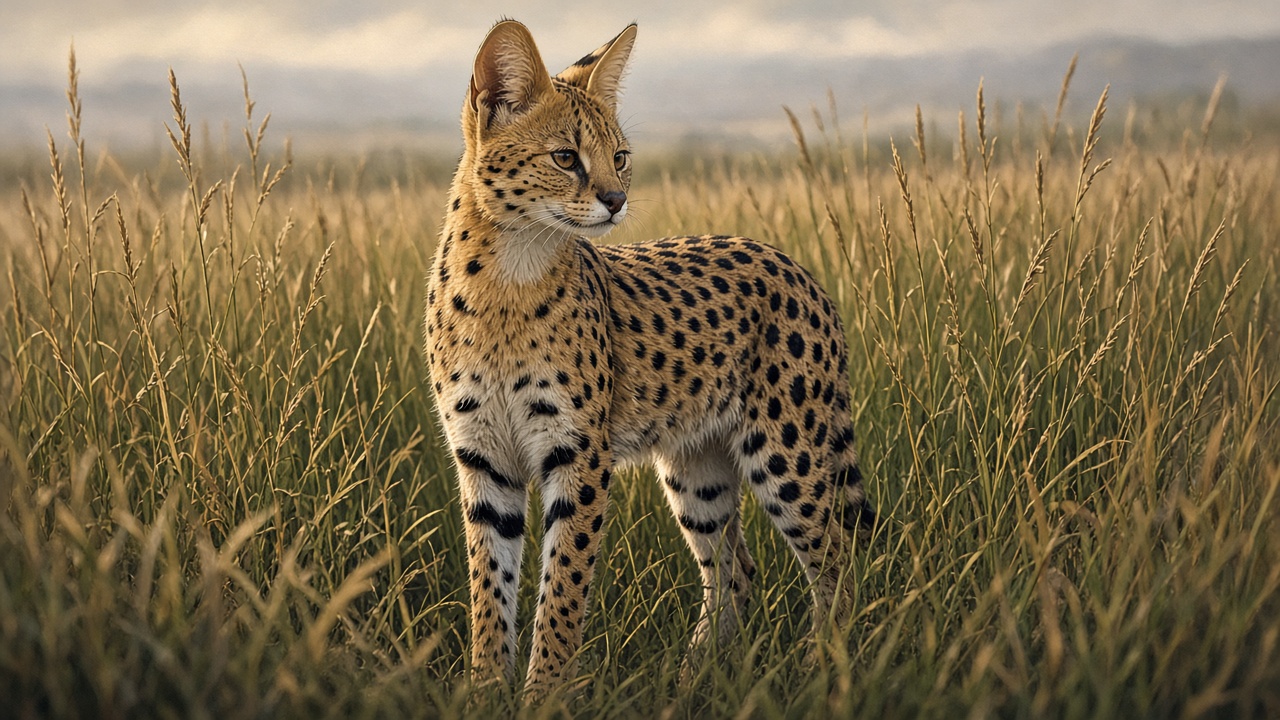
Serval
Leptailurus servalServal (Leptailurus serval): coexistence sheet across its documented range — presence, biology and prudence, without an invented hunting status.
Seen in: Namibia · South Africa
Overview
Serval (Leptailurus serval) is a coexistence sheet across its documented range: presence, biology and prudence — not a hunting status claim.
Classification: order Carnivora, family Felidae, genus Leptailurus. Common names: Serval in English, Serval in French, Serval in Spanish.
Identification
A slender, agile cat, the serval weighs 9 to 18 kg in males and 9 to 13 kg in females. Relative to its size, its legs and ears are the longest of any cat. The coppery coat, white below and on parts of the face, bears black spots and stripes that differ between individuals; grassland servals have larger spots than forest ones. Four lines run from the top of the head and break into spots from the shoulders back; the tail is ringed with a black tip. The backs of the ears are black with a white bar. Melanistic animals are occasionally seen.
It hunts mainly in the early morning and late afternoon, rests at midday and travels about 2.4 km a day. Its diet is 93.5% small mammals (rats, mice, shrews) and 5% birds, plus some insects, frogs and lizards; near people it becomes nocturnal. It waits motionless for up to 15 minutes, ears turned towards the prey, then pounces 1 to 4 m, pinning it with its front paws; it leaps up to 1.5 m to catch lesser flamingos, spoonbills or ducks. Solitary, it has 2 or 3 kittens of about 250 g after 65 to 75 days of gestation, weaned at 3 to 5 months.
Habitats and range
MDD gives it across much of sub-Saharan Africa, from Senegal to Ethiopia and south to South Africa, and considers it probably extirpated in Algeria, Morocco and Tunisia. It favours reed beds and Themeda triandra grassland, but also forest brush, bamboo thickets, marshes and streams. In Ngorongoro Crater it lives between 1,400 and 2,200 m. Its territory covers at least 11.6 km² and up to 20 km².
The countries where the species’ presence is established are shown in the tags on this sheet.
Field signs
It marks its territory heavily: spraying urine, rubbing its cheeks on the ground or vegetation, defecating and scratching, all more frequent when another serval is around (one male following a female left 566 marks in 4 hours). It often hunts along roads and tracks, where plucked bird remains may be found. Surprised by a competitor, it flees in confusing darting leaps.
Conservation
For conservation status of Leptailurus serval, consult the current IUCN assessment and cross with national monitoring programmes in countries of documented presence. Never turn a global IUCN category into a local hunting rule. GBIF occurrences help situate distribution but remain effort-biased.
The IUCN lists it as Least Concern. ADW cites habitat loss to human and agricultural expansion and shooting by farmers, although its impact on livestock is minimal; reintroductions work best at least 10 km from settlements. Formerly named Felis serval, it includes a subspecies, L. s. constantina, listed as endangered by the US Fish and Wildlife Service.
Limits
This sheet on the Serval covers presence and biology. A species being present in a country does not mean it may be hunted, and no season or quota is published here.
Local densities and management plans are not covered here: they are a matter for the managers of each area.
Sources
Sources consulted for this sheet:
- IUCN Red List — species search (consulted 2026-11-02)
- ASM Mammal Diversity Database — Leptailurus serval (consulted 2026-11-02)
- GBIF — species search (consulted 2026-11-02)
- Animal Diversity Web — Leptailurus serval (serval) (consulted 2026-11-04)
Conclusion
In short: use the scientific name Leptailurus serval to cross-check sources, confirm taxonomy and conservation status on the institutional portals listed above, and relate every field sign to the habitat where it was actually found.
Identification
Leptailurus serval
Serval · preferred
Serval · preferred
Serval · preferred
Classification
Class : Mammalia
Order : Carnivora
Family : Felidae
Genus : Leptailurus
Conservation
IUCN : LC
CITES : —
iucn · LC (global)
Habitat
Frequently asked questions
How do I recognise Serval?
Use Leptailurus serval as the scientific anchor. A slender, agile cat, the serval weighs 9 to 18 kg in males and 9 to 13 kg in females. Relative to its size, its legs and ears are the longest of any cat. The coppery coat, white below and on parts of the face, bears black spots and stripes that differ between individuals; grassl...
Where does Serval typically live?
MDD gives it across much of sub-Saharan Africa, from Senegal to Ethiopia and south to South Africa, and considers it probably extirpated in Algeria, Morocco and Tunisia. It favours reed beds and Themeda triandra grassland, but also forest brush, bamboo thickets, marshes and streams. In Ngorongoro Crater it lives between 1,400 and 2,200 m. Its territory cover...
What field signs help confirm Serval?
It marks its territory heavily: spraying urine, rubbing its cheeks on the ground or vegetation, defecating and scratching, all more frequent when another serval is around (one male following a female left 566 marks in 4 hours). It often hunts along roads and tracks, where plucked bird remains may be found. Surprised by a competitor, it flees in confusing dar...