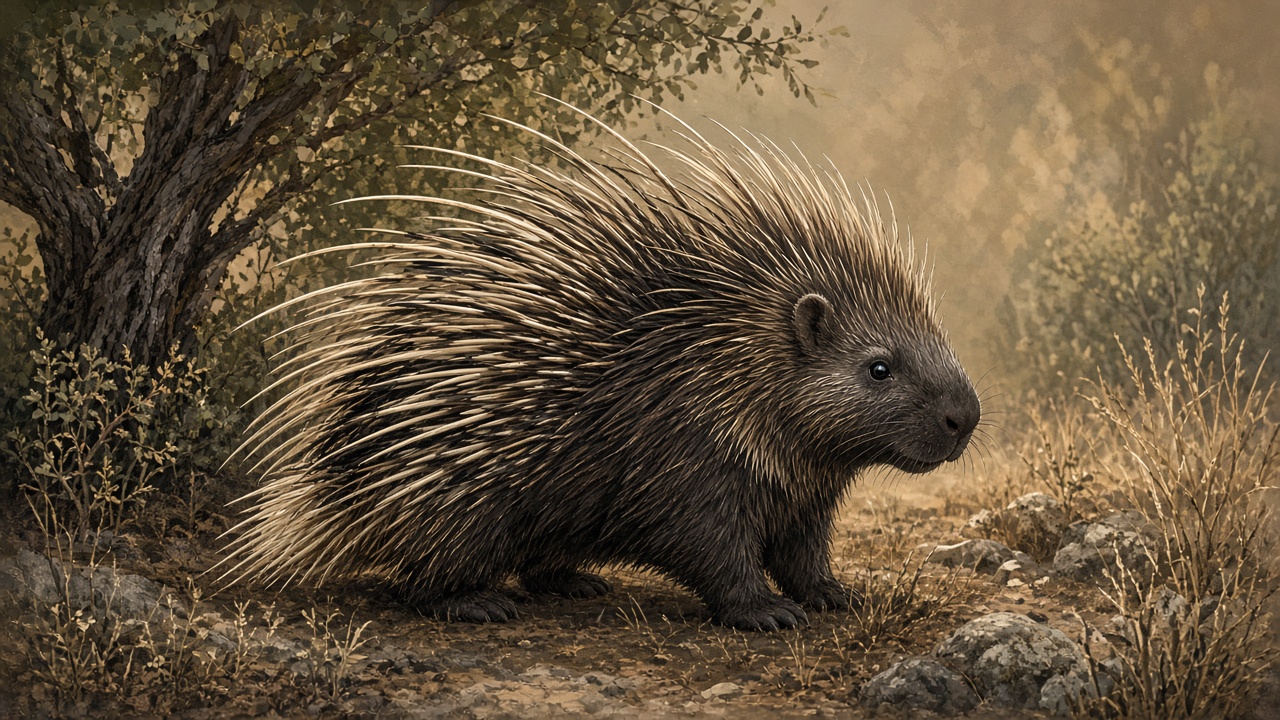
Crested Porcupine (Hystrix cristata): coexistence sheet across its documented range — presence, biology and prudence, without an invented hunting status.
Seen in: Italy
Overview
Crested Porcupine (Hystrix cristata) is a coexistence sheet across its documented range: presence, biology and prudence — not a hunting status claim.
Classification: order Rodentia, family Hystricidae, genus Hystrix. Common names: Crested Porcupine in English, Porc-épic à crête in French, Puercoespín crestado in Spanish.
Identification
The crested porcupine measures 60 to 93 cm, plus an 8 to 17 cm tail, and weighs 10 to 30 kg. The head, neck, shoulders, limbs and underside are covered with coarse dark brown or black bristles. Quills along the head, nape and back can be raised into a crest, and sturdier quills about 35 cm long, banded light and dark, cover the sides and rear of the body. The short tail carries hollow rattle quills that make a hiss-like rattle. The front paws have four clawed digits, the hind paws five; the gait is plantigrade, and the eyes and ears are very small.
A herbivore, it eats bark, roots, tubers, rhizomes, bulbs, fallen fruit and crops, occasionally insects, small vertebrates or carrion; it gnaws bones for calcium and to sharpen its incisors. Strictly nocturnal and terrestrial, it rarely climbs but can swim; it may stay in its burrow through winter without truly hibernating. Monogamous, it lives in small family groups (a pair with young of various ages) sharing one burrow system. After 112 days of gestation, 1 or 2 well-developed young are born with open eyes and leave the den after only a week. Lions, leopards, hyenas and large birds of prey are its enemies.
Habitats and range
MDD gives it from Morocco to Egypt and from Senegal to Ethiopia and northern Tanzania, as well as in Sicily, Italy, Albania and northern Greece, where the European population is possibly introduced; in central Africa it overlaps with Hystrix africaeaustralis. Highly adaptable, it uses forests, rocky areas, mountains, farmland and sandy deserts, sheltering in caves, rock crevices, aardvark holes or burrows it digs itself, which are often extensive and used for years.
The countries where the species’ presence is established are shown in the tags on this sheet.
Field signs
Extensive burrows used over many years and gnawed bones show its presence. When disturbed it raises and fans its quills, stamps the ground and rattles the hollow tail quills, which can be heard, before charging backwards. Its tracks are those of a plantigrade animal with four clawed toes in front and five behind. It may travel long distances at night in search of food.
Conservation
For conservation status of Hystrix cristata, consult the current IUCN assessment and cross with national monitoring programmes in countries of documented presence. Never turn a global IUCN category into a local hunting rule. GBIF occurrences help situate distribution but remain effort-biased.
The IUCN lists it as Least Concern. ADW states that it has been protected in Italy since 1974 and suffers from poaching for its meat and from being killed as an agricultural pest. Fossils show it has been in Italy since at least the Upper Pleistocene, despite the idea of a Roman introduction. ADW reports it as recently extinct in the Balkans, whereas MDD still lists Albania and northern Greece.
Limits
This sheet on the Crested Porcupine covers presence and biology. A species being present in a country does not mean it may be hunted, and no season or quota is published here.
Local densities and management plans are not covered here: they are a matter for the managers of each area.
Sources
Sources consulted for this sheet:
- IUCN Red List — species search (consulted 2026-11-02)
- ASM Mammal Diversity Database — Hystrix cristata (consulted 2026-11-02)
- GBIF — species search (consulted 2026-11-02)
- Animal Diversity Web — Hystrix cristata (North African crested porcupine) (consulted 2026-11-04)
Conclusion
In short: use the scientific name Hystrix cristata to cross-check sources, confirm taxonomy and conservation status on the institutional portals listed above, and relate every field sign to the habitat where it was actually found.
Identification
Hystrix cristata
Porc-épic à crête · preferred
Puercoespín crestado · preferred
Crested Porcupine · preferred
North African Crested Porcupine
Classification
Class : Mammalia
Order : Rodentia
Family : Hystricidae
Genus : Hystrix
Conservation
IUCN : LC
CITES : —
iucn · LC (global)
Habitat
Frequently asked questions
How do I recognise Crested Porcupine?
Use Hystrix cristata as the scientific anchor. The crested porcupine measures 60 to 93 cm, plus an 8 to 17 cm tail, and weighs 10 to 30 kg. The head, neck, shoulders, limbs and underside are covered with coarse dark brown or black bristles. Quills along the head, nape and back can be raised into a crest, and sturdier quills a...
Where does Crested Porcupine typically live?
MDD gives it from Morocco to Egypt and from Senegal to Ethiopia and northern Tanzania, as well as in Sicily, Italy, Albania and northern Greece, where the European population is possibly introduced; in central Africa it overlaps with Hystrix africaeaustralis. Highly adaptable, it uses forests, rocky areas, mountains, farmland and sandy deserts, sheltering in...
What field signs help confirm Crested Porcupine?
Extensive burrows used over many years and gnawed bones show its presence. When disturbed it raises and fans its quills, stamps the ground and rattles the hollow tail quills, which can be heard, before charging backwards. Its tracks are those of a plantigrade animal with four clawed toes in front and five behind. It may travel long distances at night in sear...