Giant Forest Hog
Hylochoerus meinertzhageniNo solid country presence documented yet.
Giant Forest Hog (Hylochoerus meinertzhageni): biology, habitats and field signs across its documented range, hunting-context reading.
Overview
Giant Forest Hog (Hylochoerus meinertzhageni) is presented here in a hunting-context reading across its documented range: biology, habitats and field signs useful to observers — without publishing season, quota or authorisation.
Classification: order Artiodactyla, family Suidae, genus Hylochoerus. Common names: Giant Forest Hog in English, Hylochère in French, Hilóquero in Spanish.
Identification
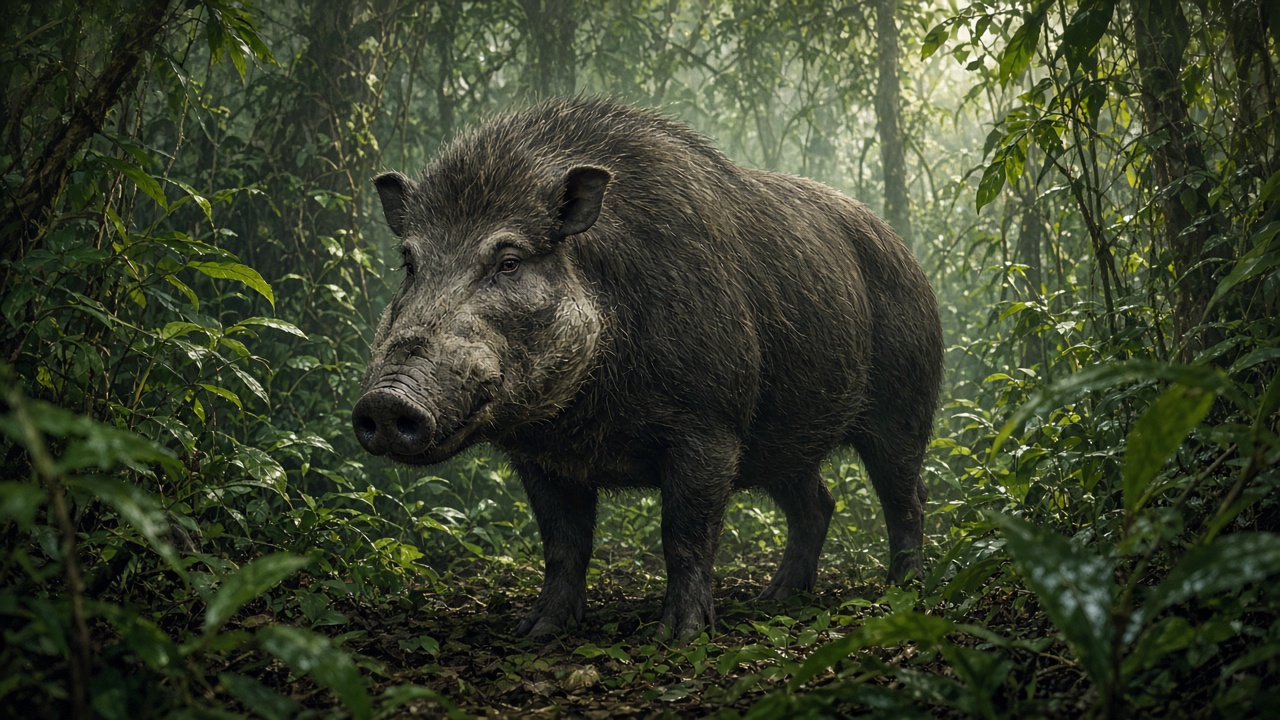
The giant forest hog is a massive pig: about 1 m at the shoulder, 190 cm long and 180 to 275 kg. The head is huge and broad, the ears large and pointed, and the body and tail covered with bristly hair. It is slate grey, with some lighter hair on the face. Males have pads of naked, inflated skin near the eyes that contain scent glands. Both sexes carry small, straight tusks that flare outwards (up to 30 cm); females are slightly smaller than males.
A herbivore, it grazes on grasses, sedges and herbage; unable to root like other pigs, it digs with its tusks for roots and minerals and sometimes eats carrion or eggs. It lives in sounders of 6 to 14 animals led by a male, while subadult males form bachelor groups. After about 151 days of gestation, 2 to 11 piglets are born and weaned at around 9 weeks. Hyenas and leopards are its predators; adults surround piglets to defend them.
Habitats and range
According to MDD, it occurs in West Africa (Guinea, Côte d’Ivoire, Ghana) and in Central and East Africa, including Cameroon, Central African Republic, northern and eastern DR Congo, south-western Ethiopia, northern Gabon, Kenya, eastern Nigeria, Uganda and South Sudan. It uses dry forest, humid lowland forest and montane forest up to 3,800 m, mostly near permanent water with thick understorey, but ventures into clearings and grassland to graze.
The countries where the species’ presence is established are shown in the tags on this sheet.
Field signs
Shy and nocturnal, it grazes in the open mainly between dusk and midnight. Its home range links pastures, sleeping sites, water holes, wallows, rubbing places, latrines and mineral licks by paths through the undergrowth; it scrapes out soil beneath logs or roots to bed down. Boars fight by forehead ramming, which can produce a loud report; piglets freeze at the sound of an alarm grunt.
Conservation
For conservation status of Hylochoerus meinertzhageni, consult the current IUCN assessment and cross with national monitoring programmes in countries of documented presence. Never turn a global IUCN category into a local hunting rule. GBIF occurrences help situate distribution but remain effort-biased.
The IUCN lists it as Least Concern; ADW describes it as patchily distributed and pressured by habitat loss and human use, without a general decline. It is a symptomless carrier of African swine fever, lethal to domestic pigs, and can damage crops. MDD includes ivoriensis and rimator, which Groves and Grubb (2011) treated as separate species.
Limits
This sheet on the Giant Forest Hog publishes no season, quota, hunting method or fee: those rules differ between countries and territories and must be checked in official texts. Being described here does not mean a species may be hunted.
Local densities and management plans are not covered here: they are a matter for the managers of each area.
Sources
Sources consulted for this sheet:
- IUCN Red List — species search (consulted 2026-11-02)
- ASM Mammal Diversity Database — Hylochoerus meinertzhageni (consulted 2026-11-02)
- GBIF — species search (consulted 2026-11-02)
- Animal Diversity Web — Hylochoerus meinertzhageni (giant forest hog) (consulted 2026-11-04)
Conclusion
In short: use the scientific name Hylochoerus meinertzhageni to cross-check sources, confirm taxonomy and conservation status on the institutional portals listed above, and relate every field sign to the habitat where it was actually found.
Identification
Hylochoerus meinertzhageni
Hylochère · preferred
Hilóquero · preferred
Giant Forest Hog · preferred
Classification
Class : Mammalia
Order : Artiodactyla
Family : Suidae
Genus : Hylochoerus
Conservation
IUCN : LC
CITES : —
iucn · LC (global)
Frequently asked questions
How do I recognise Giant Forest Hog?
Use Hylochoerus meinertzhageni as the scientific anchor. The giant forest hog is a massive pig: about 1 m at the shoulder, 190 cm long and 180 to 275 kg. The head is huge and broad, the ears large and pointed, and the body and tail covered with bristly hair. It is slate grey, with some lighter hair on the face. Males have pads of naked...
Where does Giant Forest Hog typically live?
According to MDD, it occurs in West Africa (Guinea, Côte d’Ivoire, Ghana) and in Central and East Africa, including Cameroon, Central African Republic, northern and eastern DR Congo, south-western Ethiopia, northern Gabon, Kenya, eastern Nigeria, Uganda and South Sudan. It uses dry forest, humid lowland forest and montane forest up to 3,800 m, mostly near pe...
What field signs help confirm Giant Forest Hog?
Shy and nocturnal, it grazes in the open mainly between dusk and midnight. Its home range links pastures, sleeping sites, water holes, wallows, rubbing places, latrines and mineral licks by paths through the undergrowth; it scrapes out soil beneath logs or roots to bed down. Boars fight by forehead ramming, which can produce a loud report; piglets freeze at...