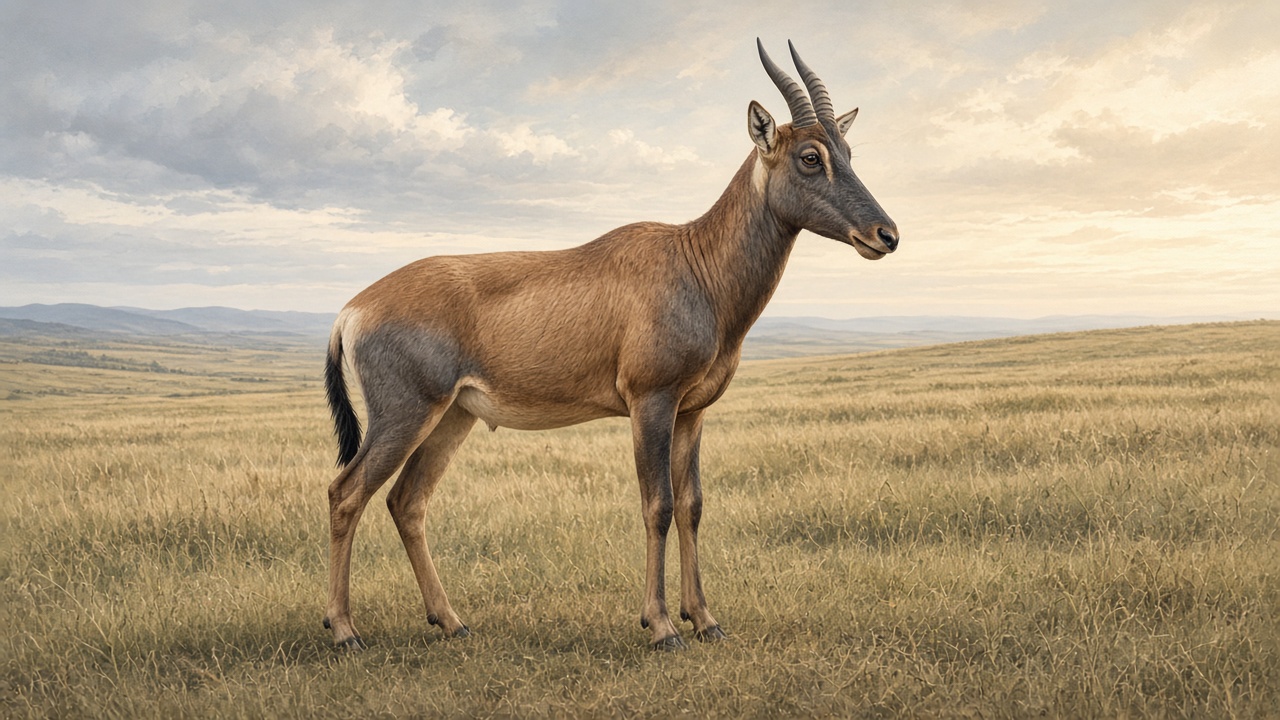
Tsessebe
Damaliscus lunatusTsessebe (Damaliscus lunatus): coexistence sheet across its documented range — presence, biology and prudence, without an invented hunting status.
Seen in: Namibia · South Africa
Overview
Tsessebe (Damaliscus lunatus) is a coexistence sheet across its documented range: presence, biology and prudence — not a hunting status claim.
Classification: order Artiodactyla, family Bovidae, genus Damaliscus. Common names: Tsessebe in English, Damalisque in French, Damalisco in Spanish.
Identification
A medium-sized antelope, the tsessebe or topi stands 104 to 126 cm at the shoulder in males and 105 to 118 cm in females, weighing 90 to 147 kg. Its short, glossy coat is tan, with dark or white markings. The muzzle is long and narrow; the ringed horns are S-shaped and 30 to 40 cm long. Adult males are darker than females, and young calves have light markings.
Its diet is almost entirely grass, with two eating peaks, in the morning and late afternoon. If the grass it eats is waterlogged, it does not need to drink; on dry grass, it must drink every day or two. Calving usually takes place at the end of the dry season after about eight months of gestation, one calf per female. Depending on herd size, the calf either follows the group or stays hidden away from it with its mother.
Habitats and range
Its separate populations stretch from the northern savannas of sub-Saharan Africa to East and southern Africa; MDD lists, among others, Benin, Burkina Faso, Chad, South Sudan, Ethiopia, Somalia, Kenya, Tanzania, Zambia, Botswana, Namibia and South Africa. It prefers grassland, from large treeless plains to tree savanna with little bush, usually in lowlands rather than uplands. During the rains, it avoids grass that is too short or too mature.
The countries where the species’ presence is established are shown in the tags on this sheet.
Field signs
Every territory has high vantage points, often mounds: males stand on them to advertise their territory and females to warn of danger, so an animal standing on a rise is typical. In the breeding period, males approach females in a rocking canter or a low, stretched posture. Herds eat mostly in the morning and late afternoon.
Conservation
For conservation status of Damaliscus lunatus, consult the current IUCN assessment and cross with national monitoring programmes in countries of documented presence. Never turn a global IUCN category into a local hunting rule. GBIF occurrences help situate distribution but remain effort-biased.
The IUCN lists it as Least Concern. Its large range has been broken up by hunting and habitat destruction. MDD lumps under Damaliscus lunatus several forms that Groves and Grubb (2011) treated as separate, including topi, tiang, korrigum, jimela and ugandae, which explains its many common names: tsessebe, sassaby, topi, tiang or korrigum.
Limits
This sheet on the Tsessebe covers presence and biology. A species being present in a country does not mean it may be hunted, and no season or quota is published here.
Local densities and management plans are not covered here: they are a matter for the managers of each area.
Sources
Sources consulted for this sheet:
- IUCN Red List — species search (consulted 2026-11-02)
- ASM Mammal Diversity Database — Damaliscus lunatus (consulted 2026-11-02)
- GBIF — species search (consulted 2026-11-02)
- Animal Diversity Web — Damaliscus lunatus (topi, tsessebe) (consulted 2026-11-04)
Conclusion
In short: use the scientific name Damaliscus lunatus to cross-check sources, confirm taxonomy and conservation status on the institutional portals listed above, and relate every field sign to the habitat where it was actually found.
Identification
Damaliscus lunatus
Tsessebe · preferred
Damalisque · preferred
Damalisco · preferred
Sassaby
Basterhartebeest
Topi
Serengeti Topi
Ruaha Topi
Common Tsessebe
Bangweulu Tsessebe
Tiang
Korrigum
Coastal Topi
Uganda Topi
Classification
Class : Mammalia
Order : Artiodactyla
Family : Bovidae
Genus : Damaliscus
Conservation
IUCN : LC
CITES : —
iucn · LC (global)
Habitat
Frequently asked questions
How do I recognise Tsessebe?
Use Damaliscus lunatus as the scientific anchor. A medium-sized antelope, the tsessebe or topi stands 104 to 126 cm at the shoulder in males and 105 to 118 cm in females, weighing 90 to 147 kg. Its short, glossy coat is tan, with dark or white markings. The muzzle is long and narrow; the ringed horns are S-shaped and 30 to 40 c...
Where does Tsessebe typically live?
Its separate populations stretch from the northern savannas of sub-Saharan Africa to East and southern Africa; MDD lists, among others, Benin, Burkina Faso, Chad, South Sudan, Ethiopia, Somalia, Kenya, Tanzania, Zambia, Botswana, Namibia and South Africa. It prefers grassland, from large treeless plains to tree savanna with little bush, usually in lowlands r...
What field signs help confirm Tsessebe?
Every territory has high vantage points, often mounds: males stand on them to advertise their territory and females to warn of danger, so an animal standing on a rise is typical. In the breeding period, males approach females in a rocking canter or a low, stretched posture. Herds eat mostly in the morning and late afternoon.