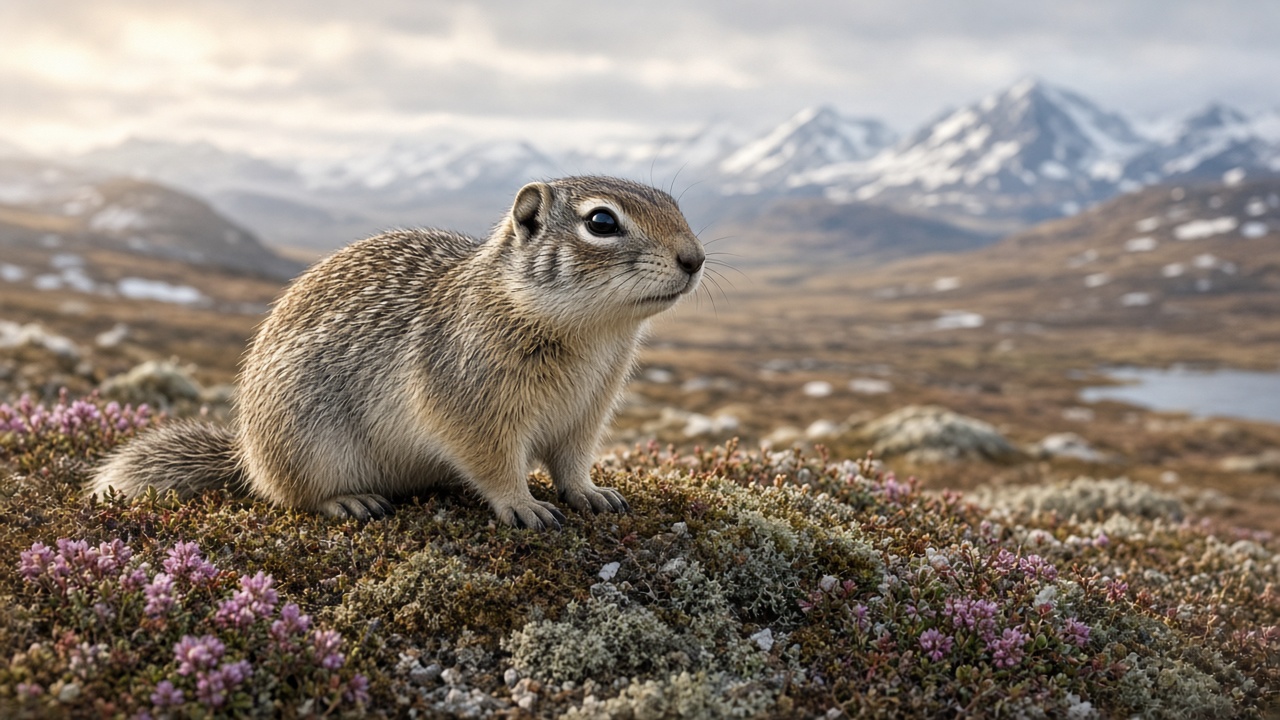
Arctic Ground Squirrel (Urocitellus parryii): ecology sheet across its documented range — natural history and habitats, without hunting framing.
Seen in: Canada
Overview
Arctic Ground Squirrel (Urocitellus parryii) is an ecology sheet across its documented range: natural history and habitats, without any hunting framing.
Classification: order Rodentia, family Sciuridae, genus Urocitellus. Common names: Arctic Ground Squirrel in English, Spermophile arctique in French, Ardilla terrestre ártica in Spanish.
Identification
The Arctic ground squirrel is the largest of the ground squirrels: 332 to 495 mm long (390 mm on average) and 524 to 1,500 g depending on sex and season. The tawny or cinnamon back is flecked with white spots, the underparts are paler buff, and the 77 to 153 mm tail darkens towards the tip. The body is cylindrical, with short, powerful forelimbs and sharp digging claws; large cheek pouches are used to carry food. Males are larger and heavier than females. It moults twice a year, in spring and autumn.
An obligate hibernator, it is active only three to five months a year and hibernates for 215 to 240 days, with its body temperature dropping as low as −2.9 °C. Mating takes place over two weeks in late April, just after emergence; after 25 to 30 days of gestation, the female gives birth in mid-May to 2 to 10 young, which come above ground around mid-June. Mostly herbivorous, it also eats invertebrates, eggs, chicks, lemmings and carrion; only males cache plant food. Lynx, foxes, wolves, grizzly bears, golden eagles and snowy owls are among its many predators.
Habitats and range
MDD lists it from north-western Canada, Alaska and the far north-east of Russia (Yakutia, Anadyr, Chukotka); ADW describes it from the west coast of Hudson Bay to Alaska and eastern Siberia. It lives in Arctic and alpine tundra, boreal forest and alpine meadows, from sea level to 900 m. It prefers well-drained slopes with sparse vegetation, from which it can spot predators, and avoids wet soils and shrubby hummocks. Some populations in the Aleutian Islands were introduced.
The countries where the species’ presence is established are shown in the tags on this sheet.
Field signs
Colonial and diurnal, it is active between 5 am and 11 pm and often sits or stands up on its hind legs to scan around. Its burrows, shallow and up to 20 m long, include escape holes with several exits. When danger approaches, it gives a high-pitched whistle for a bird of prey and a guttural chatter for a ground predator, then dashes for its burrow. Colonies look deserted from August–September to mid-April.
Conservation
For conservation status of Urocitellus parryii, consult the current IUCN assessment and cross with national monitoring programmes in countries of documented presence. Never turn a global IUCN category into a local hunting rule. GBIF occurrences help situate distribution but remain effort-biased.
The IUCN lists it as Least Concern. A keystone species, it supports many predators, especially during lows in the snowshoe hare cycle, and can turn over up to 18 tonnes of soil per hectare per year. The Alutiiq and Aleut peoples used its pelts for clothing, which may explain some island introductions. MDD moved it from Spermophilus to Urocitellus; ADW still treats it as Spermophilus parryii.
Limits
This sheet on the Arctic Ground Squirrel covers biology and ecology only; it publishes no hunting season, quota or authorisation.
Local densities and management plans are not covered here: they are a matter for the managers of each area.
Sources
Sources consulted for this sheet:
- IUCN Red List — species search (consulted 2026-11-02)
- ASM Mammal Diversity Database — Urocitellus parryii (consulted 2026-11-02)
- GBIF — species search (consulted 2026-11-02)
- Animal Diversity Web — Spermophilus parryii (Arctic ground squirrel) (consulted 2026-11-04)
Conclusion
In short: use the scientific name Urocitellus parryii to cross-check sources, confirm taxonomy and conservation status on the institutional portals listed above, and relate every field sign to the habitat where it was actually found.
Identification
Urocitellus parryii
Spermophile arctique · preferred
Ardilla terrestre ártica · preferred
Arctic Ground Squirrel · preferred
Spermophilus parryii
Classification
Class : Mammalia
Order : Rodentia
Family : Sciuridae
Genus : Urocitellus
Conservation
IUCN : LC
CITES : —
iucn · LC (global)
Frequently asked questions
How do I recognise Arctic Ground Squirrel?
Use Urocitellus parryii as the scientific anchor. The Arctic ground squirrel is the largest of the ground squirrels: 332 to 495 mm long (390 mm on average) and 524 to 1,500 g depending on sex and season. The tawny or cinnamon back is flecked with white spots, the underparts are paler buff, and the 77 to 153 mm tail darkens towar...
Where does Arctic Ground Squirrel typically live?
MDD lists it from north-western Canada, Alaska and the far north-east of Russia (Yakutia, Anadyr, Chukotka); ADW describes it from the west coast of Hudson Bay to Alaska and eastern Siberia. It lives in Arctic and alpine tundra, boreal forest and alpine meadows, from sea level to 900 m. It prefers well-drained slopes with sparse vegetation, from which it can...
What field signs help confirm Arctic Ground Squirrel?
Colonial and diurnal, it is active between 5 am and 11 pm and often sits or stands up on its hind legs to scan around. Its burrows, shallow and up to 20 m long, include escape holes with several exits. When danger approaches, it gives a high-pitched whistle for a bird of prey and a guttural chatter for a ground predator, then dashes for its burrow. Colonies...