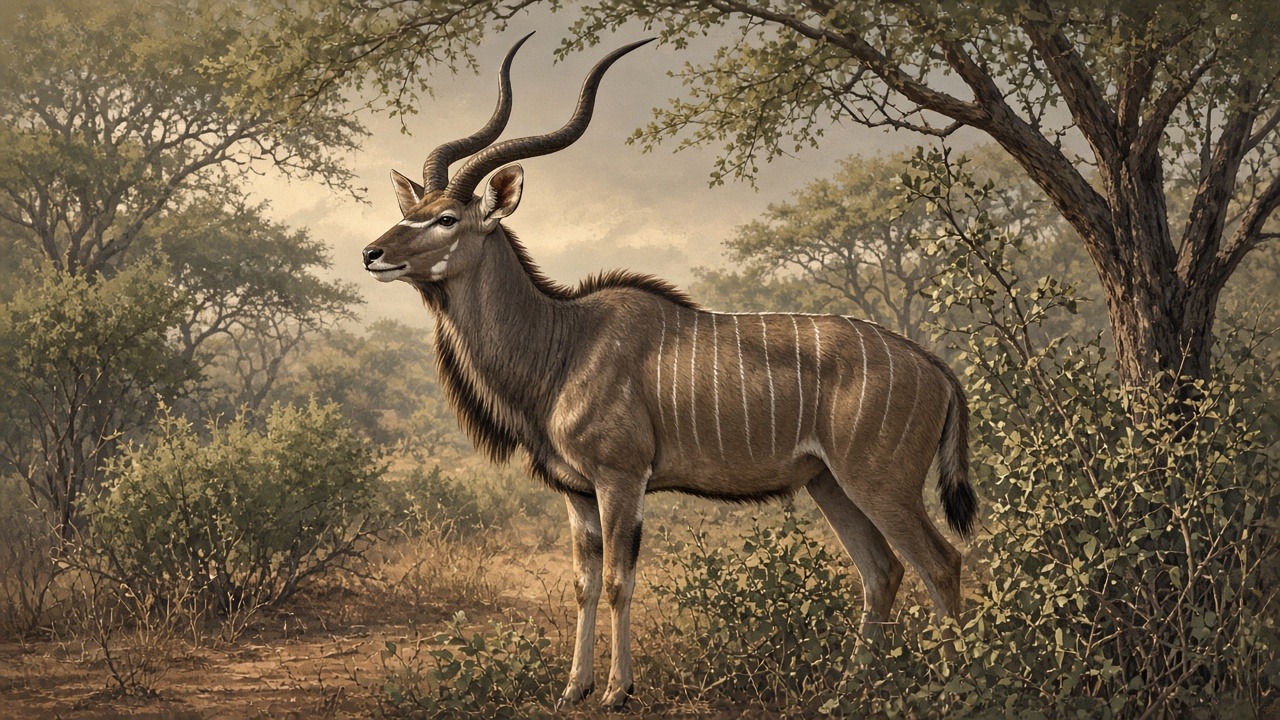
Greater Kudu
Tragelaphus strepsicerosGreater Kudu (Tragelaphus strepsiceros): coexistence sheet across its documented range — presence, biology and prudence, without an invented hunting status.
Seen in: Namibia · South Africa
Overview
Greater Kudu (Tragelaphus strepsiceros) is a coexistence sheet across its documented range: presence, biology and prudence — not a hunting status claim.
Classification: order Artiodactyla, family Bovidae, genus Tragelaphus. Common names: Greater Kudu in English, Grand koudou in French, Kudú mayor in Spanish.
Identification
The greater kudu is one of the tallest antelopes: 100 to 150 cm at the shoulder and 120 to 315 kg. It has the largest horns in the bushbuck tribe, averaging 120 cm. The coat ranges from reddish brown to bluish grey, the darkest animals living in the south of the range, and males darken with age. Six to ten stripes mark the back, and the tail is black-tipped with a white underside. Males have a beard that females lack.
Females live in small groups of one to three with their young, sometimes merging temporarily; males form bachelor groups of 2 to 10, and the sexes only associate during the mating season. A seasonal breeder in southern Africa, near the equator it calves in the rainy season, from February to June. After about nine months a single calf is born, which stays hidden for two weeks before joining the group; it is weaned at six months. It browses leaves, herbs, fruit, vines, flowers and some fresh grass. Lions, leopards, wild dogs and spotted hyenas prey on it.
Habitats and range
MDD records it from South Africa, Botswana, Namibia and Angola north to Kenya, Ethiopia, Eritrea, Sudan, Chad and the Central African Republic; its presence in Djibouti and Somalia is uncertain. It is densest in the south; in East Africa many groups are isolated in mountains. It needs bush and thicket cover: deciduous woodland in the rains, and richly vegetated riverbanks in the dry season.
The countries where the species’ presence is established are shown in the tags on this sheet.
Field signs
It is mostly seen in small groups of females or males in thickets and open woodland, and along watercourses in the dry season. The back stripes, the male’s beard and the white underside of the tail, conspicuous as it moves off, help identify it. It can survive without water but drinks in the dry season when it can, and sometimes damages crops.
Conservation
For conservation status of Tragelaphus strepsiceros, consult the current IUCN assessment and cross with national monitoring programmes in countries of documented presence. Never turn a global IUCN category into a local hunting rule. GBIF occurrences help situate distribution but remain effort-biased.
The IUCN lists it as Least Concern. In southern Africa it has reclaimed much of the habitat threatened by human population growth, whereas northern populations remain sparse and isolated. MDD notes that it was moved to the genus Strepsiceros and then back to Tragelaphus, and includes the forms zambesiensis, chora and cottoni, treated as distinct by Groves and Grubb (2011).
Limits
This sheet on the Greater Kudu covers presence and biology. A species being present in a country does not mean it may be hunted, and no season or quota is published here.
Local densities and management plans are not covered here: they are a matter for the managers of each area.
Sources
Sources consulted for this sheet:
- IUCN Red List — species search (consulted 2026-11-02)
- ASM Mammal Diversity Database — Tragelaphus strepsiceros (consulted 2026-11-02)
- GBIF — species search (consulted 2026-11-02)
- Animal Diversity Web — Tragelaphus strepsiceros (greater kudu) (consulted 2026-11-04)
Conclusion
In short: use the scientific name Tragelaphus strepsiceros to cross-check sources, confirm taxonomy and conservation status on the institutional portals listed above, and relate every field sign to the habitat where it was actually found.
Identification
Tragelaphus strepsiceros
Grand koudou · preferred
Kudú mayor · preferred
Greater Kudu · preferred
Cape Kudu
Zambezi Kudu
Northern Kudu
Western Kudu
Strepsiceros strepsiceros
Classification
Class : Mammalia
Order : Artiodactyla
Family : Bovidae
Genus : Tragelaphus
Conservation
IUCN : LC
CITES : —
iucn · LC (global)
Habitat
Practices
Frequently asked questions
How do I recognise Greater Kudu?
Use Tragelaphus strepsiceros as the scientific anchor. The greater kudu is one of the tallest antelopes: 100 to 150 cm at the shoulder and 120 to 315 kg. It has the largest horns in the bushbuck tribe, averaging 120 cm. The coat ranges from reddish brown to bluish grey, the darkest animals living in the south of the range, and males...
Where does Greater Kudu typically live?
MDD records it from South Africa, Botswana, Namibia and Angola north to Kenya, Ethiopia, Eritrea, Sudan, Chad and the Central African Republic; its presence in Djibouti and Somalia is uncertain. It is densest in the south; in East Africa many groups are isolated in mountains. It needs bush and thicket cover: deciduous woodland in the rains, and richly vegeta...
What field signs help confirm Greater Kudu?
It is mostly seen in small groups of females or males in thickets and open woodland, and along watercourses in the dry season. The back stripes, the male’s beard and the white underside of the tail, conspicuous as it moves off, help identify it. It can survive without water but drinks in the dry season when it can, and sometimes damages crops.