Sulawesi Warty Pig
Sus celebensisNo solid country presence documented yet.
Sulawesi Warty Pig (Sus celebensis): biology, habitats and field signs across its documented range, hunting-context reading.
Overview
Sulawesi Warty Pig (Sus celebensis) is presented here in a hunting-context reading across its documented range: biology, habitats and field signs useful to observers — without publishing season, quota or authorisation.
Classification: order Artiodactyla, family Suidae, genus Sus. Common names: Sulawesi Warty Pig in English, Sanglier des Célèbes in French, Cerdo verrugoso de Célebes in Spanish.
Identification
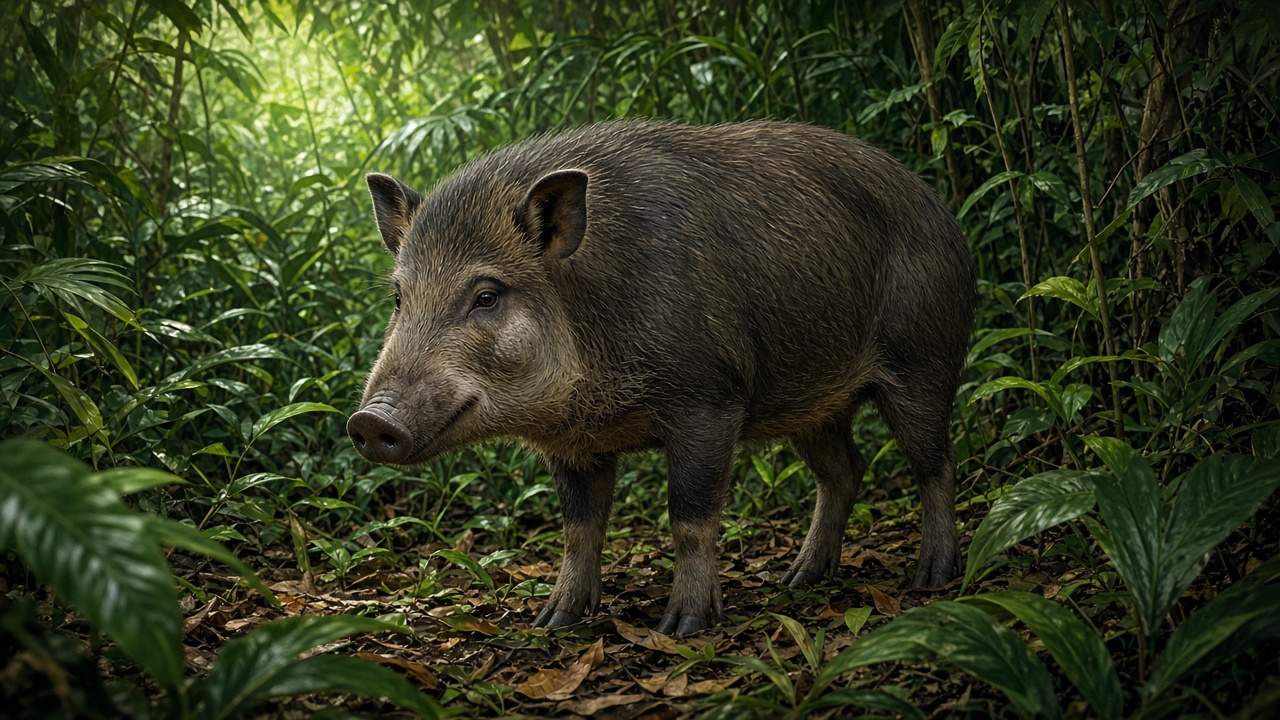
The Sulawesi warty pig measures 80 to 130 cm long and weighs 40 to 70 kg. Its coat is often black with yellow or white hairs mixed in, sometimes reddish-brown; the belly lightens to creamy off-white with age. There is always a dark dorsal stripe and a yellow band around the snout, and tufts of hair adorn the forehead. Males, larger than females, carry three pairs of facial warts; the preorbital pair, the largest, only reaches full size when the boar is about eight years old. The back is short and slightly convex, the legs short and the tail long and simply tufted.
An omnivore, it eats roots, fruit, leaves, shoots, carrion and insects. Unlike most pigs, it forages mainly by day, with peaks in the early morning and late afternoon. The basic social unit is the family group, and two or three families may join into larger herds. Breeding can occur all year, with a mating peak in February and most births in April or May. The female builds a large nest of grass, leaves and branches over a shallow depression about two metres across; litters number 1 to 8, usually 2 to 3, striped until about six months old.
Habitats and range
Endemic to Indonesia according to MDD, it lives on Sulawesi and nearby small islands; ADW names Selayar, Muna, Buton, Peleng, Lembeh and the Togian Islands. It is common in northern, central and eastern Sulawesi but has become scarce in the south. Feral populations exist on Halmahera and Simeulue, and possibly on Flores and Timor. It uses rainforest, swamps, high grassland and farmland, up to moss forest at about 2,300 m, with a preference for valleys.
The countries where the species’ presence is established are shown in the tags on this sheet.
Field signs
Active by day, it is seen mainly in the early morning and late afternoon, in family groups. Large farrowing nests of grass, leaves and branches built over a hollow are characteristic. Pigs of its genus root up the soil and wallow in mud whenever they can. Adult males are recognised by their large preorbital warts, the yellow snout band and the forehead tufts.
Conservation
For conservation status of Sus celebensis, consult the current IUCN assessment and cross with national monitoring programmes in countries of documented presence. Never turn a global IUCN category into a local hunting rule. GBIF occurrences help situate distribution but remain effort-biased.
MDD gives its IUCN status as Near Threatened. ADW describes it as locally abundant but threatened by habitat loss, by intense commercial hunting for meat in northern Sulawesi – 2,317 animals recorded over twelve months in 1990–1991, with females more affected – and by hybridisation and disease from domestic pigs. People have introduced it to several Indonesian islands, and it may be extinct on Selayar.
Limits
This sheet on the Sulawesi Warty Pig publishes no season, quota, hunting method or fee: those rules differ between countries and territories and must be checked in official texts. Being described here does not mean a species may be hunted.
Local densities and management plans are not covered here: they are a matter for the managers of each area.
Sources
Sources consulted for this sheet:
- IUCN Red List — species search (consulted 2026-11-02)
- ASM Mammal Diversity Database — Sus celebensis (consulted 2026-11-02)
- GBIF — species search (consulted 2026-11-02)
- Animal Diversity Web — Sus celebensis (Celebes wild boar) (consulted 2026-11-04)
Conclusion
In short: use the scientific name Sus celebensis to cross-check sources, confirm taxonomy and conservation status on the institutional portals listed above, and relate every field sign to the habitat where it was actually found.
Identification
Sus celebensis
Sanglier des Célèbes · preferred
Cerdo verrugoso de Célebes · preferred
Sulawesi Warty Pig · preferred
Classification
Class : Mammalia
Order : Artiodactyla
Family : Suidae
Genus : Sus
Conservation
IUCN : NT
CITES : —
iucn · NT (global)
Frequently asked questions
How do I recognise Sulawesi Warty Pig?
Use Sus celebensis as the scientific anchor. The Sulawesi warty pig measures 80 to 130 cm long and weighs 40 to 70 kg. Its coat is often black with yellow or white hairs mixed in, sometimes reddish-brown; the belly lightens to creamy off-white with age. There is always a dark dorsal stripe and a yellow band around the snout...
Where does Sulawesi Warty Pig typically live?
Endemic to Indonesia according to MDD, it lives on Sulawesi and nearby small islands; ADW names Selayar, Muna, Buton, Peleng, Lembeh and the Togian Islands. It is common in northern, central and eastern Sulawesi but has become scarce in the south. Feral populations exist on Halmahera and Simeulue, and possibly on Flores and Timor. It uses rainforest, swamps,...
What field signs help confirm Sulawesi Warty Pig?
Active by day, it is seen mainly in the early morning and late afternoon, in family groups. Large farrowing nests of grass, leaves and branches built over a hollow are characteristic. Pigs of its genus root up the soil and wallow in mud whenever they can. Adult males are recognised by their large preorbital warts, the yellow snout band and the forehead tufts...