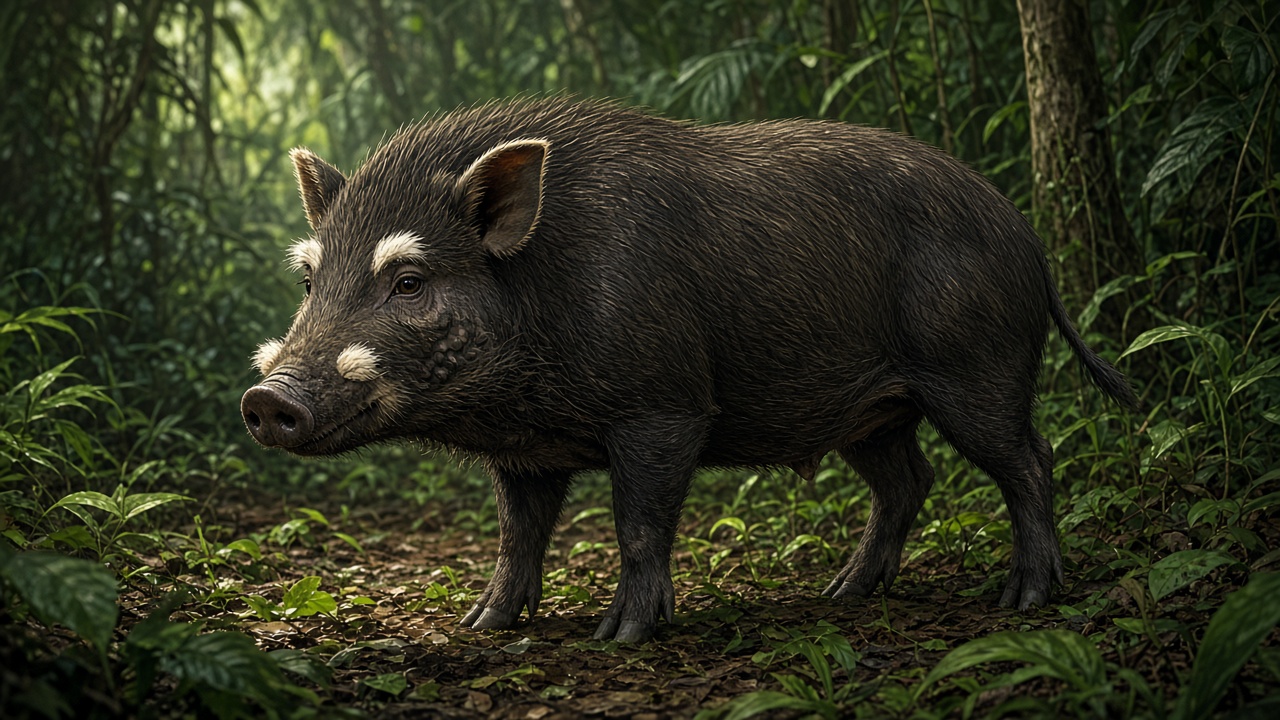
Visayan Warty Pig
Sus cebifronsNo solid country presence documented yet.
Visayan Warty Pig (Sus cebifrons): biology, habitats and field signs across its documented range, hunting-context reading.
Overview
Visayan Warty Pig (Sus cebifrons) is presented here in a hunting-context reading across its documented range: biology, habitats and field signs useful to observers — without publishing season, quota or authorisation.
Classification: order Artiodactyla, family Suidae, genus Sus. Common names: Visayan Warty Pig in English, Cochon verruqueux des Visayas in French, Cerdo verrugoso de Visayas in Spanish.
Identification
The Visayan warty pig is a small pig: about 100 cm head and body, a 23 cm tail, 30 to 45 cm at the shoulder in females and up to 63 cm in males. Females weigh 20 to 35 kg and males 35 to 40 kg (up to 80 kg reported from Negros). The coat is grey-black in females and young males, and more fawn mixed with black in adult males. Both sexes have a mane reaching the loins; in the breeding season the male’s grows longer and often flops over his eyes. A broad white or yellowish band crosses the male’s snout. Despite the name, its facial warts are small.
An omnivore, it eats, judging from scats and food remains, the fruit of Lithocarpus, Platea excelsa and Dillenia reifferscheidia – it may be the only seed disperser of the first two – as well as vines, palms, wild bananas, crops such as taro and avocado, and earthworms. It lives in small groups, often one adult male with three or four females and young. Gestation lasts about 118 days; the female builds a nest one to two weeks before giving birth and has 2 to 4 young, striped orange-brown and black until seven to nine months.
Habitats and range
Endemic to the West Visayas (Philippines), it once occurred on all six main islands of the group: Cebu, Guimaras and Ticao, where it is extinct, plus Negros, Panay and Masbate. Only fragmented populations survive today on Negros and Panay; on Masbate there has been no confirmed record since 1993. It lived in primary and secondary forest from sea level to mossy forest at about 1,600 m, but the loss of lowland forest now confines it to forested areas above 800 m. A few animals persist in Imperata cylindrica grassland where dense cover remains.
The countries where the species’ presence is established are shown in the tags on this sheet.
Field signs
Where it is hunted, it avoids people and is mainly active at night, sometimes raiding crops at the forest edge. Scats and food remains are the main clues that revealed its diet. In captivity it readily bathes and wallows in mud, and it is assumed to do the same in the wild. An animal with a short snout, large ears, a reduced mane or piebald markings suggests a hybrid with domestic pigs.
Conservation
For conservation status of Sus cebifrons, consult the current IUCN assessment and cross with national monitoring programmes in countries of documented presence. Never turn a global IUCN category into a local hunting rule. GBIF occurrences help situate distribution but remain effort-biased.
The IUCN lists it as Critically Endangered. It is thought to be extinct in over 95% of its former range, through forest loss, hunting for food or in retaliation for crop raiding, and hybridisation with domestic pigs. A conservation programme launched in 1993 with the Philippine Department of Environment and Natural Resources (DENR) set up breeding centres on Negros and Panay. Long treated as a subspecies of S. celebensis, S. philippensis or S. barbatus, it has been recognised as a full species only since 1993.
Limits
This sheet on the Visayan Warty Pig publishes no season, quota, hunting method or fee: those rules differ between countries and territories and must be checked in official texts. Being described here does not mean a species may be hunted.
Local densities and management plans are not covered here: they are a matter for the managers of each area.
Sources
Sources consulted for this sheet:
- IUCN Red List — species search (consulted 2026-11-02)
- ASM Mammal Diversity Database — Sus cebifrons (consulted 2026-11-02)
- GBIF — species search (consulted 2026-11-02)
- IUCN SSC Wild Pig Specialist Group — Visayan Warty Pig (Sus cebifrons), detailed profile (consulted 2026-11-04)
Conclusion
In short: use the scientific name Sus cebifrons to cross-check sources, confirm taxonomy and conservation status on the institutional portals listed above, and relate every field sign to the habitat where it was actually found.
Identification
Sus cebifrons
Cochon verruqueux des Visayas · preferred
Cerdo verrugoso de Visayas · preferred
Visayan Warty Pig · preferred
Classification
Class : Mammalia
Order : Artiodactyla
Family : Suidae
Genus : Sus
Conservation
IUCN : CR
CITES : —
iucn · CR (global)
Frequently asked questions
How do I recognise Visayan Warty Pig?
Use Sus cebifrons as the scientific anchor. The Visayan warty pig is a small pig: about 100 cm head and body, a 23 cm tail, 30 to 45 cm at the shoulder in females and up to 63 cm in males. Females weigh 20 to 35 kg and males 35 to 40 kg (up to 80 kg reported from Negros). The coat is grey-black in females and young males,...
Where does Visayan Warty Pig typically live?
Endemic to the West Visayas (Philippines), it once occurred on all six main islands of the group: Cebu, Guimaras and Ticao, where it is extinct, plus Negros, Panay and Masbate. Only fragmented populations survive today on Negros and Panay; on Masbate there has been no confirmed record since 1993. It lived in primary and secondary forest from sea level to mos...
What field signs help confirm Visayan Warty Pig?
Where it is hunted, it avoids people and is mainly active at night, sometimes raiding crops at the forest edge. Scats and food remains are the main clues that revealed its diet. In captivity it readily bathes and wallows in mud, and it is assumed to do the same in the wild. An animal with a short snout, large ears, a reduced mane or piebald markings suggests...