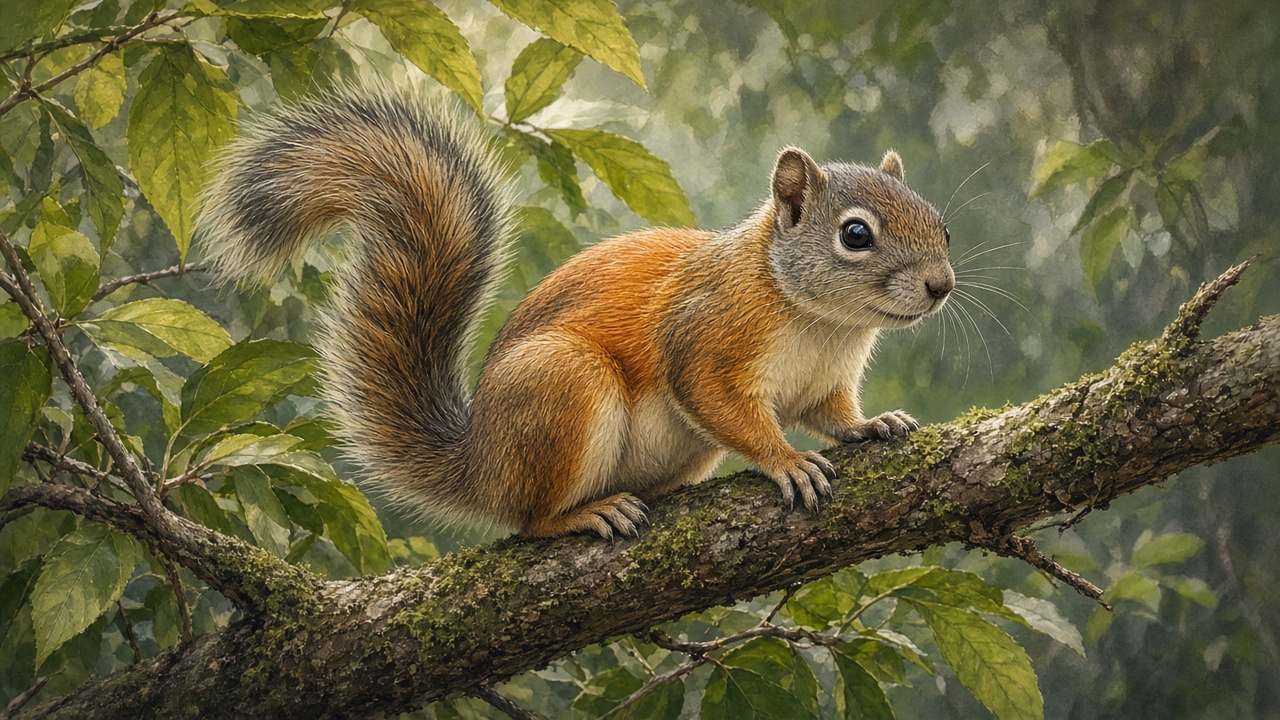
Pallas's Squirrel (Callosciurus erythraeus): ecology sheet across its documented range — natural history and habitats, without hunting framing.
Seen in: Japan
Overview
Pallas's Squirrel (Callosciurus erythraeus) is an ecology sheet across its documented range: natural history and habitats, without any hunting framing.
Classification: order Rodentia, family Sciuridae, genus Callosciurus. Common names: Pallas's Squirrel in English, Écureuil à ventre rouge in French, Ardilla de vientre rojo in Spanish.
Identification
A medium-sized tree squirrel, also called the red-bellied tree squirrel: adult males measure 20 to 26 cm in head and body, with a 17 to 20 cm tail, and weigh about 300 to 440 g. Colour varies geographically; in populations introduced to Japan, the back mixes black and ochre hairs and the belly is chestnut. Strong claws on fingers and toes, highly rotating ankles for running on trunks and large, protruding eyes giving a wide field of view are typical. Males and females look alike.
Active by day, it forages mainly in trees on seeds, fruit, flowers, leaves and acorns, but also ants, cicadas, snails and bird eggs, and it buries caches of nuts. On a Japanese island it eats camellia flowers in winter, leaves in April–May and fruit in June; in winter it also strips bark to lick the sap. It can breed all year round, up to three times a year, with 1 to 3 young born in a nest; on the female’s day of oestrus, several males compete and she usually mates with more than one.
Habitats and range
MDD describes a native range on both sides of the Irrawaddy River: India, Myanmar and south-eastern China to the west; Myanmar, Thailand, Peninsular Malaysia, Indochina, southern China and Taiwan to the east. It has been introduced to Argentina, Japan (Izu Oshima from 1935, then other sites) and Europe: France, Belgium, Italy and the Netherlands. It lives mainly in broad-leaved evergreen forest, but also in deciduous and conifer woods, parks, gardens and built-up areas; in France it is very abundant in the gardens of Cap d’Antibes.
The countries where the species’ presence is established are shown in the tags on this sheet.
Field signs
Diurnal and very vocal, it is noticed by its calls and its runs through the branches, where it builds its nests. Encounters often turn into chases, and a dominance hierarchy forms at shared foraging sites. Where it has been introduced, bark stripped from trunks, sometimes killing the tree, and damage to power cables and houses reveal its presence.
Conservation
For conservation status of Callosciurus erythraeus, consult the current IUCN assessment and cross with national monitoring programmes in countries of documented presence. Never turn a global IUCN category into a local hunting rule. GBIF occurrences help situate distribution but remain effort-biased.
The IUCN lists it as Least Concern. Where introduced it reaches 5 to 10 animals per hectare, has a diet similar to the red squirrel’s and seems able to outcompete it; it eats bird eggs and can cause substantial losses in plantations through bark stripping. MDD has moved the subspecies griseimanus and flavimanus, with their synonyms, to Callosciurus finlaysonii on genetic evidence.
Limits
This sheet on the Pallas's Squirrel covers biology and ecology only; it publishes no hunting season, quota or authorisation.
Local densities and management plans are not covered here: they are a matter for the managers of each area.
Sources
Sources consulted for this sheet:
- IUCN Red List — species search (consulted 2026-11-02)
- ASM Mammal Diversity Database — Callosciurus erythraeus (consulted 2026-11-02)
- GBIF — species search (consulted 2026-11-02)
- Animal Diversity Web — Callosciurus erythraeus (Pallas’s squirrel) (consulted 2026-11-04)
- National Institute for Environmental Studies (Japan) — Invasive Species of Japan: Callosciurus erythraeus (consulted 2026-11-04)
- National Institute for Environmental Studies (Japan) — クリハラリス (Callosciurus erythraeus), Japanese record (consulted 2026-11-04)
- Belgian Biodiversity Platform — Invasive Alien Species in Belgium: Callosciurus erythraeus (consulted 2026-11-04)
Conclusion
In short: use the scientific name Callosciurus erythraeus to cross-check sources, confirm taxonomy and conservation status on the institutional portals listed above, and relate every field sign to the habitat where it was actually found.
Identification
Callosciurus erythraeus
Pallas's Squirrel · preferred
Formosan Squirrel
Red-bellied Squirrel
Classification
Class : Mammalia
Order : Rodentia
Family : Sciuridae
Genus : Callosciurus
Conservation
IUCN : LC
CITES : —
iucn · LC (global)
Frequently asked questions
How do I recognise Pallas's Squirrel?
Use Callosciurus erythraeus as the scientific anchor. A medium-sized tree squirrel, also called the red-bellied tree squirrel: adult males measure 20 to 26 cm in head and body, with a 17 to 20 cm tail, and weigh about 300 to 440 g. Colour varies geographically; in populations introduced to Japan, the back mixes black and ochre hairs...
Where does Pallas's Squirrel typically live?
MDD describes a native range on both sides of the Irrawaddy River: India, Myanmar and south-eastern China to the west; Myanmar, Thailand, Peninsular Malaysia, Indochina, southern China and Taiwan to the east. It has been introduced to Argentina, Japan (Izu Oshima from 1935, then other sites) and Europe: France, Belgium, Italy and the Netherlands. It lives ma...
What field signs help confirm Pallas's Squirrel?
Diurnal and very vocal, it is noticed by its calls and its runs through the branches, where it builds its nests. Encounters often turn into chases, and a dominance hierarchy forms at shared foraging sites. Where it has been introduced, bark stripped from trunks, sometimes killing the tree, and damage to power cables and houses reveal its presence.