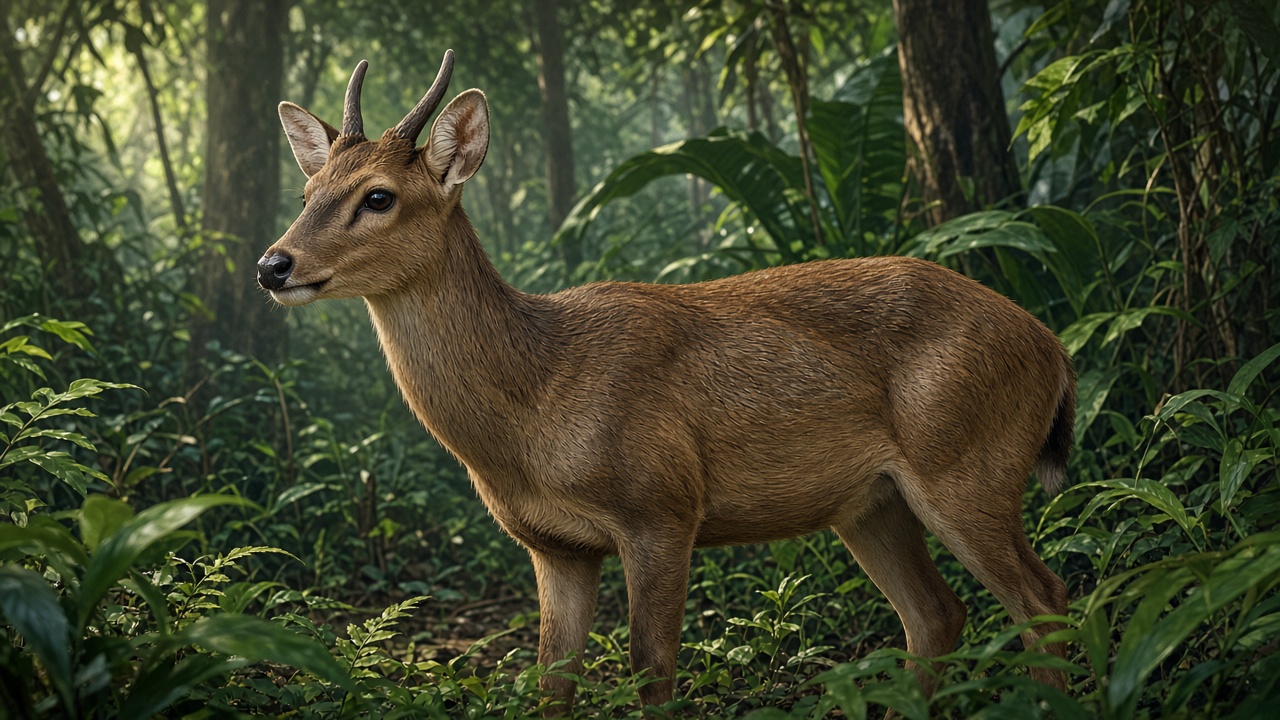
Philippine Brown Deer
Rusa mariannaNo solid country presence documented yet.
Philippine Brown Deer (Rusa marianna): biology, habitats and field signs across its documented range, hunting-context reading.
Overview
Philippine Brown Deer (Rusa marianna) is presented here in a hunting-context reading across its documented range: biology, habitats and field signs useful to observers — without publishing season, quota or authorisation.
Classification: order Artiodactyla, family Cervidae, genus Rusa. Common names: Philippine Brown Deer in English, Cerf des Philippines in French, Sambar de Filipinas in Spanish.
Identification
Rusa marianna, the Philippine brown deer, is one of three deer endemic to the Philippines, alongside Rusa alfredi and Axis calamianensis. It is a dwarf island form with short legs and short antlers; as in other Rusa, the antlers are rugged and three-pointed. Only males carry them, shedding and regrowing them every year. The adult coat is brown and darkens with age to dark brown or almost black; fawns are born with white spots that fade as they grow. The Mandaya people of Mindanao have separate names for the doe, the adult male, the young and the male with branched antlers.
According to a study among the Mandaya (Davao Oriental, Mindanao), it eats grasses, leaves, shrubs and seeds, especially rattan fruits, sought out when they ripen in December, and plants such as Ficus, Macaranga and Melastoma. When it was more abundant, it also entered maize and sweet potato fields near the forest. Mainly nocturnal, it may also be active by day. Its birth rate is low and no twins have been recorded there. Young deer may be taken by the Philippine eagle (Pithecophaga jefferyi) or by reticulated pythons.
Habitats and range
Endemic to the Philippines according to MDD, it was once widespread on Luzon, Samar, Leyte and Mindanao. A forest-dependent species, it is now confined to the remaining forests, and local extinctions have been documented in several isolated habitats. It lives in the forest interior, away from settlements, and beds down in caves, near cliffs or under fallen trunks; it shares this habitat with Sus philippensis. The type material of the species comes from the Mariana Islands, where it was introduced.
The countries where the species’ presence is established are shown in the tags on this sheet.
Field signs
Shy and elusive, it moves away at the slightest disturbance and is wary of people and dogs, so it is rarely seen. It mostly gives itself away at night with loud calls, especially around the full moon. Its beds are found in caves, at the foot of cliffs or under fallen logs. The Mandaya also describe play and leaps in which the deer leaves the ground with all four legs at once.
Conservation
For conservation status of Rusa marianna, consult the current IUCN assessment and cross with national monitoring programmes in countries of documented presence. Never turn a global IUCN category into a local hunting rule. GBIF occurrences help situate distribution but remain effort-biased.
The IUCN lists it as Vulnerable, on an assessment over ten years old; the Philippine Red List treats it as endangered and it is protected under the Philippine wildlife law (Republic Act 9147). Poaching and deforestation are the main threats: the country’s forest area fell from 15 to 7 million hectares between 2014 and 2020. MDD places it in Rusa (it is still often placed in Cervus) and includes barandanus and nigellus within it.
Limits
This sheet on the Philippine Brown Deer publishes no season, quota, hunting method or fee: those rules differ between countries and territories and must be checked in official texts. Being described here does not mean a species may be hunted.
Local densities and management plans are not covered here: they are a matter for the managers of each area.
Sources
Sources consulted for this sheet:
- IUCN Red List — species search (consulted 2026-11-02)
- ASM Mammal Diversity Database — Rusa marianna (consulted 2026-11-02)
- GBIF — species search (consulted 2026-11-02)
- PubMed Central — Human–Wildlife Interactions: Cultural Sensitivities and Perspectives Influence the Conservation of the Philippine Brown Deer (Rusa marianna) (consulted 2026-11-04)
Conclusion
In short: use the scientific name Rusa marianna to cross-check sources, confirm taxonomy and conservation status on the institutional portals listed above, and relate every field sign to the habitat where it was actually found.
Identification
Rusa marianna
Philippine Brown Deer · preferred
Philippine Deer
Philippine Sambar
Classification
Class : Mammalia
Order : Artiodactyla
Family : Cervidae
Genus : Rusa
Conservation
IUCN : VU
CITES : —
iucn · VU (global)
Frequently asked questions
How do I recognise Philippine Brown Deer?
Use Rusa marianna as the scientific anchor. Rusa marianna, the Philippine brown deer, is one of three deer endemic to the Philippines, alongside Rusa alfredi and Axis calamianensis. It is a dwarf island form with short legs and short antlers; as in other Rusa, the antlers are rugged and three-pointed. Only males carry them...
Where does Philippine Brown Deer typically live?
Endemic to the Philippines according to MDD, it was once widespread on Luzon, Samar, Leyte and Mindanao. A forest-dependent species, it is now confined to the remaining forests, and local extinctions have been documented in several isolated habitats. It lives in the forest interior, away from settlements, and beds down in caves, near cliffs or under fallen t...
What field signs help confirm Philippine Brown Deer?
Shy and elusive, it moves away at the slightest disturbance and is wary of people and dogs, so it is rarely seen. It mostly gives itself away at night with loud calls, especially around the full moon. Its beds are found in caves, at the foot of cliffs or under fallen logs. The Mandaya also describe play and leaps in which the deer leaves the ground with all...