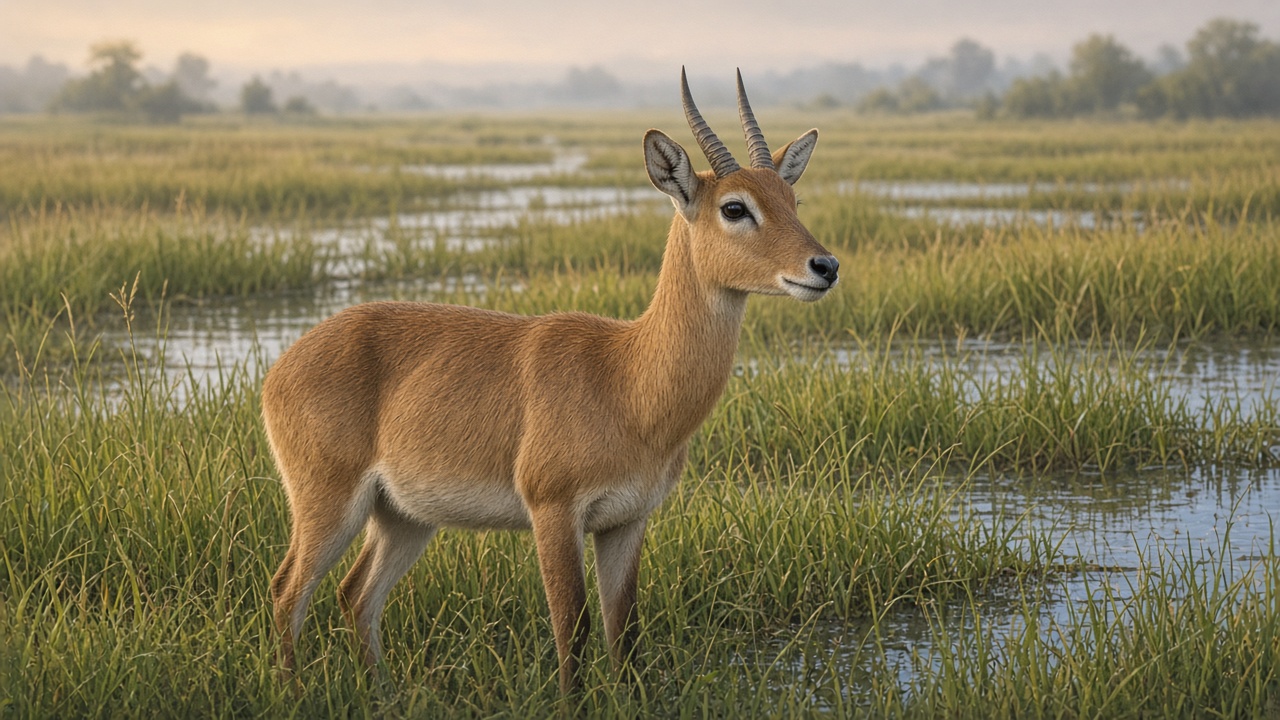
Bohor Reedbuck
Redunca reduncaNo solid country presence documented yet.
Bohor Reedbuck (Redunca redunca): coexistence sheet across its documented range — presence, biology and prudence, without an invented hunting status.
Overview
Bohor Reedbuck (Redunca redunca) is a coexistence sheet across its documented range: presence, biology and prudence — not a hunting status claim.
Classification: order Artiodactyla, family Bovidae, genus Redunca. Common names: Bohor Reedbuck in English, Redunca de Bohor in French, Redunca de Bohor in Spanish.
Identification
A medium-sized antelope: males stand 75 to 89 cm at the shoulder and females 69 to 76 cm, for 36 to 55 kg. The coat ranges from yellow to greyish brown, generally yellower than in other reedbucks; the belly and underside of the tail are white and there is a round bare patch below each ear. Males, larger and more clearly marked, are the only ones with horns, 20 to 41 cm long and hooked slightly forward. Young animals have darker, longer hair than adults.
A grazer, it seeks grasses high in protein and low in fibre and turns to other plants in the dry season; it depends on water unless it has green pasture. It is mainly nocturnal. With no fixed breeding season, it has a peak around the rains; after a gestation of seven and a half months a single calf is born, which hides for up to eight weeks before joining others of its age. Females breed at about two years, sometimes at one, males at about three.
Habitats and range
MDD lists it from Senegal, Gambia and southern Mauritania to Ethiopia and northern Eritrea, and south to northern DR Congo, Rwanda, Burundi, Kenya and Tanzania. It uses floodplain and drainage-line grasslands in the northern and southern savannas, as well as broad plains with tall grass to hide in, and is rarely found on steep slopes.
The countries where the species’ presence is established are shown in the tags on this sheet.
Field signs
It may live alone, in small groups or in large herds: in the dry season, hundreds gather near rivers. It does not scent-mark its territory but uses whistles, which also serve as an alarm. Without cover, females and their young form groups of about ten; young males go about in twos or threes. Near farms, it sometimes grazes wheat and other grain crops.
Conservation
For conservation status of Redunca redunca, consult the current IUCN assessment and cross with national monitoring programmes in countries of documented presence. Never turn a global IUCN category into a local hunting rule. GBIF occurrences help situate distribution but remain effort-biased.
The IUCN lists it as Least Concern (MDD, ADW), with no special CITES status according to ADW. MDD includes in Redunca redunca the forms bohor, cottoni and nigeriensis, which Groves and Grubb (2011) treated as distinct, so names such as Nagor, Sudan or Nigerian Reedbuck refer to the same species. ADW reports that young found by Bahima herders are sometimes raised alongside goats.
Limits
This sheet on the Bohor Reedbuck covers presence and biology. A species being present in a country does not mean it may be hunted, and no season or quota is published here.
Local densities and management plans are not covered here: they are a matter for the managers of each area.
Sources
Sources consulted for this sheet:
- IUCN Red List — species search (consulted 2026-11-02)
- ASM Mammal Diversity Database — Redunca redunca (consulted 2026-11-02)
- GBIF — species search (consulted 2026-11-02)
- Animal Diversity Web — Redunca redunca (Bohor reedbuck) (consulted 2026-11-04)
Conclusion
In short: use the scientific name Redunca redunca to cross-check sources, confirm taxonomy and conservation status on the institutional portals listed above, and relate every field sign to the habitat where it was actually found.
Identification
Redunca redunca
Bohor Reedbuck · preferred
Redunca de Bohor · preferred
Redunca de Bohor · preferred
Nagor Reedbuck
Senegal Reedbuck
Western Reedbuck
Nigerian Reedbuck
Sudan Reedbuck
Common Reedbuck
Western Bohor Reedbuck
Sudan Bohor Reedbuck
Eastern Bohor Reedbuck
Abyssinian Bohor Reedbuck
Sudan Bohor Reedbuck
Nigerian Bohor Reedbuck
Classification
Class : Mammalia
Order : Artiodactyla
Family : Bovidae
Genus : Redunca
Conservation
IUCN : LC
CITES : —
iucn · LC (global)
Habitat
Frequently asked questions
How do I recognise Bohor Reedbuck?
Use Redunca redunca as the scientific anchor. A medium-sized antelope: males stand 75 to 89 cm at the shoulder and females 69 to 76 cm, for 36 to 55 kg. The coat ranges from yellow to greyish brown, generally yellower than in other reedbucks; the belly and underside of the tail are white and there is a round bare patch below...
Where does Bohor Reedbuck typically live?
MDD lists it from Senegal, Gambia and southern Mauritania to Ethiopia and northern Eritrea, and south to northern DR Congo, Rwanda, Burundi, Kenya and Tanzania. It uses floodplain and drainage-line grasslands in the northern and southern savannas, as well as broad plains with tall grass to hide in, and is rarely found on steep slopes.
What field signs help confirm Bohor Reedbuck?
It may live alone, in small groups or in large herds: in the dry season, hundreds gather near rivers. It does not scent-mark its territory but uses whistles, which also serve as an alarm. Without cover, females and their young form groups of about ten; young males go about in twos or threes. Near farms, it sometimes grazes wheat and other grain crops.