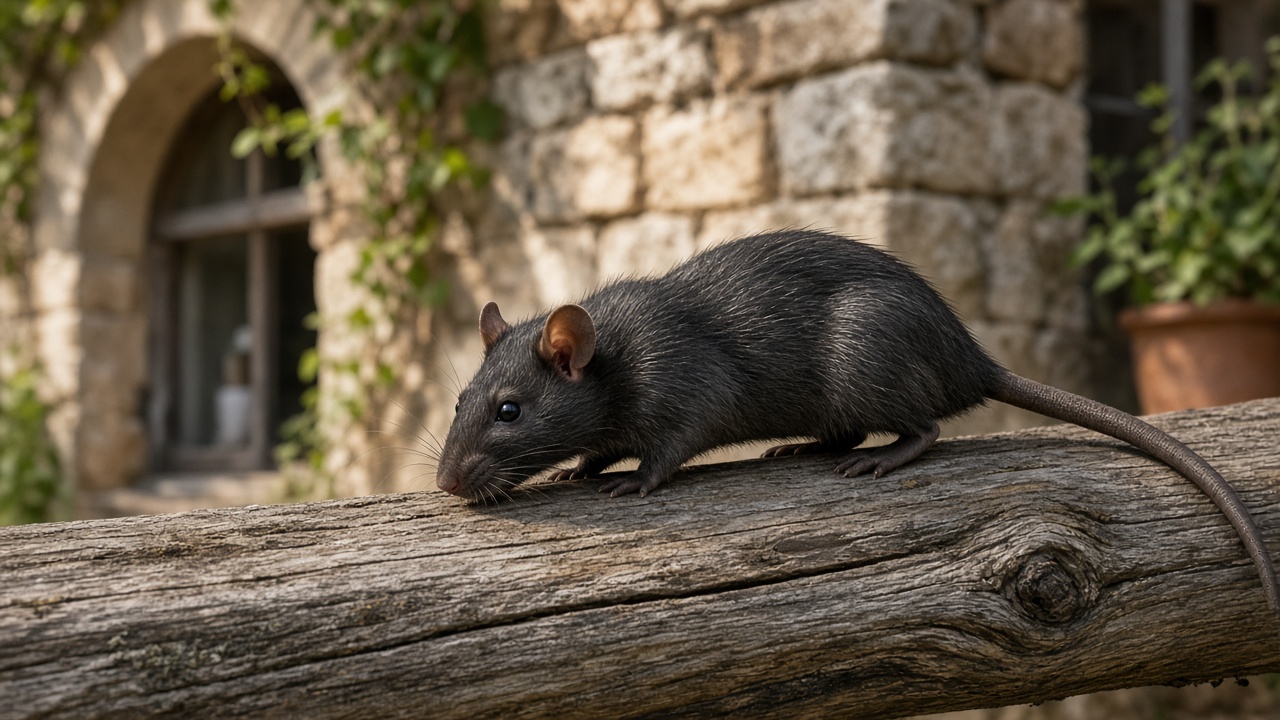
Roof Rat
Rattus rattusRoof Rat (Rattus rattus): ecology sheet across its documented range — natural history and habitats, without hunting framing.
Seen in: Austria · Belgium · Bulgaria · Croatia · Czechia
Overview
Roof Rat (Rattus rattus) is an ecology sheet across its documented range: natural history and habitats, without any hunting framing.
Classification: order Rodentia, family Muridae, genus Rattus. Common names: Roof Rat in English, Rat noir in French, Rata negra in Spanish.
Identification
A medium-sized rat, the roof rat has relatively large ears and a tail nearly always longer than its body. It weighs 70 to 300 g, with a head-and-body length of 16 to 22 cm and a tail of 19 cm or more; males are longer and heavier. Many individuals are black with a paler belly, but coats combine black, white, grey and agouti. Compared with the Norway rat (R. norvegicus), it has finer fur, a lighter skull and a slightly differently shaped first upper molar.
Mainly nocturnal, it lives in groups of several males and females headed by a dominant male; females are usually more aggressive. It feeds mostly on fruit, grain, cereals and other plant matter, but also on insects and other invertebrates, about 15 g of food and 15 ml of water a day. It can breed year-round, peaking in summer and autumn: up to five litters of 6 to 12 young after 21 to 29 days of gestation; young are weaned at 3–4 weeks and can breed at 3 to 5 months. In towns, house cats are its main threat.
Habitats and range
Native to the Indian Peninsula according to MDD, it has been introduced by people worldwide, as far as subantarctic Macquarie Island, where sealers brought it in the 19th century. It is most common on coasts, in human settlements and on ships, hence the name ship rat. An agile climber, it lives on the upper floors of buildings or in trees, rarely swims and seldom settles in sewers. In temperate regions the Norway rat has largely displaced it; ADW records it up to 250 m above sea level.
The countries where the species’ presence is established are shown in the tags on this sheet.
Field signs
It builds nests of sticks and leaves, sometimes in burrows, and leaves oily smears along its runs to mark territorial boundaries, rarely more than about 100 m² around a food source. It squeaks when threatened or socialising. It strips bark from trees, gnaws through many materials and fouls the remains of its meals with urine and droppings. When threatened, it rears up on its hind feet and bares its teeth.
Conservation
For conservation status of Rattus rattus, consult the current IUCN assessment, then cross with French monitoring programmes when they exist (OFB portal and related publications). Never turn a global IUCN category into a departmental hunting rule. GBIF occurrences help situate documented distribution but remain effort-biased.
The IUCN lists it as Least Concern; it is widespread and abundant, especially around people. A pest of crops, fruit trees and stored food, it is a disease vector best known for its role in spreading bubonic plague; its fleas carry several pathogens. According to MDD, the limits between R. rattus and related species (R. tanezumi, R. sakeratensis, R. tiomanicus) remain poorly defined and need revision.
Limits
This sheet on the Roof Rat covers biology and ecology only; it publishes no hunting season, quota or authorisation.
Local densities and management plans are not covered here: they are a matter for the managers of each area. A species living alongside people, with no hunting framework: the sheet covers biology, ecology and documented health risks.
Sources
Sources consulted for this sheet:
- IUCN Red List — species search (consulted 2026-11-01)
- ASM Mammal Diversity Database — Rattus rattus (consulted 2026-11-01)
- GBIF — species search (consulted 2026-11-01)
- Animal Diversity Web — Rattus rattus (house rat) (consulted 2026-11-04)
Conclusion
In short: use the scientific name Rattus rattus to cross-check sources, confirm taxonomy and conservation status on the institutional portals listed above, and relate every field sign to the habitat where it was actually found.
Identification
Rattus rattus
Roof Rat · preferred
Rat noir · preferred
Rata negra · preferred
Black Rat
Common House Rat
House Rat
Ship Rat
Classification
Class : Mammalia
Order : Rodentia
Family : Muridae
Genus : Rattus
Conservation
IUCN : LC
CITES : —
iucn · LC (global)
Frequently asked questions
How do I recognise Roof Rat?
Use Rattus rattus as the scientific anchor. A medium-sized rat, the roof rat has relatively large ears and a tail nearly always longer than its body. It weighs 70 to 300 g, with a head-and-body length of 16 to 22 cm and a tail of 19 cm or more; males are longer and heavier. Many individuals are black with a paler belly, bu...
Where does Roof Rat typically live?
Native to the Indian Peninsula according to MDD, it has been introduced by people worldwide, as far as subantarctic Macquarie Island, where sealers brought it in the 19th century. It is most common on coasts, in human settlements and on ships, hence the name ship rat. An agile climber, it lives on the upper floors of buildings or in trees, rarely swims and s...
What field signs help confirm Roof Rat?
It builds nests of sticks and leaves, sometimes in burrows, and leaves oily smears along its runs to mark territorial boundaries, rarely more than about 100 m² around a food source. It squeaks when threatened or socialising. It strips bark from trees, gnaws through many materials and fouls the remains of its meals with urine and droppings. When threatened, i...