Yucatan Brown Brocket
Odocoileus pandoraYucatan Brown Brocket (Odocoileus pandora): biology, habitats and field signs across its documented range, hunting-context reading.
Seen in: Mexico
Overview
Yucatan Brown Brocket (Odocoileus pandora) is presented here in a hunting-context reading across its documented range: biology, habitats and field signs useful to observers — without publishing season, quota or authorisation.
Classification: order Artiodactyla, family Cervidae, genus Odocoileus. Common names: Yucatan Brown Brocket in English, Cariacou du Yucatan in French, Temazate pardo de Yucatán in Spanish.
Identification
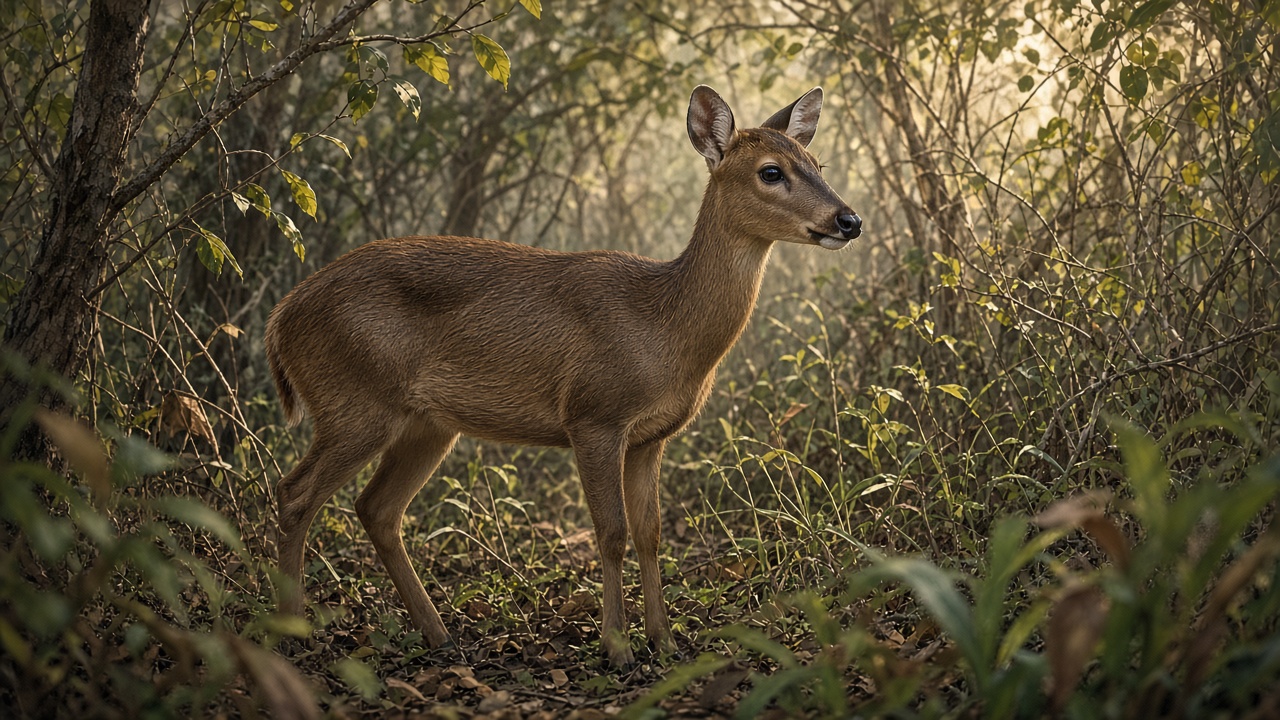
The Yucatan brown brocket is a medium-sized brocket, slightly larger than the Central American red brocket with which it shares its range: about 70 cm at the shoulder and 17 to 21 kg, with few published measurements. Its coat is grey-brown, with pale brown to whitish underparts, and a tuft of stiff hairs grows on the forehead. Males carry relatively long, lengthwise-furrowed antlers whose tips may curve inwards. The grey-brown rather than reddish colour is the best feature for separating it from the red brocket.
Mainly frugivorous, it nevertheless eats a wide range of plants, and its diet is richer in species during the wet season. It seems to breed through most of the year. Basically solitary, it lives in small home ranges. Its activity pattern is poorly known: the Handbook considers it almost surely crepuscular, possibly active at other hours depending on human pressure, while camera traps at Calakmul ponds recorded it mainly by day.
Habitats and range
MDD lists it from Mexico, on the Yucatán Peninsula, with possible occurrence in Belize and Guatemala. A generalist, it lives in wet and dry forest and in shrubland, preferring tall and medium semi-evergreen forest; it also uses mangroves above high-tide level and sometimes enters plantations in search of food.
The countries where the species’ presence is established are shown in the tags on this sheet.
Field signs
In the Calakmul Biosphere Reserve, ponds monitored by camera traps from 2014 to 2022 showed a high probability of occupancy for this species but low abundance: it is often present at water points, rarely in numbers. There it shares the forest with white-tailed deer and the redder Central American red brocket.
Conservation
For conservation status of Odocoileus pandora, consult the current IUCN assessment and cross with national monitoring programmes in countries of documented presence. Never turn a global IUCN category into a local hunting rule. GBIF occurrences help situate distribution but remain effort-biased.
MDD lists the species as Not Evaluated under its current name; as Mazama pandora, the Handbook (2011) gave it as Vulnerable and declining, threatened by overexploitation and habitat loss. Formerly treated as part of M. gouazoubira or M. americana, it was moved to the genus Odocoileus on mitochondrial evidence, since supported by nuclear data.
Limits
This sheet on the Yucatan Brown Brocket publishes no season, quota, hunting method or fee: those rules differ between countries and territories and must be checked in official texts. Being described here does not mean a species may be hunted.
Local densities and management plans are not covered here: they are a matter for the managers of each area.
Sources
Sources consulted for this sheet:
- IUCN Red List — species search (consulted 2026-11-02)
- ASM Mammal Diversity Database — Odocoileus pandora (consulted 2026-11-02)
- GBIF — species search (consulted 2026-11-02)
- Zenodo / Plazi — Mazama pandora, Handbook of the Mammals of the World vol. 2 (Wilson & Mittermeier 2011) (consulted 2026-11-04)
- THERYA — Occupancy, relative abundance and activity patterns of three sympatric deer in ponds of Calakmul Biosphere Reserve (consulted 2026-11-04)
Conclusion
In short: use the scientific name Odocoileus pandora to cross-check sources, confirm taxonomy and conservation status on the institutional portals listed above, and relate every field sign to the habitat where it was actually found.
Identification
Odocoileus pandora
Yucatan Brown Brocket · preferred
Mazama pandora
Classification
Class : Mammalia
Order : Artiodactyla
Family : Cervidae
Genus : Odocoileus
Conservation
IUCN : VU
CITES : —
iucn · VU (global)
Frequently asked questions
How do I recognise Yucatan Brown Brocket?
Use Odocoileus pandora as the scientific anchor. The Yucatan brown brocket is a medium-sized brocket, slightly larger than the Central American red brocket with which it shares its range: about 70 cm at the shoulder and 17 to 21 kg, with few published measurements. Its coat is grey-brown, with pale brown to whitish underparts,...
Where does Yucatan Brown Brocket typically live?
MDD lists it from Mexico, on the Yucatán Peninsula, with possible occurrence in Belize and Guatemala. A generalist, it lives in wet and dry forest and in shrubland, preferring tall and medium semi-evergreen forest; it also uses mangroves above high-tide level and sometimes enters plantations in search of food.
What field signs help confirm Yucatan Brown Brocket?
In the Calakmul Biosphere Reserve, ponds monitored by camera traps from 2014 to 2022 showed a high probability of occupancy for this species but low abundance: it is often present at water points, rarely in numbers. There it shares the forest with white-tailed deer and the redder Central American red brocket.